
Scandals & Feuds · 1990s
The Maksimir Riot and Zvonimir Boban’s Kick at a Police Officer
On 13 May 1990, violence between Dinamo Zagreb and Red Star Belgrade supporters spread through Maksimir Stadium before Dinamo captain Zvonimir Boban kicked police officer Refik Ahmetović on the pitch. The riot became a national symbol, but the surviving public record does not prove that the match started the war or was staged by hidden political forces.
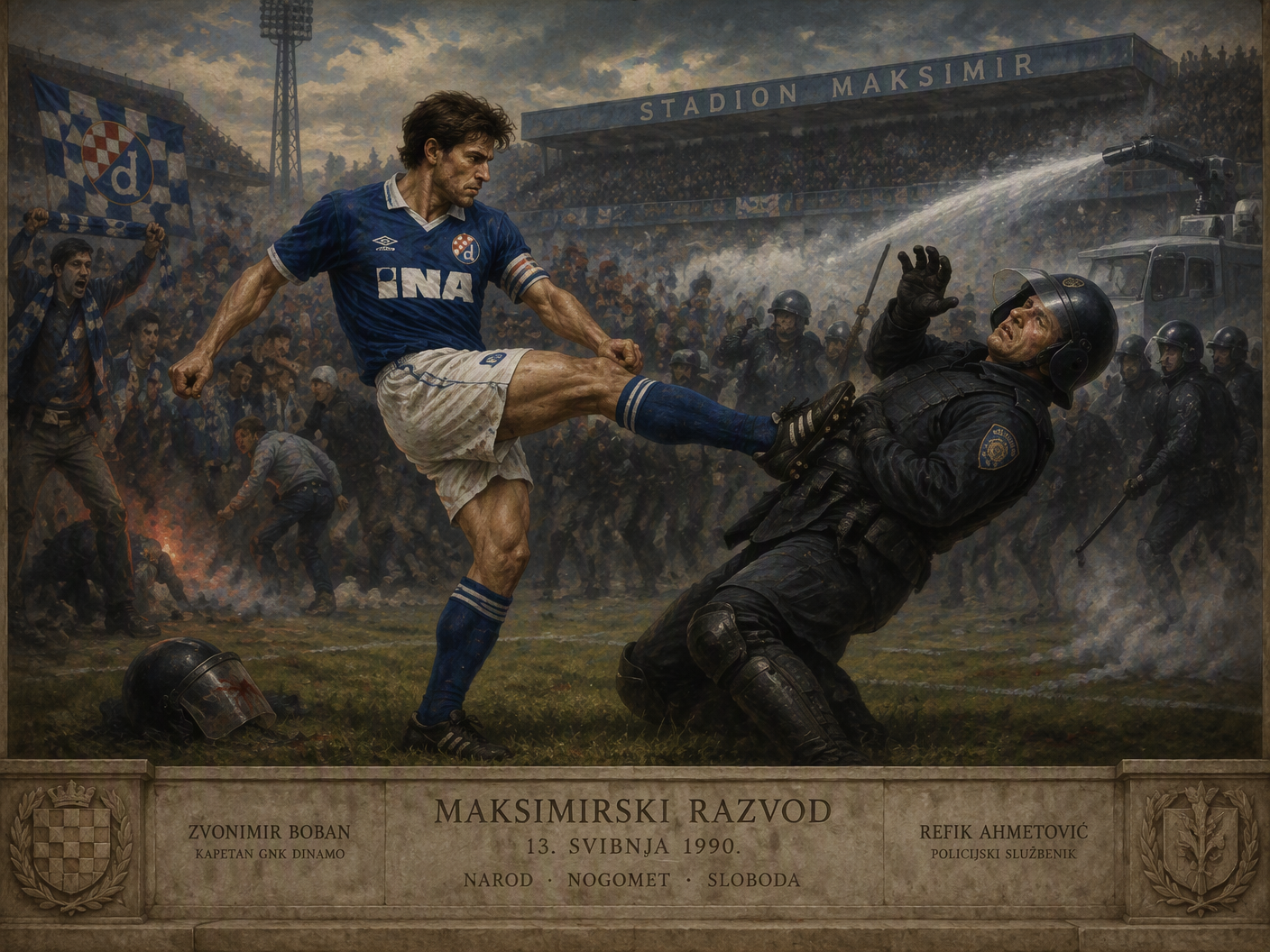
Boban ran toward the police line and kicked an officer on the pitch. Around him, Maksimir Stadium had broken into separate fights between Dinamo Zagreb supporters and Red Star Belgrade supporters. The match on 13 May 1990 was no longer a contest between two football clubs. Police moved through the disorder with batons, tear gas, armored vans, and water cannons. The kick lasted a second. The riot around it had already changed the ground beneath everybody.
The fixture had carried the weight of a border crossing. Dinamo came from Zagreb. Red Star came from Belgrade. Their supporters did not meet as strangers in a neutral place. They arrived with club loyalties tied to the political antagonisms of a country beginning to split along national lines. That larger pressure did not make every later theory true. It did explain why a football match could become a meeting point for anger that had been building outside the stadium walls.
Inside Maksimir, the supporters collided first. The disturbance spread through the stands and toward the field, where police intervened to break it apart. Vehicles entered the stadium grounds. Water struck the crowd. Tear gas and batons turned the pitch into an enforcement zone. The police response was forceful and visible, but it did not restore the match. Players and officials were left inside a public breakdown that neither club could contain.
Boban was Dinamo’s captain. He entered the disorder instead of remaining apart from it. The officer he kicked was identified as Refik Ahmetović. The act happened during the police intervention, on the playing surface, with the crowd violence still unfolding around it. That sequence matters. Boban’s kick was not an isolated act in an empty stadium, nor was it the beginning of the disturbance. It was a personal confrontation inside a riot already in progress.
The immediate scene around the kick has been remembered through more than one version. Manjkas said Boban kicked out at a policeman after another officer attacked him. Ahmetović later gave his own account of the moment, identifying himself as the officer struck and describing the violence that preceded it. The accounts preserve the same hard fact: Boban kicked a police officer. They differ over the seconds that made the kick possible.
Ahmetović’s later account added another figure to the narrow corridor of the incident. Josip Kuže, Dinamo’s coach, intervened and pulled Boban away. The coach’s action placed him between the captain and the officer as the confrontation continued. It was a small human decision inside a large public rupture: one man closing the distance, another being taken from it, and the police line trying to hold against a crowd that had already crossed the barrier.
The police used the tools available to them and the disorder grew harder to control. Batons came down. Tear gas moved through the stadium. Armored vans and water cannons were used to disperse the rioters. Supporters of both clubs were caught in the response. The images that followed fixed the confrontation in public memory, but the physical sequence remained more practical than symbolic: crowds fought, police advanced, and the match ended beneath the pressure of a state trying to clear its own stadium.
Boban’s status made the kick travel farther than an ordinary clash between a supporter and a police officer. He was not standing outside the turnstiles. He was Dinamo’s captain, wearing the authority of the home side while the pitch filled with police and fleeing players. His choice gave the incident a central character. It also supplied later generations with a clean image of defiance, even though the surrounding riot was broader, rougher, and less obedient to a single explanation.
The stadium became a national story almost immediately. In later years, the riot was treated as a point where football and the breakup of Yugoslavia met in public. The phrase that the match “started the war” became a piece of popular memory. It made the day easy to retell: a kick, a police officer, a crowd, and a country moving toward armed conflict. History rarely stays that tidy once people need a single afternoon to carry the weight of what followed.
Later reporting challenged that neat version. The riot became a national myth, but the match itself was not established as the cause of the Croatian War of Independence. Claims that the violence had been staged by Yugoslav secret services, Croatian authorities, or nationalist organizers also persisted without becoming established fact. What remained solid was narrower: Dinamo played Red Star at Maksimir, supporters fought, police used force, and Boban kicked Ahmetović on the pitch.
Ahmetović returned to the incident three decades later, in a May 2020 interview. His recollection kept the officer’s body inside the story rather than leaving him as a nameless figure beneath Boban’s legend. He described the kick and said Kuže stopped him from striking Boban again. The interview did not erase the competing account about what came first. It put a human witness back in the frame, where public mythology had often left only the captain’s raised leg.
The photograph of Boban’s kick became easier to carry than the full afternoon. It offered a hero, an antagonist, and a gesture that could be lifted from the crowd violence surrounding it. But Maksimir was not one act. It was a match between Dinamo Zagreb and Red Star Belgrade, a clash among supporters, a police dispersal involving batons, gas, armored vans, and water cannons, and a captain who struck an officer identified as Refik Ahmetović. The pitch held all of it.
Investigative Dossier & Evidence
Read the companion investigation notes, verified source claims, and primary documents.
Read the Companion Notes & Evidence Record →