
Violence & Brawls · 1980s
The 2–1 Defeat That Brought Police to Beijing’s Workers’ Stadium
On 19 May 1985, Hong Kong defeated China PR 2–1 in a World Cup qualifier at Workers’ Stadium in Beijing. The defeat was followed by unrest inside and around the stadium, 127 reported arrests, and the resignation of China manager Zeng Xuelin.
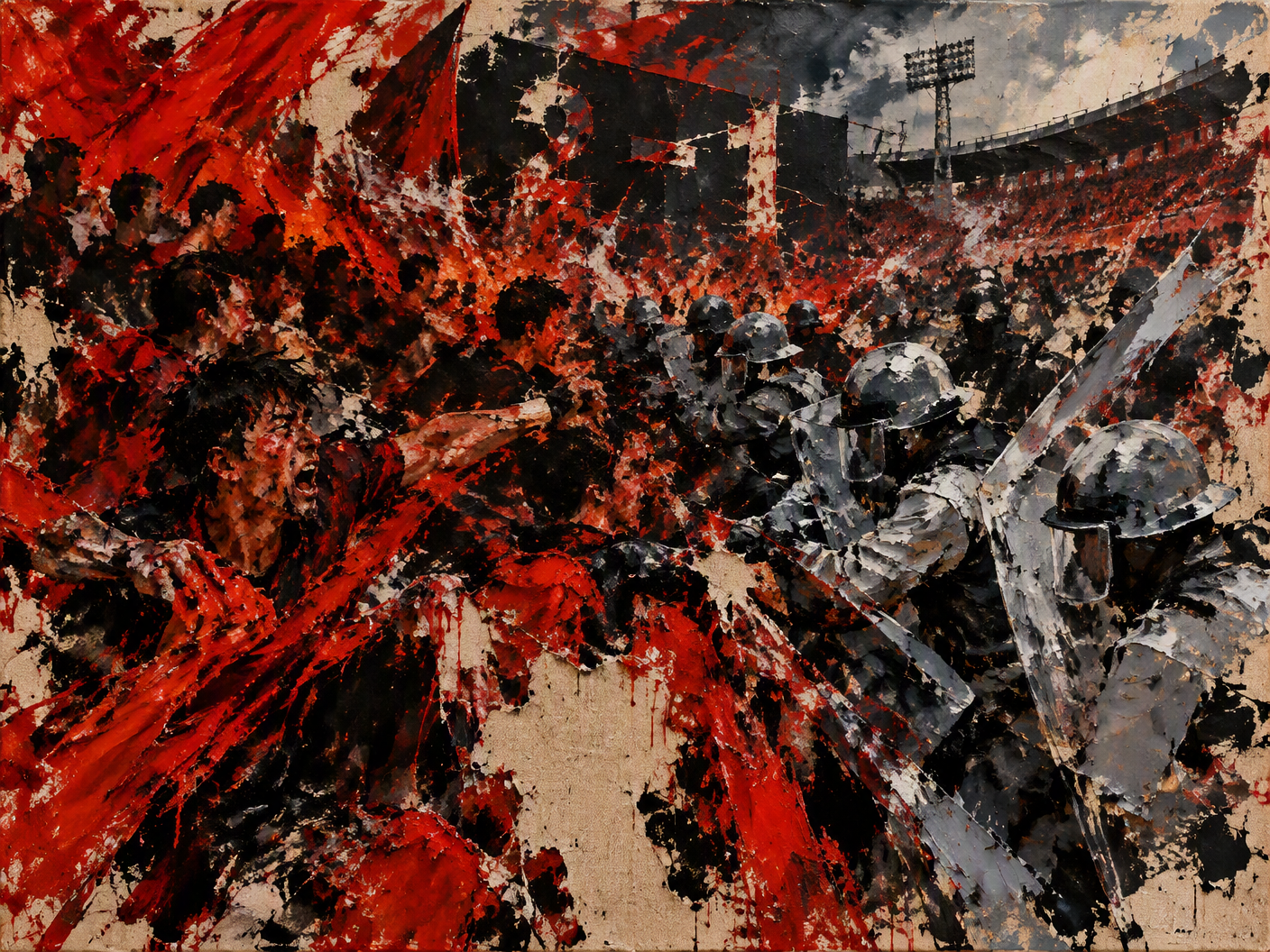
The final whistle turned Workers’ Stadium against itself. China PR had lost 2–1 to Hong Kong in a 1986 FIFA World Cup qualifier, and the defeat did not end when the players left the field. Crowds surged into disorder inside the stadium and in the streets around it. Debris flew. Vehicles were damaged. Police moved in, and the People’s Armed Police were called to restore order. By the time the authorities had cleared the area, 127 people had been arrested.
The match had begun as a contest China was expected to control. It was played on 19 May 1985 at Workers’ Stadium in Beijing, with a place in the World Cup qualification campaign at stake. Hong Kong did not arrive as scenery. Cheung Chi Tak scored first for the visitors, putting China behind on its own ground and giving the match its first hard turn.
China answered through Li Hui. His goal brought the score level and gave the home side a route back into the match. For a while, the contest had the shape of a familiar football evening: one side struck, the other repaired the damage, and the result remained available to both. The repair did not hold. Hong Kong found the next opening, and Ku Kam Fai scored the goal that restored the visitors’ lead.
Ku Kam Fai’s goal left China chasing an equalizer that never came. Hong Kong won 2–1. The numbers were simple, but the setting made them heavy. This was not a neutral field or an inconsequential fixture. China had been beaten in Beijing by Hong Kong, and the final score stayed fixed after the players stopped running. The match had produced a winner. The crowd produced something else.
After the whistle, disturbances broke out inside Workers’ Stadium and spread into the surrounding area. Spectators rampaged through the grounds. Debris was thrown. Vehicles were damaged. The violence was not confined to a bad-tempered exchange near the touchline or a quarrel that ended with the teams. The post-match disorder became a public emergency, with the stadium and its approaches serving as the scene of the confrontation.
Hong Kong’s players were on the winning side, but victory did not place them beyond the reach of the disorder. They had scored twice, absorbed China’s equalizer, and left the field with the result. Around them, the occasion had shifted from football to crowd control. Police intervened as the disturbance grew, and the People’s Armed Police were brought in to help restore order. The response belonged to the state, but the cause was a football defeat.
The arrests followed the unrest. Police took 127 spectators into custody after the disturbance at and around the stadium. That figure became the clearest measure of the immediate response: not a few people escorted away from a gate, but a mass law-enforcement operation after the match. Each arrest carried its own unknown details, yet the public consequence was plain. The authorities treated the disorder as something requiring force, removal, and formal detention.
The damage reached the people who had put China’s team on the field. Zeng Xuelin, the national manager, resigned after the incident. The result had become an administrative problem as well as a sporting one. Li Fenglou, chairman of the China Football Association, was also caught in the fallout and was described as having resigned or been forced out. The men at the top could not keep the defeat in the stadium once the crowd carried it into the streets.
For the footballers, the match remained a sequence of names and goals. Cheung Chi Tak put Hong Kong ahead. Li Hui leveled for China. Ku Kam Fai scored again, and Hong Kong finished with the victory. For the officials, the sequence continued after the scoreline: disorder, police intervention, arrests, and the loss of leadership. The same ninety minutes produced two different ledgers. One counted goals. The other counted consequences.
Workers’ Stadium had been the site of a World Cup qualifier. By night’s end, it had also become the place where a football result broke through the boundary officials prefer between the field and the public life around it. Hong Kong left Beijing with a 2–1 win. Police left with 127 arrested spectators. Zeng Xuelin left his post. The score stayed on the board; the careers and names attached to the response did not.
Investigative Dossier & Evidence
Read the companion investigation notes, verified source claims, and primary documents.
Read the Companion Notes & Evidence Record →