
Violence & Brawls · 2000s
The White Hart Fire and Stoke’s Huddersfield Clash
On 29 December 2001, Stoke City-linked hooligan firms fought Huddersfield supporters and the White Hart pub was smashed up and set on fire. The attack left extensive damage and became the most severe property incident in a day of football disorder.
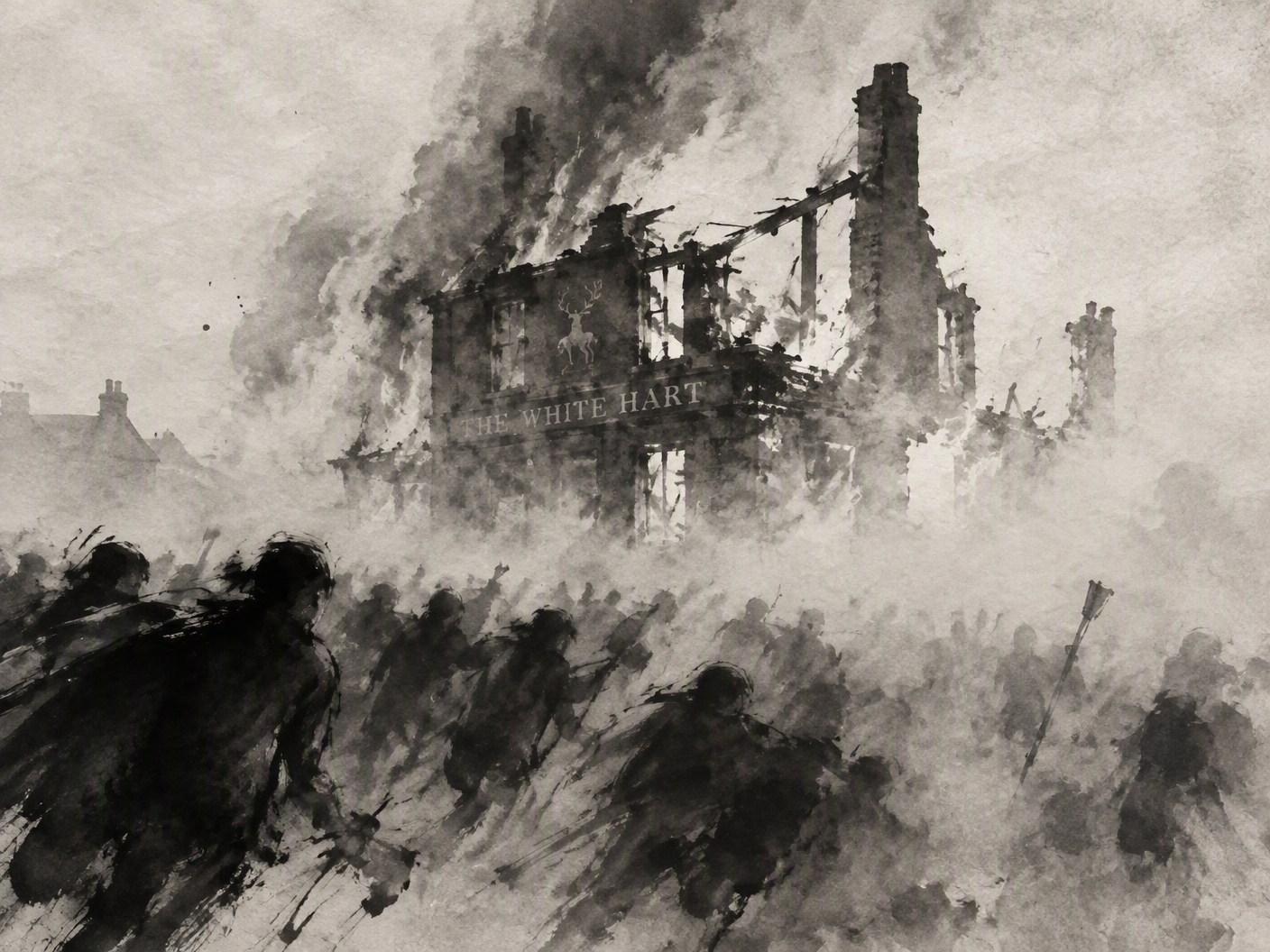
The White Hart pub took the punishment. On 29 December 2001, in Huddersfield, Stoke City hooligans fought Huddersfield supporters while the public house was smashed up and set on fire. The damage was extensive. The names attached to the Stoke side were Naughty Forty and Under 5’s, firms linked to the club’s supporter culture. The pub attack stood apart from the fighting because it left a building broken and burning. By the end of the day, football disorder had moved from a confrontation between rival groups into an assault on a place that was not the pitch.
Naughty Forty was not a casual nickname hung on a Saturday crowd. It was identified as a Stoke City-linked firm, one of the groups that carried the club’s identity beyond the turnstiles and into confrontations with opposing supporters. Under 5’s appeared beside it in the Huddersfield account. The two names supplied a rough map of the Stoke presence that day, but not a list of individual hands. The public story attached the firms to the fighting; it did not turn the names into a courtroom roll call.
The name Naughty Forty carried its own origin story. In 1985, forty Stoke City followers made a riotous trip to Portsmouth, and that trip was said to have given birth to the firm. Sixteen years later, the name had become part of the vocabulary used to describe Stoke disorder. That history mattered less for what it proved than for what it revealed: the firm had an identity built around travel, numbers, and confrontation. In Huddersfield, the name was no longer an old story about Portsmouth. It was attached to a live disturbance.
The immediate opponents were Huddersfield supporters. The clash took place in Huddersfield on 29 December, with Stoke hooligans and the home side’s followers meeting in violence while the White Hart became the principal site of destruction. The account does not require a grand plan to explain the day. Groups arrived carrying their loyalties, found one another, and the conflict spread into property damage. The pub was smashed up first in the language of the event, then set on fire. Its walls and fittings absorbed the cost of the confrontation.
That distinction is important. A fight between rival supporters can be contained, however badly, within the movements of the groups involved. A pub is different. Its doors, windows, fixtures, and rooms do not run onto the field when the match ends. The White Hart attack made the violence physical in another way: glass and timber, walls and contents, all became part of the damage. The fire gave the incident a second life after the fighting. What began as football allegiance ended in a public house left smashed and burning.
Stoke’s season already had a documented trail of trouble. On 21 October 2001, rival fans clashed at the Port Vale against Stoke City derby at Vale Park in Burslem. Missiles were thrown. Police arrested 84 people. That number did not explain every hand in the disorder, but it fixed the scale of the earlier confrontation. Ten weeks later, the Stoke name appeared again in Huddersfield, this time beside a pub attack whose damage was described as extensive.
The Huddersfield violence therefore sat inside a season marked by repeated collisions around Stoke fixtures. The dates do not make the incidents identical. Port Vale was a derby with missiles and 84 arrests. Huddersfield brought fighting with local supporters and the White Hart fire. Each event had its own ground, opponents, and immediate damage. Together they show how quickly supporter disorder could leave the match itself behind, moving through streets and public premises where the people and property at risk were not part of the contest.
The next marker came on 28 April 2002 at the Britannia Stadium in Stoke-on-Trent. Stoke City played Cardiff City, but the match stopped for seven minutes while police attempted to arrest Stoke hooligans inside the ground. The interruption was not an afterthought. Officers worked in the stadium while the game waited. Four months had passed since the White Hart was smashed and burned; the Stoke-related disorder had not vanished from the calendar. It had returned to the place where football was supposed to be watched.
The three dates leave a hard sequence: a derby in Burslem, a street confrontation in Huddersfield, then police arrests attempted during a match in Stoke-on-Trent. The scale changed from one episode to the next, as did the setting. The pressure on clubs, police, and ordinary supporters remained concrete. At Port Vale, 84 people were arrested after missiles flew. At Huddersfield, the White Hart suffered extensive damage and fire. Against Cardiff, play stopped for seven minutes while officers moved against Stoke hooligans in the ground.
What remains attached to 29 December is not a single named culprit but a group identity and a place. Naughty Forty and Under 5’s were named among the Stoke firms involved in the fighting. Huddersfield supporters were the opposing force in the clash. The White Hart was the object left damaged by smashing and fire. The public account fixes those parts firmly enough: who the groups were understood to be, where the violence occurred, and what happened to the pub.
The quieter questions sit behind the broken premises. Who struck which wall, who carried what, who started the fire, and whether anyone was later prosecuted for the pub attack are not answered by the public account used here. Nor does it give a precise value for the loss or prove that the violence was centrally planned. The story is narrower than the mythology that grew around football firms. It establishes a confrontation, names the Stoke-linked groups, and records a pub smashed and set alight.
By April, police were still trying to make arrests in the ground while a Stoke match stood still. The White Hart had already paid its price in damage. The 1985 Portsmouth trip remained part of Naughty Forty’s origin story, and the 21 October derby had left 84 people arrested. None of those numbers repaired the pub or restored the interrupted matches. The residue was plain: a firm name, a burned public house, a seven-minute stoppage, and a season in which football followed its followers into places built for everything else.
Investigative Dossier & Evidence
Read the companion investigation notes, verified source claims, and primary documents.
Read the Companion Notes & Evidence Record →