
Scandals & Feuds · 2000s
The Vilnius Pitch Invasion That Brought Legia Warsaw a European Ban
At halftime of the July 2007 Intertoto Cup match in Vilnius, several hundred Legia Warsaw supporters left the stands, confronted police, and turned the game into a public-order incident. The match was abandoned, 26 fans were arrested, and UEFA barred Legia from European competition for a season, with another ban suspended over the following five years.
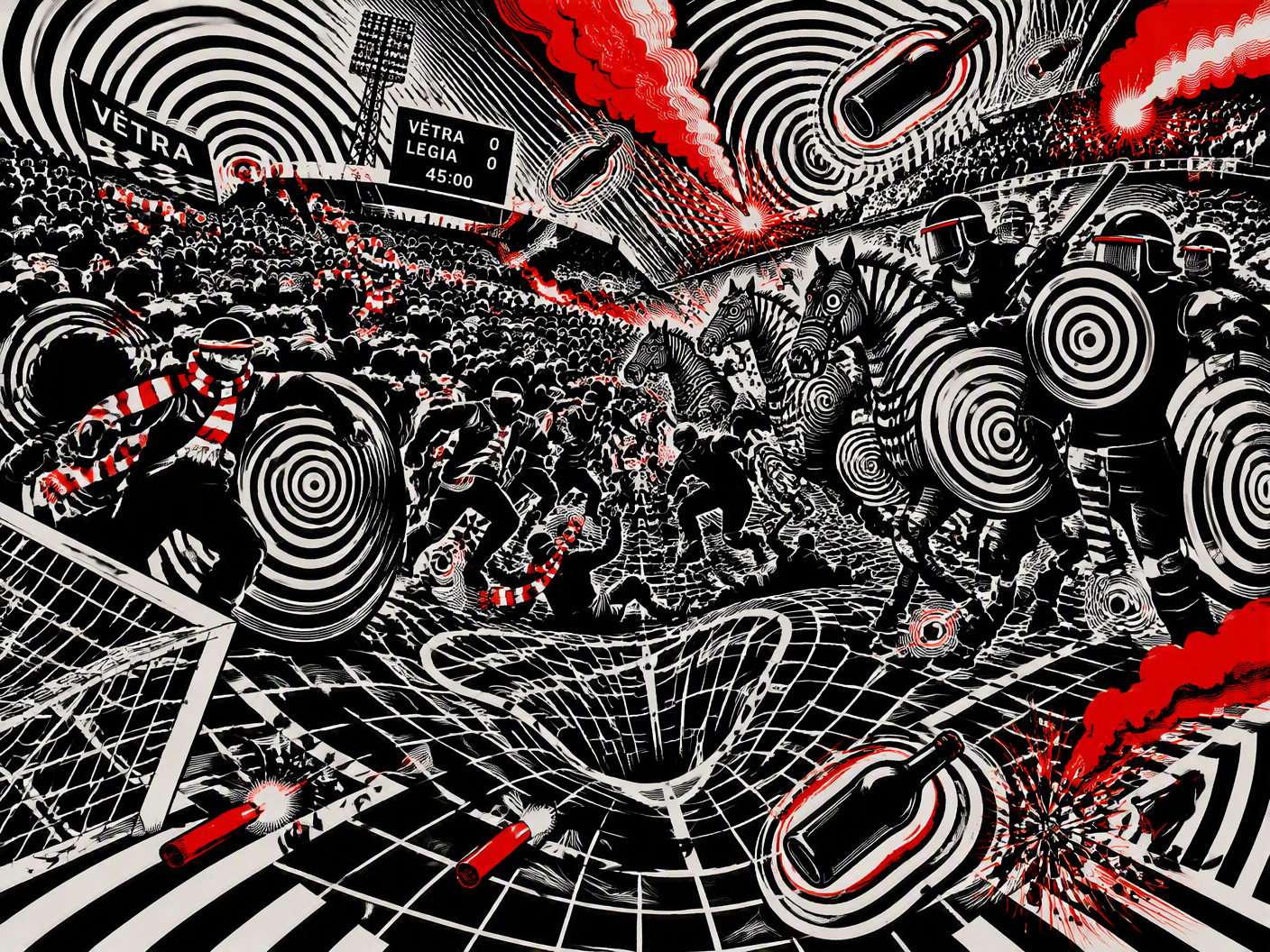
At halftime in Vilnius, with Vėtra leading Legia Warsaw 2-0, several hundred Polish supporters came down from the stands and onto the pitch. About 2,500 Legia fans had traveled for the Intertoto Cup match. The players had gone off. The game had not been settled. Then the field filled with people who were not meant to be there, and police moved toward them. A football match became a confrontation between a visiting crowd and the authorities responsible for keeping it inside the ground.
The supporters did not stop at crossing the touchline. They confronted police and threw objects at officers: concrete, bottles, and flares. The objects turned the pitch into a place where uniforms and flying debris mattered more than the score. The disturbance had its own physical logic. A barrier was crossed, an authority was challenged, and the response came hard. The match officials could not return the teams to an ordinary contest while the field remained the site of a crowd assault and police intervention.
Vilnius police brought mounted officers into the disorder. Tear gas followed. Baton charges pushed against the supporters as officers tried to contain the crowd and clear the field. There was no graceful reset, no second half waiting behind the dressing-room door. The contest between Vėtra and Legia ended at halftime, abandoned before either side could play the remaining minutes. Vėtra kept the 2-0 position it held when the violence stopped the match, while Legia carried the conduct of its traveling supporters into police custody and UEFA’s disciplinary jurisdiction.
The numbers gave the incident a blunt shape. Several hundred supporters had invaded the pitch from a much larger Polish contingent. Police confronted them with horses, gas, and batons. The match disappeared beneath the disturbance. Those facts established the public event without explaining every private decision behind it. The documented episode was a mass intrusion and a fight with police, not a completed football match interrupted by a minor argument. Its consequences would move through two separate channels: Lithuanian arrests and a European sanction aimed at the club.
Twenty-six Legia Warsaw fans were arrested after the riot. The arrests gave the night a second setting beyond the pitch: the custody of individual men after the crowd had broken apart. The club’s name remained attached to the incident, but the police action dealt with people. Each arrest narrowed the distance between supporter identity and personal consequence. A shirt, a ticket, and a place in the traveling section no longer described the whole encounter. For those taken away, the next measure of time would be set by Lithuanian justice authorities.
Seven of the arrested supporters were later jailed for periods ranging from five to fifteen days and fined. The sentences were short, but they were concrete. Days were removed from ordinary life. Money was taken. The confrontation that had begun with a movement from the stands ended in cells and court penalties for a portion of the group. The record does not assign a complete internal command structure to the riot or establish a club-directed plan. It leaves the individual roles less fully drawn than the collective event itself.
UEFA did not wait for the club to treat the incident as someone else’s problem. In July 2007, European football’s governing body banned Legia Warsaw from European competition for one season. The punishment reached beyond the supporters arrested in Vilnius. It reached the institution that carried the club crest, entered the competition, and depended on access to European football. A match abandoned in Lithuania became a season taken away in the offices that controlled the continent’s tournaments.
UEFA added another one-season European ban if Legia qualified for European competition during the following five years. That second punishment was conditional, but it hung over the club’s next attempts to return. The first ban closed one door. The additional sanction placed another behind it, waiting for qualification to make it real. The distinction belonged to administrators and calendars. For Legia, the consequence was still easy to understand: what happened in Vilnius could continue to affect whether the club was allowed to play elsewhere.
The disciplinary response separated responsibility without erasing the connection. Police handled the people who invaded the pitch and threw concrete, bottles, and flares. Lithuanian justice authorities imposed jail terms and fines on seven supporters. UEFA handled Legia Warsaw, excluding the club from European competition and attaching a further conditional ban. Each institution took a different piece of the same night. None returned the match to the schedule. The score remained 2-0 to Vėtra at halftime because there was no second half to change it.
What remained in Vilnius was not a final whistle but an interrupted contest, a police operation, and the residue of a traveling crowd’s choices. Vėtra had been leading when the field was invaded. Legia’s supporters had confronted police and been arrested. Seven served short jail terms and paid fines. Legia lost a season in Europe and faced another possible season’s exclusion. The empty remainder of the match was never played. Its consequences were carried instead by the people taken into custody and the club barred from the competition.
Investigative Dossier & Evidence
Read the companion investigation notes, verified source claims, and primary documents.
Read the Companion Notes & Evidence Record →