
Violence & Brawls · 1990s
The Hamburg Stabbing That Recast Security in Professional Tennis
On April 30, 1993, Monica Seles was stabbed during a quarterfinal in Hamburg by a man who wanted to alter the world rankings through violence. The conviction, suspended sentence, prolonged absence, and immediate changes to tournament security revealed how little protection existed between a seated player and the public.
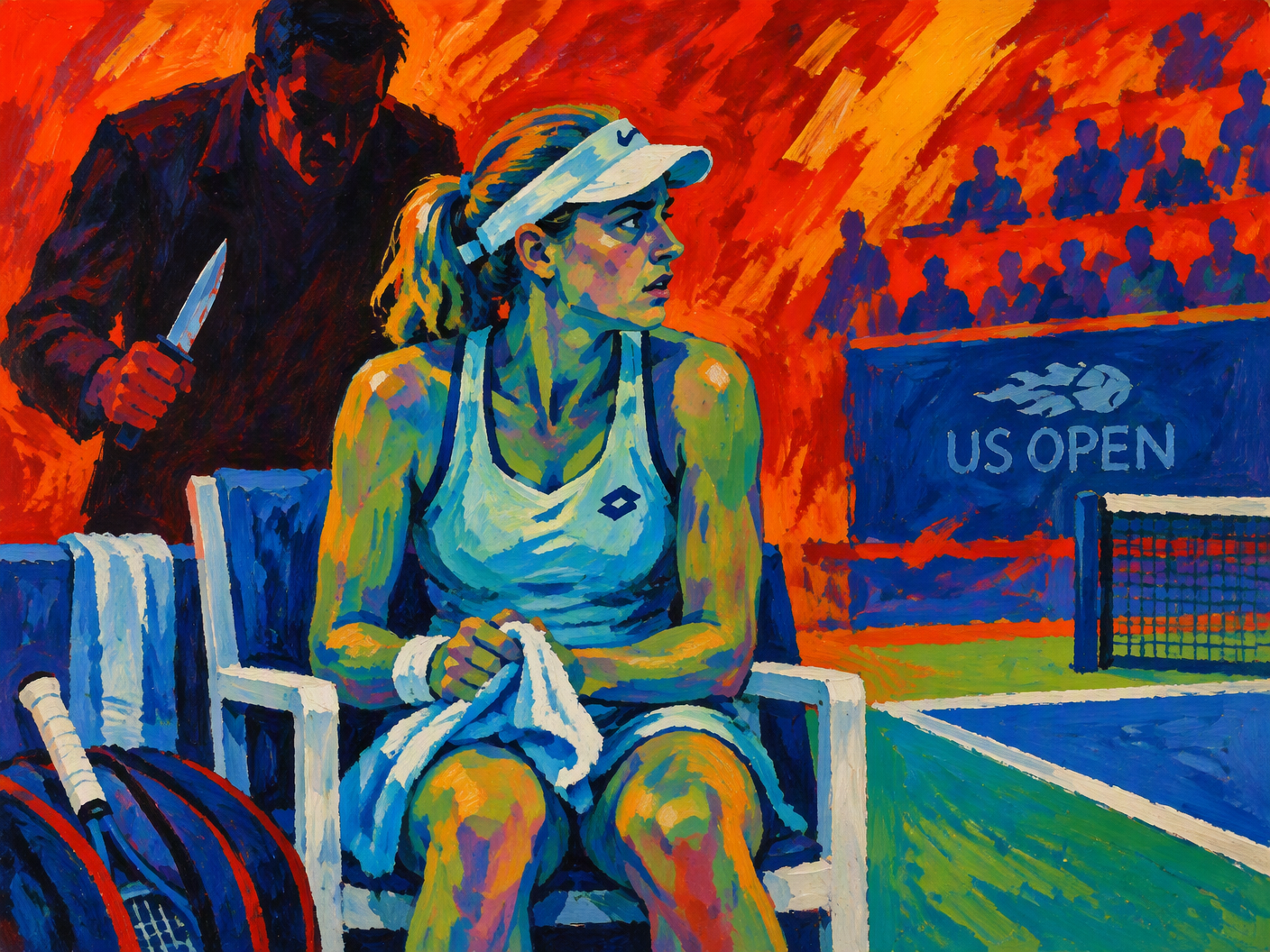
On April 30, 1993, Monica Seles was seated during a break in her Citizen Cup quarterfinal in Hamburg when Gunter Parche reached her and drove a knife into her upper back. Seles had been playing Magdalena Maleeva. The match stopped; the ordinary interval between games became the point at which professional tennis lost its assumption that the court and the player’s chair were separate from the public. Parche was identified, removed, and taken into custody. Seles was taken to a hospital, and the tournament became the scene of an assault that had been carried out not in a passageway or parking area, but beside a live match.
The injury was serious enough to require hospitalization but measured in a way that later made the event difficult for outsiders to comprehend. The wound in Seles’s upper back was described as approximately half an inch, or 1.5 centimeters, deep. Its size did not explain the interruption that followed. Seles was one of the central players of her generation, and the attack reached her at the moment tennis expected her to be most exposed: seated, between points, with attention directed toward the match rather than toward the people beyond the court.
Hamburg police gave the assault a competitive motive. Parche, they said, did not intend to kill Seles. He wanted to injure her so that Steffi Graf could become world No. 1 again. The explanation placed a private obsession inside the public arithmetic of tennis rankings, where victories and losses were converted into a changing order of names. Seles had become the obstacle in that imagined calculation. Graf, the rival whose return to the top Parche wanted, had not ordered or participated in the attack; her name entered the case because of the purpose authorities attributed to him.
The motive also produced a second question in Germany, where Seles’s origins in Yugoslavia could have encouraged speculation about politics. German authorities said there was no political motive. The explanation that remained was narrower and more disturbing: a man had treated a professional ranking as a reason to put a player’s body at risk. The attack was not a dispute between nations or a protest against tennis. It was an act directed at Seles because Parche wanted the hierarchy of the women’s game to change.
For Seles, the immediate consequence was medical and then personal. She left Hamburg without completing the quarterfinal against Maleeva and entered an absence that extended beyond the normal rhythm of a tennis season. The event could be reduced in later retellings to the length of the wound or the speed with which the attacker was detained, but Seles’s career was measured in months away from competition. The player who had been interrupted while sitting between games would not simply return for the next tournament on the calendar.
The criminal case moved through the German courts later that year. In October 1993, Gunter Parche was convicted for stabbing Seles. The disposition was a two-year suspended sentence, accompanied by psychological treatment. It was a formal conviction, but not a prison term that removed him from public life for years. The court’s response placed the attack within a legal category narrower than the fear it had generated around the sport: a conviction for the stabbing, suspension of the sentence, and treatment ordered as part of the consequence.
Tennis officials responded more quickly at the level they controlled. At Wimbledon in 1993, tournament officials positioned the players’ seats with their backs to the umpire’s chair. The change was modest in physical scale, but it altered the arrangement of a match’s vulnerable interval. A player sitting between games would no longer present the same open line from the public side toward the back of the chair. Security at tennis events increased after Hamburg, and seating became part of that response.
The adjustment also showed the limits of what tournament security had previously assumed. Tennis had concentrated its attention on the boundaries of play: officials, ball persons, line calls, and the movement of spectators around the grounds. Hamburg exposed the player’s chair as another point of access. The response did not abolish the interval or transform the court into a sealed enclosure. It changed sightlines and placed greater distance, supervision, and control around a player who was temporarily out of motion but still within reach.
Seles did not play professional tennis for more than two years after the stabbing. That interval became part of the legal and sporting aftermath, longer than the initial reports of the injury might have suggested. The attack had not ended her career, but it had interrupted its sequence: tournaments continued, rankings moved, and the player at the center of the assault was absent from the professional circuit. Her return therefore carried a meaning that could not be separated from the chair in Hamburg or from the period of competition that followed without her.
In August 1995, Seles returned to competition at the Canadian Open and won her first tournament after the absence. The result did not erase the stabbing, the hospitalization, the conviction, or the security changes made in its wake. It established something more exact: the attack had interrupted her professional life without permanently ending it. After Hamburg, players’ seats could be repositioned, courts could be watched more carefully, and legal authorities could impose a suspended sentence with treatment. The lasting arrangement was a sport that had learned to guard the space behind the chair because that was where its old confidence had failed.
Investigative Dossier & Evidence
Read the companion investigation notes, verified source claims, and primary documents.
Read the Companion Notes & Evidence Record →