
Tragedy ·
Before the Animal Attack at Perge
Two Late Antique terracotta fragments appear to depict the restraint and staging of a Roman arena execution—not the fatal assault itself.
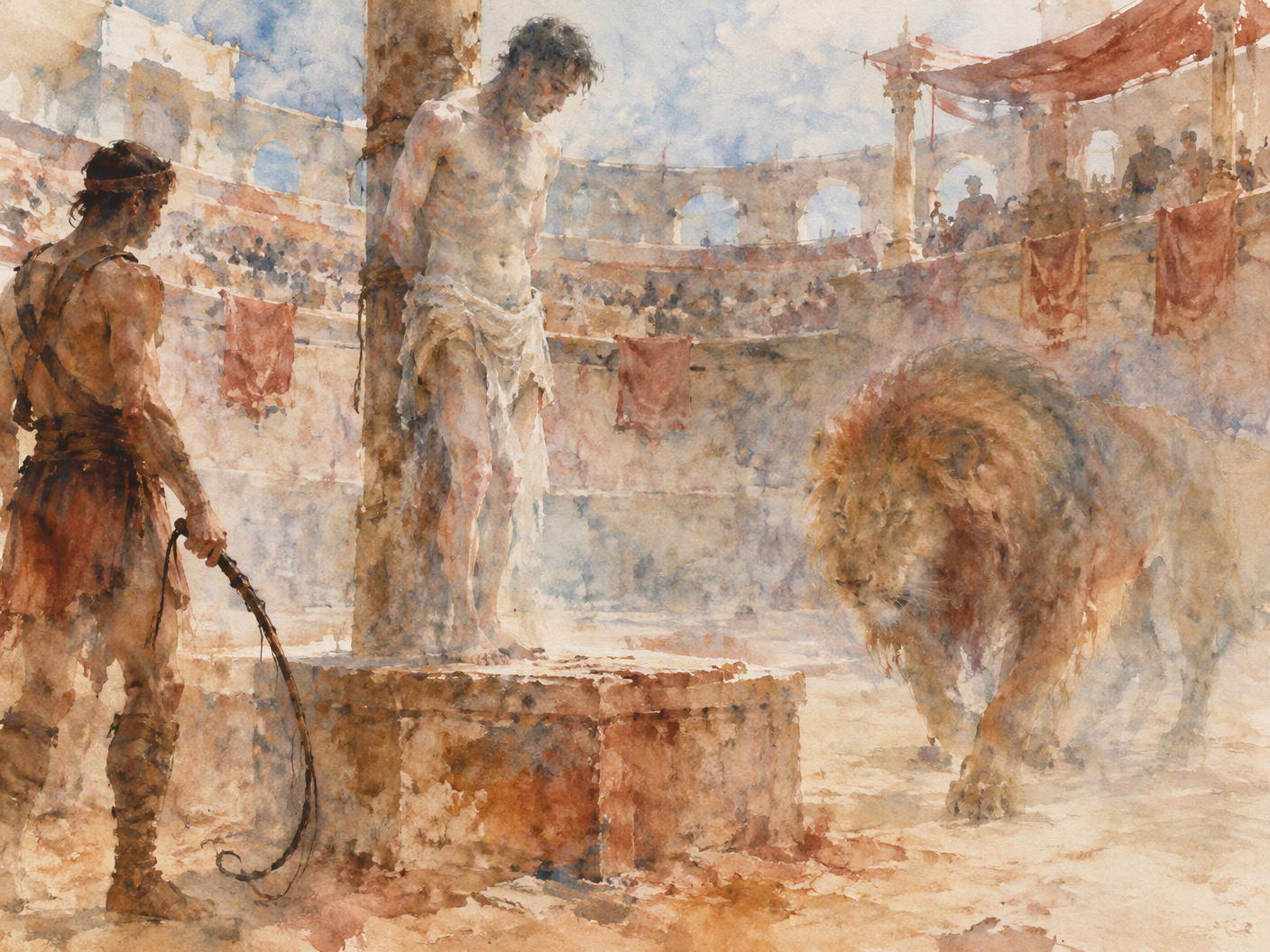
On a terracotta vessel-lid fragment from Late Antique Perge, a condemned prisoner is shown on a raised platform. A lion approaches; a whip-bearing figure, identified as a bestiarius, accompanies the scene. The image appears to stop before the fatal attack. Its subject, according to the archaeological study “Staging Execution,” is the preparation for damnatio ad bestias: judicial execution by animals in the Roman arena.
A second lid fragment, recovered from Perge’s West Necropolis, makes the restraint clearer. It depicts the condemned person physically restrained on the platform. The other is the Stadium-Amphitheatre example. Although found in different archaeological contexts, the two preserve what the study identifies as complementary elements of the same iconographic programme. Read together, they show placement, restraint and the controlled initiation of an animal attack.
The distinction between preparation and killing matters. The study places these images within the established Roman visual tradition of arena execution, but interprets them as showing stages immediately before the fatal assault, rather than the assault itself. The raised platform, the restraint and the whip-bearing figure make the organisation of the punishment visible without depicting its final moment.
The Perge fragments are especially significant because securely identified representations of this form of execution are rare. Another object offers a related, though less certain, image: a decorated copper-alloy key handle excavated from a Roman town house in Leicester. Its figures are modelled in high relief. Above, a bearded, unarmed man fights a lion. Below him, four naked male youths embrace one another protectively.
In their study “At Death’s Door,” John Pearce, Gavin Speed and Nicholas J. Cooper call damnatio ad bestias the best interpretation of the handle’s decoration. They also preserve an important qualification: the image does not directly reproduce other known scenes of the punishment, and other readings are possible depending on the viewer’s context and perspective. It is a qualified visual parallel, not a second record of the platform and restraints depicted at Perge.
The objects hold different moments in view: an encounter with a lion on the Leicester handle, an approaching lion and a restrained prisoner on the Perge fragments. At Perge, the surviving image leaves the condemned person on the platform, with the attack apparently still to come.