
Violence & Brawls · 1700s-1800s
The Rules Written Against Boxing’s Violence
Boxing’s rules evolved from bare-knuckle prizefighting toward timed rounds, counted knockdowns, and prohibited fouls. The reforms constrained visible brutality, but Australian mortality figures and medical findings show that repeated blows continued to carry a lethal neurological cost.
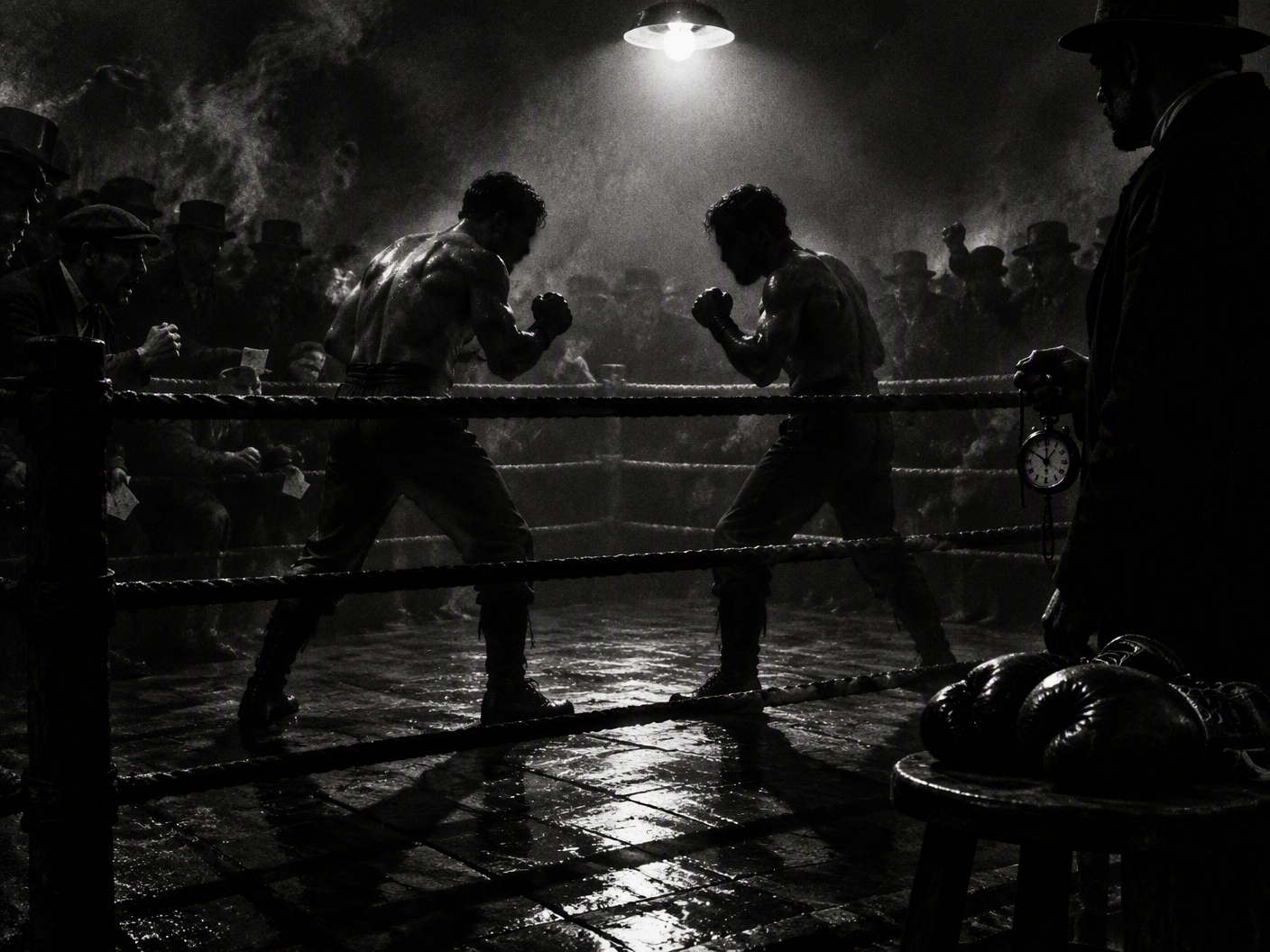
The first bell is not the beginning. It is the warning. In eighteenth-century England, men enter rough rings with bare fists, wagers moving through the crowd like contraband, while the possibility of death hangs over the contest as plainly as sweat on the fighters’ shoulders. This is already an organized world: champions have names, promoters have money, and rules exist because the violence has become too predictable to ignore. In 1743, Jack Broughton—champion, professional fighter, and architect of his own danger—puts regulations around the prizefight after deaths sometimes occur inside the ring.
Broughton’s rules do not turn the ring gentle. They draw a perimeter around the damage. The London Prize Ring Rules later sharpen the boundary, prohibiting butting, gouging, scratching, kicking, striking a fallen man, and biting. The list has the grim precision of an emergency inventory: here are the actions men are willing to use when the contest strips away restraint; here are the actions the sport must name before it can forbid them. Bare knuckles remain bare knuckles. The body remains the wager. But the chaos now has an official vocabulary.
Then London, 1867. John Graham Chambers drafts a new framework under the patronage of John Sholto Douglas, the ninth Marquess of Queensberry, and the old prizefight begins to acquire the clockwork of modern boxing. Three-minute rounds. One minute to sit, breathe, spit, and return. A ten-second count when a fighter hits the floor. Wrestling banned. The ring becomes a machine for measuring exhaustion, with the referee, the stopwatch, and the knockdown count converting raw punishment into procedure.
Outside that measured square, the culture stays volatile. Late-nineteenth-century prizefights gather around gambling venues, places thick with smoke, cash, coded signals, and men who have come to see whether another man can be broken. Police arrive to break up bouts. Crowds surge against authority. Riots become common in the late nineteenth and early twentieth centuries, the spectators’ appetite for violence spilling beyond the ropes and into streets where uniforms, fists, and betting money collide. The fight is never only the two bodies in the center. It is the crowd’s nervous system, overloading.
Every later rule carries that inheritance. Modern boxing still bans the old blunt instruments—head-butting, kicking, biting, and strikes that are not delivered with the fist. The language has been polished; the gloves are larger; the rounds are timed under bright commission lights. Yet the central transaction remains brutally simple. One fighter sends force into another fighter’s body, and the sport decides which forms of force count as legal. The rules can discipline the spectacle. They cannot make impact disappear. They can identify a foul. They cannot call back the concussion already moving through the skull.
The Australian numbers give that invisible damage a shape. Between 1832 and 2020, 162 boxers died in Australia: 122 professionals and 40 amateurs. Seventy-four percent of those deaths were attributed to traumatic brain injury. The figures stretch across the entire life of the sport, from rougher contests to regulated arenas, from bare skin and improvised surroundings to sanctioned gloves and medical supervision. The rules have changed repeatedly. The body’s vulnerability has remained stubbornly continuous, registering each era in bruises, collapse, coma, and the long silence after the crowd has gone.
The injury is not confined to the single blow that ends a bout. A boxer may absorb tens of thousands of head impacts over a career, a private accumulation hidden beneath the public arithmetic of wins and losses. Repeated blows can contribute to chronic traumatic encephalopathy, a degenerative brain condition associated with progressive neurological damage. The crowd sees the clean combination, the glove snapping against the target, the opponent’s knees turning uncertain. It does not see the years gathering behind the eyes, the small impacts stacking up like metal filings in a machine that keeps running because the bell keeps ringing.
In November 2019, Dwight Ritchie is training in Melbourne when a punch to the body lands. He collapses during the session and dies. There is no gambling-house mob, no police line forcing a prizefight into the dark, no antique rulebook held up against the noise. There is a professional fighter, a training room, a blow delivered in preparation for competition, and then the abrupt removal of a living man from the machinery of the sport. Ritchie becomes the most recent death named in the Australian account, a modern figure standing inside an old pattern.
Safety regulations arrived in Australia in the mid-1970s, after generations of fighters had paid for the sport’s customs with their health and lives. Even after those regulations, 11 Australian boxers died. The number does not erase the value of a timed round, a referee’s count, a ban on wrestling, or a medical check. It exposes the limit of reform. Regulation can shorten exposure, interrupt a contest, punish an illegal strike, and impose order on the room. It cannot guarantee that a legal punch will leave no neurological wound.
That is the long voltage running from Broughton’s ring to Ritchie’s collapse: boxing repeatedly writes rules after violence has revealed what the previous rules failed to contain. The sport learns to count rounds, count seconds, count fouls, count deaths. It builds safer borders around an act that still depends on concussion, impact, and the controlled surrender of one human body to another. Under the floodlights, the gloves rise and the crowd leans forward. The bell cuts the air. Somewhere beneath the ceremony, the old warning remains—written not in the rules, but in the bodies that made rules necessary.
Investigative Dossier & Evidence
Read the companion investigation notes, verified source claims, and primary documents.
Read the Companion Notes & Evidence Record →