
Tragedy · 2010s
Bob Kuechenberg, the 1972 Dolphins, and the Brain Found After Death
Bob Kuechenberg spent 14 seasons as a Miami Dolphins guard, including the undefeated 1972 campaign. After his death in 2019, later reporting said his brain showed chronic traumatic encephalopathy, placing one celebrated lineman inside the longer medical history of professional football.
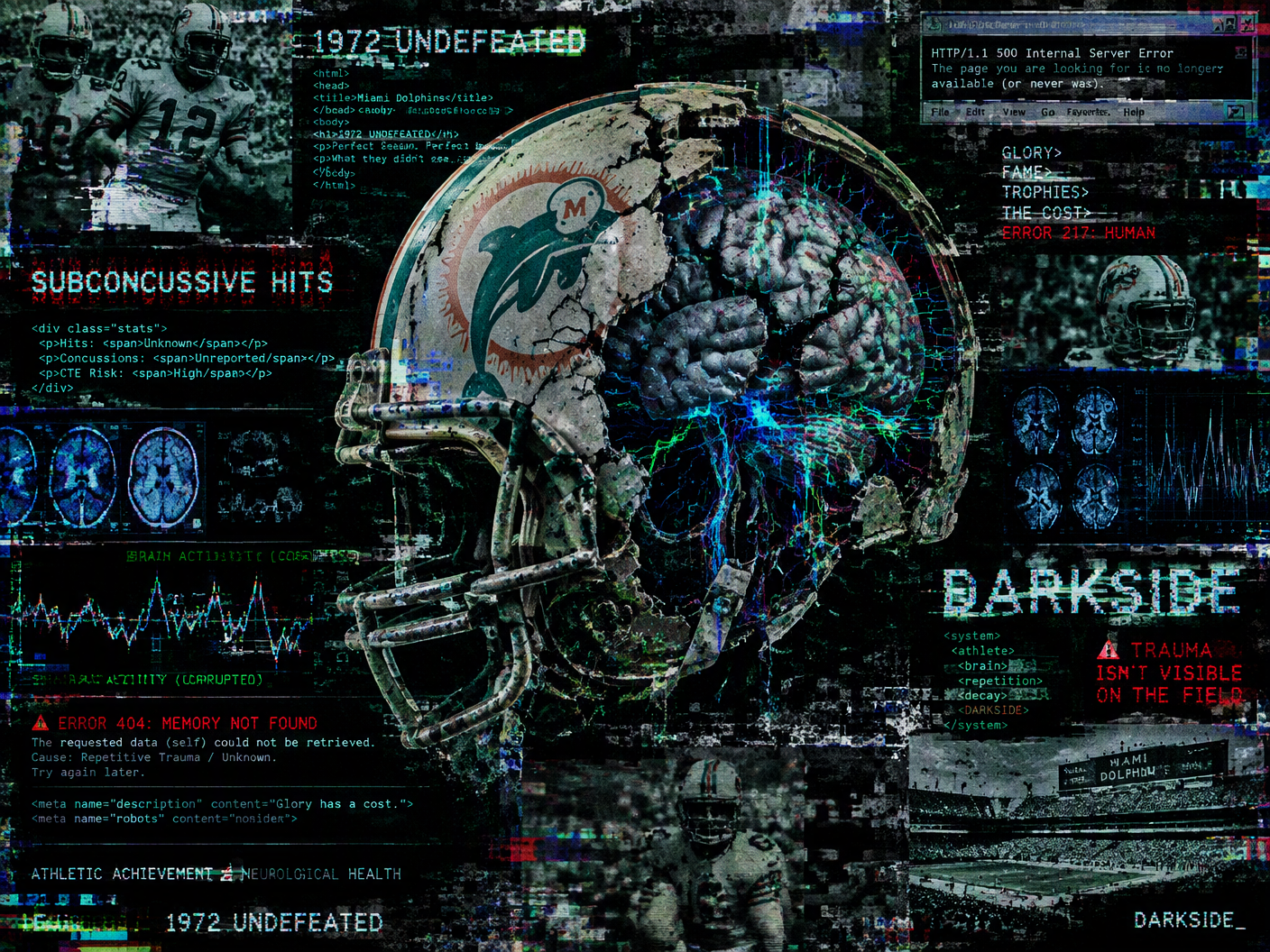
On January 12, 2019, Bob Kuechenberg died in Fort Lauderdale at 71. The decisive medical fact attached to his life came later: after death, his brain was reported to have shown chronic traumatic encephalopathy, a disease that can be diagnosed only through examination of brain tissue. Kuechenberg had spent the central years of his adult life at the interior of the Miami Dolphins’ offensive line, where the work was measured in contact repeated play after play. His death did not answer what had caused it. It changed the question surrounding the career he had left behind.
Kuechenberg joined the Dolphins in 1970 as a guard and remained with the club through 1983. He was not a brief participant in its rise. Over 14 seasons, he played nearly 200 NFL games, a span that made durability part of his public identity. Guards operated close to the line of scrimmage, where the space was narrow and the collisions arrived at short range. The work did not require a player to be the most visible figure on the field. It required him to return to that field, season after season, and absorb the ordinary violence of the position.
The career reached its most celebrated point with the 1972 Dolphins. Kuechenberg was part of the team that completed a 17-0 season, then won Super Bowl VII in January 1973. The achievement fixed the club in the public imagination as a finished unit: unbeaten, disciplined, and preserved in the language of achievement. Kuechenberg’s place within it was specific. He was an offensive lineman among the players whose labor made the team’s record possible, though the work of guards rarely survives in the same form as a quarterback’s throws or a receiver’s catches.
For Kuechenberg, the Dolphins years continued long after that perfect season. The league counted games and seasons; the body counted contact differently. Some impacts produce a diagnosed concussion, with symptoms that force an interruption. Others fall below that threshold. The Concussion Legacy Foundation uses the term subconcussive hits for impacts below the concussion threshold, a distinction that matters in the case of players whose exposure accumulated without one publicly identified injury becoming the whole explanation. A lineman’s career could therefore carry medical significance even when no single play was named as decisive.
Kuechenberg left professional football in 1983, after the long interval that had made him a Miami institution. The public meaning of his career remained tied to the Dolphins’ most admired team, while the private consequences of repeated contact belonged to a later and less settled period. Football had supplied the structure of his working life, but it could not supply a diagnosis from the sideline, a medical forecast from a game film, or a simple accounting of every impact sustained over nearly two hundred games.
In his final years, his daughter Alexandra Kuechenberg said his memory began to fail. She also described heavy drinking and depression during that period. Those family recollections placed the changes in ordinary life—in the person his family knew, rather than in the statistics attached to his career. They gave later discussions of Kuechenberg a human chronology: the celebrated seasons first, the years after football, then the decline his family observed. They did not, by themselves, identify the neurological process beneath those changes.
Kuechenberg died in Fort Lauderdale before the public learned of the posthumous finding. On February 2, 2020, the Chicago Tribune reported that he had been found to have CTE after his death. The finding belonged to a category of medical knowledge that arrives after a player can no longer describe his symptoms or answer questions about their progression. It connected his brain to a disease associated with repeated head impacts, but it did not convert every hardship in his final years into a proven consequence of football, nor did it establish football as the cause of his death.
The distinction between exposure and conclusion remained important. Kuechenberg’s position placed him in repeated contact, and subconcussive impacts offered one explanation for why a player might later become part of neuropathological research even without a recorded concussion defining his career. But the finding concerned the condition identified in brain tissue after death. It did not name a particular game, season, collision, or moment as the cause. Nor did it provide a legal ruling about mortality. The medical narrative was real; its boundaries were real as well.
By February 2023, the subject had widened beyond one former guard. Coverage of Boston University research reported CTE in 21 former Dolphins, with Kuechenberg included among the previously disclosed cases. The number placed him within a group drawn from the same franchise and its different eras, but it did not make every former player part of the same medical category. The research entered public discussion alongside a necessary caution: findings from examined brains cannot be turned into a claim that all, or even most, NFL players have CTE.
Kuechenberg’s place in the long record is therefore divided between two kinds of evidence. His career is fixed by dates, position, games, and the 17-0 Dolphins season. His death is fixed by place and date. The posthumous CTE finding adds a medical fact that changes how the career can be understood, while leaving the cause of death unsettled. What endured was not a final verdict on every collision he absorbed, but a narrower and more consequential record: a central player from Miami’s perfect season whose brain, examined only after his life ended, became part of the evidence used to measure football’s lasting cost.
Investigative Dossier & Evidence
Read the companion investigation notes, verified source claims, and primary documents.
Read the Companion Notes & Evidence Record →