
Bizarre & Myths ·
The Extra Down Cornell Gave Back
A referee’s mistake produced an apparent 7–3 Cornell victory over Dartmouth in 1940. After films confirmed the fifth down, Cornell conceded the game.
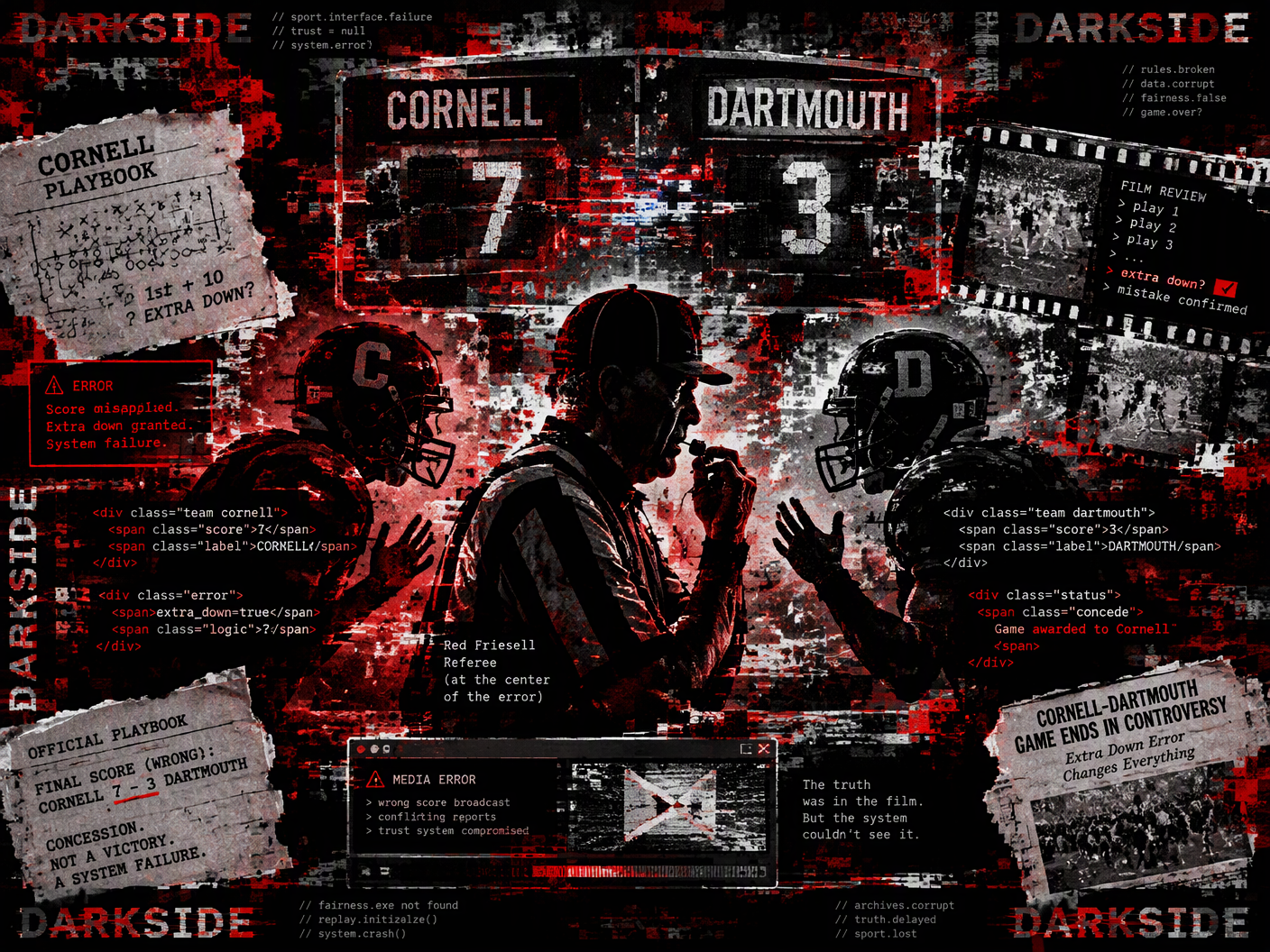
With three seconds left at Memorial Field on November 16, 1940, Dartmouth had stopped Cornell’s fourth-down pass and appeared to have secured a 3–0 win. Then referee Red Friesell put the ball back for another play. Cornell scored on the extra down and left the field with an apparent 7–3 victory. The mistake would be confirmed on film; the result would change only after Cornell conceded the game.
Cornell arrived ranked No. 2 in the country, unbeaten in six games that season and riding an 18-game winning streak. Dartmouth was 3–4. But the teams went into halftime scoreless, and a Dartmouth field goal in the fourth quarter left Cornell needing a touchdown. In the closing minutes, Cornell drove to the Dartmouth six-yard line.
The first two runs took Cornell to the one. On third down, another run brought the ball close to the goal line, but no touchdown was signaled. Cornell then requested a timeout with none remaining. The resulting five-yard penalty moved the ball back, leaving Cornell one legal chance to score. Its fourth-down pass into the end zone was knocked down by Dartmouth’s Don Norton.
The December 1940 account in Dartmouth Alumni Magazine described players and spectators celebrating the stop. It then reported that Friesell took the ball from head linesman Joe McKenney and returned it to the spot of the previous play. Dartmouth captain Lou Young argued that Cornell had used its downs. According to the magazine, Friesell refused to hear his plea and told Young to get back into the game.
Cornell used the additional play to complete a touchdown pass and left the field with a 7–3 score. The alumni magazine reported that the score was never posted on the Memorial Field scoreboard. It also described some Dartmouth players as not yet in defensive position for the extra play. That was the magazine’s account of the confusion; the decisive error was simpler and could be checked by counting the downs.
The following day, Friesell sent Young a telegram acknowledging what the films from both colleges showed. “I want to be the first to admit my very grave error on the extra down as proven by the motion pictures of both colleges,” he wrote. He apologized to Young, the players and the Dartmouth coaching staff. “I assume full responsibility.” He also thanked them for their treatment of him after the game.
Cornell president Edmund Ezra Day and coach Carl Snavely reviewed the film as well and concluded that Friesell was right. Yet recognition did not itself reverse the score. As Doug Hochstetler recounts in his study of the game, both Friesell and Eastern Intercollegiate Association commissioner Asa Bushnell said they could not change the final result.
Cornell made the concession instead. Day sent a telegram to Dartmouth president Ernest Martin Hopkins forfeiting the game and awarding Dartmouth the victory. The touchdown that had appeared to extend Cornell’s winning streak no longer decided the result. Dartmouth’s field goal did: Dartmouth 3, Cornell 0.