
Violence & Brawls · 1970s
The 1,900 Police Officers at Seaview and the North Belfast Derby
On 21 September 1979, a Cliftonville–Crusaders Ulster Cup match at Seaview was played with more than 1,900 police officers on duty. The scale of the deployment became part of the derby’s historical record; later events showed that matches between the Belfast clubs could still be disrupted by protests and crowd-control measures.
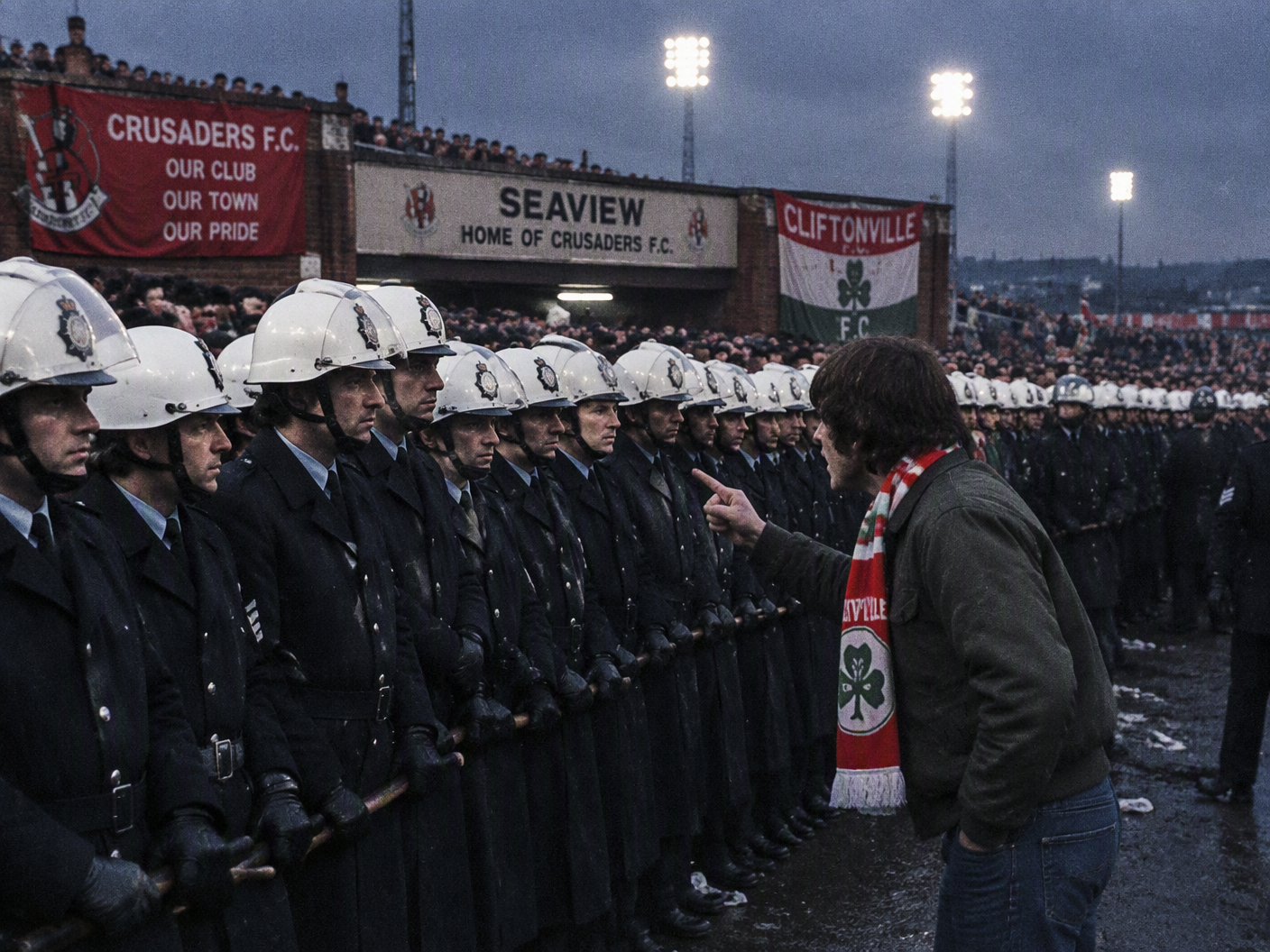
On 21 September 1979, Seaview hosted an Ulster Cup match between Crusaders and Cliftonville under a police deployment of more than 1,900 officers. The number altered the meaning of the fixture before the teams had settled the result on the field. In Northern Irish football, the match entered public memory not simply as another meeting between two Belfast clubs, but as the occasion that required a police presence on a scale associated with a major civic operation. The deployment was described as the largest ever recorded at a football match in the United Kingdom.
The clubs occupied neighboring ground in the geography of North Belfast football. Cliftonville played at Solitude; Crusaders played at Seaview. Their rivalry became known as the North Belfast derby, a name that located the contest as precisely as the two grounds themselves. Solitude and Seaview were not distant stages connected only by a fixture list. They formed the physical coordinates of a recurring contest between institutions rooted in the same part of Belfast, where the route to an away match was short but the accumulated significance of the meeting was not.
The first recorded meeting came on 13 January 1923 at Solitude, in the County Antrim Shield. Cliftonville won 1–0. At that point, the rivalry had no 1979 police operation attached to it and no later mythology built around extraordinary security. It began as a match entered into a regional competition, with one club defeating the other by a single goal. The date matters because it places the Seaview episode within a relationship that had already crossed more than half a century, rather than treating the police deployment as the beginning of the story.
The clubs met again at Solitude on 17 September 1949, this time in the Ulster Cup and with their senior teams involved. The match ended 2–2. Between the 1923 meeting and the 1949 draw, the fixture had acquired a longer competitive history, but the surviving chronology offers no single incident that explains when the derby became a public-order concern. That absence is part of the shape of the story. The rivalry can be dated, its grounds can be named, and its matches can be counted; its accumulated sensitivity developed across years rather than through one documented origin point.
By the evening of 21 September 1979, the ordinary arrangements for a cup match had been overtaken by the scale of the police response. More than 1,900 officers were on duty at Seaview as Crusaders hosted Cliftonville. The figure made the match operationally exceptional. It also placed the police, rather than the scoreline, at the center of the fixture’s afterlife. A game designed to produce a winner in the Ulster Cup became a reference point for the state’s estimate of risk around a local derby, even though the documented event is the deployment itself.
The size of the operation did not identify a convicted offender, a formal disciplinary finding, or criminal liability by either club. It recorded a decision by police authorities to place an unusually large force around one football match. Those are different things. The officers’ presence established that the fixture had been judged demanding enough to warrant exceptional control; it did not, by itself, establish that Cliftonville, Crusaders, or their supporters had committed a specific offense. The distinction has endured because the number is precise while the event that produced it remains less fully documented.
That imbalance shaped the way the 1979 match was remembered. The deployment could be repeated as a fact: Seaview, the Ulster Cup, 21 September, more than 1,900 officers. The circumstances behind the decision were harder to reduce to one sentence. No single political identity can be assigned uniformly to both clubs or all their supporters, and no named organization can be attached to the later protest activity beyond the description of flag protesters. The derby belonged to football, but its public meaning was formed within a society where football grounds could also become sites of contested authority.
The story did not end with the 1979 deployment. On 16 February 2013, Cliftonville and Crusaders were scheduled to meet again at Seaview. A small group of flag protesters gathered outside, and skirmishes with police followed. The fixture was cancelled. Once more, the match disappeared from the normal sequence of arrival, kickoff, and result. The immediate cause recorded for that day was protest-related disruption, not a footballing decision. Police and protesters occupied the space outside the ground while the scheduled contest remained unplayed.
The rearranged match took place on 22 April 2013 at Seaview, but its conditions were altered. Attendance was 395, and the away stand was empty. The empty section was not an abstract administrative detail; it changed the physical arrangement by which an away fixture ordinarily displayed rivalry. The match could proceed, but the familiar architecture of opposing supporters had been reduced. The decision connected the derby to a contemporary language of segregation, restricted access, and managed risk, even as the clubs returned to the field.
Across ninety years, the North Belfast derby therefore acquired two different kinds of historical weight. Its competitive lineage began with Cliftonville’s 1–0 victory at Solitude in 1923 and continued through the 2–2 senior-team draw there in 1949. Its public-order history gathered around Seaview: first in 1979, when more than 1,900 police officers were assigned to the Ulster Cup match, and again in 2013, when a protest disrupted the fixture and the replay was staged before 395 people with the away stand closed.
The enduring fact is not that the derby produced a proven criminal episode in 1979. It is that a football rivalry between two Belfast clubs became important enough, in the judgment of the authorities at Seaview, to draw the largest police presence ever recorded at a United Kingdom football match. Decades later, the cancelled fixture and emptied away stand showed a different form of control. The clubs remained Cliftonville and Crusaders, and the grounds remained Solitude and Seaview, but the space around the game had become part of the contest’s permanent record.
Investigative Dossier & Evidence
Read the companion investigation notes, verified source claims, and primary documents.
Read the Companion Notes & Evidence Record →