
Scandals & Feuds · 2010s
Beitar Jerusalem and the Muslim Players Who Exposed a Fan Divide
Beitar Jerusalem’s 2013 signings of Zaur Sadayev and Dzhabrail Kadiyev produced a walkout, the burning of the club’s Jerusalem offices, and open opposition from the La Familia supporter group. Later disorder in Belgium and police raids in Israel showed how a dispute over who could represent the club moved from the stands into public law enforcement.
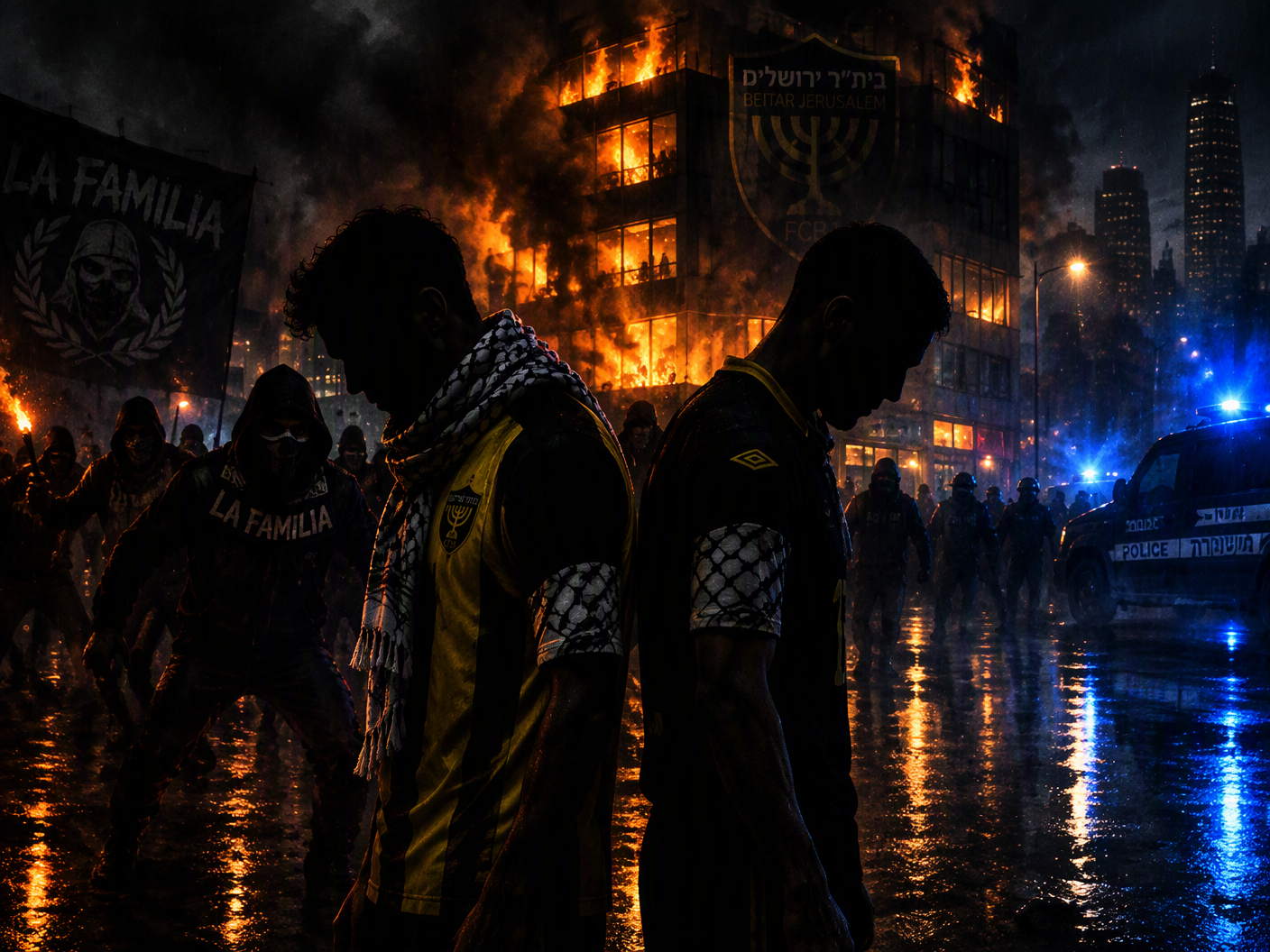
Zaur Sadayev and Dzhabrail Kadiyev arrived at Beitar Jerusalem in 2013 as footballers, but their first season in the club’s colors became a test of belonging. Both were Chechen Muslims. Some supporters walked out of a match after the signings, and the club’s offices in Jerusalem were burned down afterward. The players had crossed a boundary that had rarely been stated as a formal rule: who could wear Beitar’s shirt, and who could not. The damage was left at the club’s place of work, where contracts were handled, teams assembled, and the public identity of Jerusalem’s football institution was managed.
The opposition came from La Familia, a hard-line Beitar supporter group that rejected the signing of Muslim players. Its position gave the controversy an organized address. This was not simply a disagreement over tactics, wages, or the ability of two forwards to fit a lineup. The players’ religion became the issue. Beitar had chosen to recruit in a labor market that reached beyond the club’s established boundaries, while a section of its support treated that choice as an assault on the club itself. Sadayev and Kadiyev were employed to play football; the protest assigned their identities a different value.
The club’s position also stood out within Israeli top-flight football. Beitar Jerusalem remained the only leading Israeli club not to field an Israeli-Arab player. That distinction made the two Chechen signings more than a personnel decision inside one squad. A club that had resisted one form of inclusion was now bringing in Muslim players from outside Israel, and the reaction revealed how race, nationality, religion, and civic identity could be arranged differently depending on who was entering the workplace. The transfer market offered Beitar a route toward change; the stands answered by policing the meaning of the shirt.
For Sadayev and Kadiyev, the consequences were immediate and physical in the ordinary sense of the word: a workplace associated with their employment was burned, and a match became a place of departure rather than welcome. The available story does not require invented conversations or private thoughts to show the pressure. Their names were attached to an argument larger than their playing records. A football contract had brought them to Jerusalem, but the public response made their religious identity part of the terms under which they were expected to work.
The conflict did not remain confined to the 2013 signing. On 16 July 2015, during a Europa League match in Charleroi, Belgium, Beitar supporters threw flares onto the pitch. An object struck Charleroi goalkeeper Nicolas Penneteau. The incident shifted the setting from club offices and domestic stands to an international competition, where the supporters’ conduct imposed a bodily risk on an opposing player and disrupted the match itself. The club’s traveling identity now carried consequences beyond Jerusalem, transferred onto a goalkeeper who had no part in the original dispute.
That transfer mattered because European fixtures placed Beitar’s supporters inside a network of public rules: stadium safety procedures, visiting-team responsibilities, and police powers that did not depend on the club’s internal culture. A flare thrown onto a pitch was not a slogan or a walkout. It was an object moving through a controlled sporting space. When another object hit Penneteau, the boundary between supporter expression and danger became concrete. The episode connected the earlier hostility around Muslim players to later reporting about disorder associated with the same supporter world, without making every person in Beitar’s stands responsible for it.
By 26 July 2016, Israeli police were raiding people associated with La Familia. The operation took place across multiple locations and produced 56 arrests, including minors and nine soldiers. A supporter group that had opposed Muslim-player signings was now situated inside a police operation involving a much wider set of alleged conduct. The numbers carried their own geography: young people, military personnel, and others drawn from ordinary institutions were being taken from their routines into custody. The football dispute had acquired a public cost measured not in chants or club statements, but in arrests.
Police intervention also changed who controlled the next chapter. In 2013, the signings had forced Beitar to confront a contradiction between professional recruitment and exclusionary supporter identity. In 2015, a European match exposed the practical danger of that identity when objects and flares entered the field of play. In 2016, raids made the state an active participant. The sequence did not turn a fan faction into the whole club, nor did it make every Beitar supporter part of La Familia. It showed instead how a named group could shape the club’s public life while leaving others to carry the consequences.
The distinction between the club, its organized supporter faction, and unidentified individuals at particular matches remained central. Beitar Jerusalem made the 2013 signings; La Familia opposed Muslim players. Some supporters left a match, while the perpetrators of the office fire were not identified in the documented account. Two years later, supporters at the Charleroi fixture threw flares, and an unidentified person’s object struck Penneteau. In 2016, police raided people associated with La Familia. These were separate acts, carried out by different people at different times—not a single action by one undifferentiated crowd. Teammates, opposing players, employees, and other supporters occupied the same football world without thereby participating in racist conduct or criminal activity.
The unanswered legal questions sit beneath the visible chronology. The 2016 operation produced 56 arrests, but arrest was not a conviction, and the public material does not identify every individual who burned the offices, threw the flares, or struck Penneteau. The strongest established facts remain specific: two Chechen Muslim players signed for Beitar in 2013; some supporters protested; the Jerusalem offices were burned; La Familia opposed Muslim signings; disorder followed in Charleroi; and police later made the raids and arrests. The story’s force lies in those acts, not in assigning universal guilt where the facts do not do so.
Beitar’s choice placed Sadayev and Kadiyev at the center of a question they had not created: whether a club could recruit Muslim players without surrendering its inherited identity to a faction of its support. Their employment made the question visible, but the costs spread outward—to burned offices, interrupted matches, a goalkeeper struck in Belgium, and dozens of people taken in police raids. The players entered Jerusalem to play football. What remained around them was a club still carrying the consequences of deciding, however briefly, that the shirt could belong to someone its loudest supporters had tried to exclude.
Investigative Dossier & Evidence
Read the companion investigation notes, verified source claims, and primary documents.
Read the Companion Notes & Evidence Record →