
Tragedy · 1970s
The 5–0 IFA Shield Final and the Mohun Bagan Supporter’s Death
On 30 September 1975, East Bengal defeated Mohun Bagan 5–0 in the IFA Shield final, the largest margin preserved in the history of the Kolkata Derby. Afterward, a Mohun Bagan supporter died by suicide, binding a private death to the public memory of a football result whose precise circumstances remain obscure.
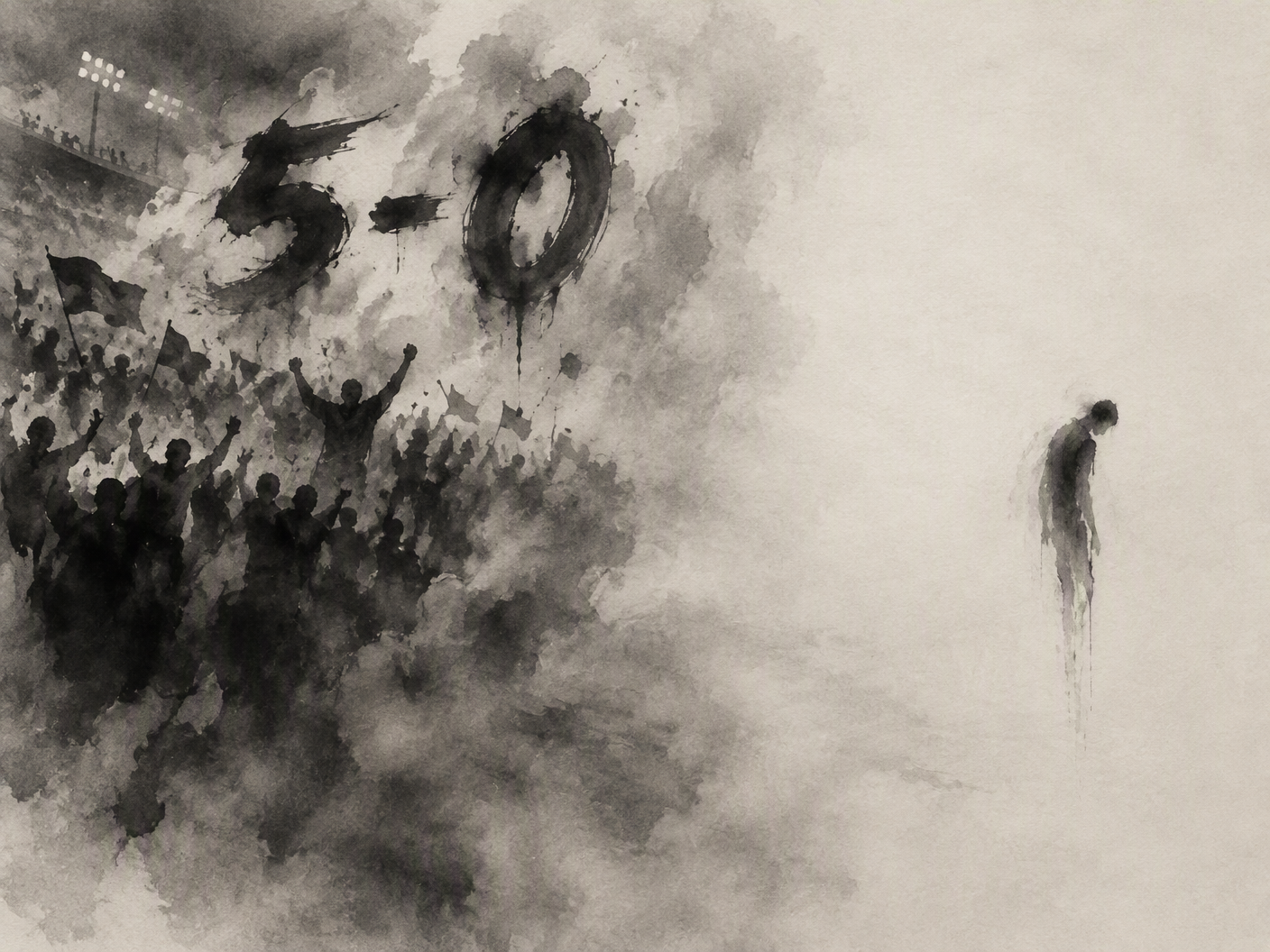
On 30 September 1975, at the IFA Shield final in Kolkata, East Bengal defeated Mohun Bagan 5–0. The score became the largest victory associated with the Kolkata Derby, a result so severe that it acquired a place beyond the ordinary arithmetic of a cup final. East Bengal had won a match; Mohun Bagan had lost a contest that carried the accumulated force of club allegiance, neighborhood identity, and family tradition. The five-goal margin fixed the afternoon in the rivalry’s record and set the terms for what followed after the football ended.
The IFA Shield was not a routine league fixture. It was a major knockout competition, and its final placed the two principal Kolkata clubs in direct opposition before a city that had long treated their meetings as occasions of communal belonging. The institutions were familiar: club colors, established names, supporters organized around inherited loyalties, and a competition whose final score could be carried from one household to another. On that September day, East Bengal’s five goals made the result impossible to reduce to a narrow defeat. The margin itself became the event.
Sometime after the final, a Mohun Bagan supporter committed suicide. The death entered the derby’s later telling as the human consequence attached to the 5–0 loss. His life outside the match was not preserved in the public story with equal detail: the surviving account supplies a supporter, a club, a defeat, and a death after the game. It does not supply the ordinary sequence by which a private crisis might be understood. What remained was the stark compression of two events—the result on 30 September and the death that followed.
That compression changed the meaning of the score. A football result normally survives through a table, a trophy, a team photograph, or the names of the goalscorers. This one survived with an account of a supporter who could not be separated, in popular memory, from the club he followed and the match he had just witnessed. The connection was temporal and narrative: the death came after the defeat. The public story did not preserve a documented medical explanation, a detailed private history, or a precise account of the final hours. It preserved the association.
The distinction between the public match and the private death is essential to the chronology. East Bengal’s victory belonged to the visible world of competition, where the score could be recorded and compared. The supporter’s suicide belonged to a different register, one that involved a single person and circumstances left largely outside the derby’s formal record. Yet the two events were carried together through later accounts. The football could be measured—five goals, one final, one winner. The loss attached to the supporter could not be measured in the same way.
The rivalry supplied later chapters without dissolving the older one. On 13 July 1997, East Bengal defeated Mohun Bagan 4–1 in a Federation Cup semifinal at Kolkata’s Vivekananda Yuba Bharati Krirangan. Bhaichung Bhutia scored a hat-trick in that match. The result belonged to another competition, another generation, and another stage of the clubs’ continuing contest. Its details were preserved with the clarity that football usually grants to a major game: venue, score, scorer, and occasion.
The 1997 semifinal demonstrated how the derby continued to produce precise sporting records. A four-goal East Bengal victory could be separated into its competition and date; Bhutia’s three goals gave the match a recognizable structure. The 1975 final had the same public clarity at the level of football. East Bengal won by five. Mohun Bagan lost by five. But the death associated with that result remained attached to the match through a shorter and more vulnerable form of remembrance, without the detail that would ordinarily explain a person’s life.
Over time, the clubs changed names and generations continued the contest. Mohun Bagan’s modern identity became Mohun Bagan Super Giant, while East Bengal remained the opposing institution in the city’s most durable football rivalry. The old results did not disappear; they became reference points against which later victories and defeats were measured. The 1975 score retained its unusual force because it combined competitive magnitude with the story of the supporter’s suicide. One part belonged to club history. The other belonged to a family and a life that the public record only partly carried forward.
In October 2024, the AFC recorded Mohun Bagan Super Giant’s victory over East Bengal in the 400th Kolkata Derby. The number marked the rivalry’s endurance through changing competitions, institutional names, and football eras. It also placed the 1975 final within a much longer sequence of meetings. New scores could be celebrated or endured, and new players could become the names attached to particular afternoons. The 5–0 final remained different because the remembered aftermath had made the score inseparable from a death that followed it.
The lasting arrangement of the story is therefore unusual but exact. East Bengal’s 5–0 victory in the 30 September 1975 IFA Shield final is the fixed sporting fact. The suicide of a Mohun Bagan supporter afterward is the human event preserved beside it. Later derbies—the 4–1 Federation Cup semifinal in 1997 and Mohun Bagan Super Giant’s win in the 400th meeting in 2024—show how the rivalry continued to generate its own record. The old account endures at the boundary between a score that can be verified and a death whose full circumstances were never carried into public view.
Investigative Dossier & Evidence
Read the companion investigation notes, verified source claims, and primary documents.
Read the Companion Notes & Evidence Record →