
Scandals & Feuds · 1990s
The Improvised Main Event That Broke Heroes of Wrestling
On October 10, 1999, a pay-per-view built around separate matches for Jake Roberts, Jim Neidhart, Yokozuna, and King Kong Bundy was reshaped during the broadcast after Roberts appeared unable to perform as planned. The improvised tag match ended with Bundy pinning Roberts, sexually suggestive use of Roberts’s snake, and an abrupt end to the program.
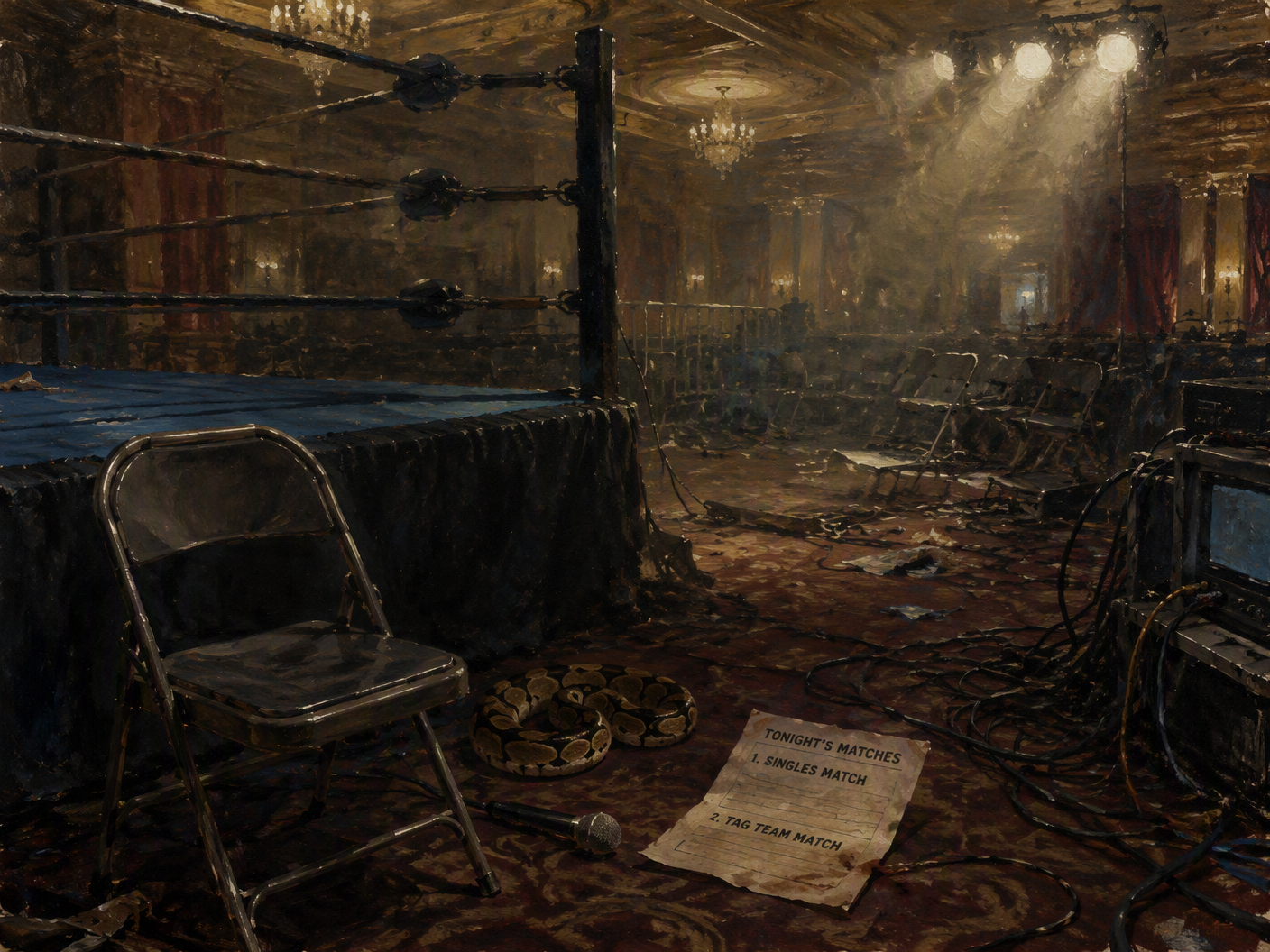
The advertised main event did not survive the night. At Casino Magic in Bay St. Louis, Mississippi, Jake Roberts was supposed to wrestle Jim Neidhart, while Yokozuna was scheduled to face King Kong Bundy. Instead, the pay-per-view reached its decisive segment with the production already coming apart around him. Roberts appeared in a state that made the planned match impossible to present as intended. The ring remained lit, the cameras remained fixed, and four aging wrestlers were left inside a show whose script had begun to lose its shape.
Before Roberts reached the ring, the broadcast placed him in a backstage interview. His speech was slurred and incoherent, the words running together until the interview became difficult to follow. The segment did not present a controlled veteran delivering a familiar wrestling persona. It presented a performer struggling to remain legible on live television, with the camera holding him in place as the boundaries between character, performance, and personal crisis grew difficult to separate.
Then came the walk toward the ring. Roberts staggered as he approached, moving with an instability that made the entrance itself part of the event. His behavior during the segment was erratic. Wrestling depends on timing, balance, cues, and the quiet cooperation of people who must make physical danger appear deliberate. Roberts’s condition disrupted that machinery in public. The spectacle was no longer only about who would win a match; it was about whether the match could safely and coherently happen at all.
The original structure was abandoned during the show. Roberts and Yokozuna were placed on one side, Neidhart and Bundy on the other, converting the two advertised matches into a tag-team contest. It was a practical rearrangement, but it also exposed the fragile architecture beneath a wrestling pay-per-view: names printed in advance, matchups promoted to buyers, and a live production forced to improvise when one participant could not carry the role assigned to him.
Roberts brought his snake into the segment. The animal had long been part of his wrestling identity, a prop that turned fear into theater. During this match, however, he used it in a sexually suggestive manner, pushing the performance into conduct that was difficult to absorb as ordinary wrestling comedy. The image became inseparable from the rest of the sequence: the unsteady entrance, the fractured timing, and the snake transformed from a stage emblem into an instrument of humiliation and disorder.
The other wrestlers continued around him. Yokozuna, Neidhart, and Bundy had been booked for separate confrontations, but now they shared a ring with a performer whose actions had made the planned contest unworkable. The tag format gave the production somewhere to go, though not a clean route out. Every movement carried the question of whether the improvised match could reach an ending without making the disorder more visible.
The ending came through Bundy. He pinned Roberts, closing the improvised tag-team match with a fall that the surrounding accounts describe differently in its mechanics and legality but consistently identify in its essential result: Bundy was the man who pinned Roberts. The finish supplied the formal punctuation of a wrestling contest, yet it could not restore the event’s promised shape. The advertised singles matches had disappeared, replaced by a conclusion assembled under pressure.
After that sequence, the broadcast ended abruptly. It did not ease into a polished closing or give the night the controlled release expected from a pay-per-view main event. The program simply stopped early, leaving the improvised match as its final sustained image. For viewers, the cut transformed a chaotic segment into the event’s defining memory: not a completed card, but a production that appeared to reach the limits of what it could continue showing.
The collapse carried financial stakes beyond the ring. Before the event, promoter Bill Stone expected approximately 41,000 pay-per-view orders to make the show profitable enough to support another production. That figure was a projection, not a final accounting, but it reveals the commercial pressure surrounding the night. Heroes of Wrestling was not merely a reunion of familiar names. It was a wager that nostalgia could be converted into enough paid homes to keep the enterprise moving.
At Casino Magic, the wager met a live event that could not hold its advertised form. The separate Roberts–Neidhart and Yokozuna–Bundy matches gave way to a tag contest; Roberts’s interview and entrance became evidence of visible disarray; the snake sequence pushed the performance into sexualized behavior; Bundy pinned Roberts; and the feed ended. The episode endured because every layer of wrestling’s machinery remained visible at once: promotion, persona, physical risk, improvisation, and the commercial need to keep the show moving after the plan had failed.
Companion notes
What the Heroes of Wrestling Record Establishes
The captured sources agree on the event’s location, advertised lineup, improvised tag match, pinfall, and early broadcast ending. They do not establish Roberts’s medical condition, what substance—if any—caused his behavior, who authorized the change in format, or the final commercial performance of the show.
The Event and Its Advertised Structure
The captured contemporary newspaper preview, archived from the Sun-Sentinel, explicitly places Heroes of Wrestling at Casino Magic in Bay St. Louis, Mississippi, on October 10, 1999. It also identifies the promoted matchups involving Jake Roberts and Jim Neidhart, along with Yokozuna and King Kong Bundy. The preview is the strongest source for what promoters were selling before the event; the Wikipedia compilation independently summarizes the same date, venue, and lineup but has no comparable primary authority. [S5], [S1]
The preview also records promoter Bill Stone’s expectation of approximately 41,000 pay-per-view orders. That number is a pre-event projection tied to Stone’s hope that the show would be profitable enough to support another event. It is not a verified final purchase total, profit statement, or proof that any later business decision followed from the broadcast’s performance. [S5]
What the Broadcast Accounts Show
The retrospective review at 411MANIA and the WrestleCrap account describe Roberts’s backstage interview as slurred, incoherent, and difficult to follow. They also describe him staggering toward the ring and behaving erratically during the main-event sequence. These sources establish how the broadcast was observed and characterized by later reviewers; they are not medical records, toxicology reports, police documents, or official production logs. [S2], [S4]
The same retrospective accounts, supplemented by the Wikipedia compilation, describe Roberts using the snake in a sexually suggestive manner. The description is corroborated across the captured accounts, but its editorial language should not be mistaken for an adjudicated finding. The sources establish conduct as presented and discussed in the broadcast history, not the private intent behind it. [S1], [S2], [S4]
The Altered Main Event
The sources agree that the planned separate matches were converted during the show into a tag-team match pairing Roberts and Yokozuna against Neidhart and Bundy. They also agree that Bundy pinned Roberts. The accounts differ over surrounding details, including the legality and mechanics of the fall, but those disagreements do not alter the central sequence: the advertised structure was replaced, and Bundy was credited with the pin. [S1], [S2], [S4]
No captured official production record, contract, or contemporaneous authorization identifies who made the decision to change the format. The alteration is therefore established as an event-level fact, while the chain of authority behind it remains unknown. Likewise, the sources do not independently establish the substance consumed by Roberts, a precise cause for his condition, or a medically verified diagnosis. [S1], [S2], [S4]
The Broadcast’s Ending and the Limits of Retrospective Memory
The Wikipedia compilation states that the feed was cut, while the 411MANIA retrospective characterizes the program as being taken off the air early. Both indicate that the broadcast ended abruptly after the improvised main-event sequence. Neither the cited records supplies an official broadcast log establishing the exact duration, the precise moment of termination, or the production decision that ended the transmission. [S1], [S2]
Taken together, the sources support a narrow conclusion: a pre-promoted pay-per-view main event was disrupted in public, converted into a tag match, concluded with Bundy pinning Roberts, and followed by an early end to the broadcast. Characterizations of the episode as proof of intoxication, medical impairment, intentional misconduct, or a particular financial outcome go beyond what these materials independently verify. [S1], [S2], [S4], [S5]
Source key
The associated evidence packet contains visible source URLs, source roles and the complete claim ledger.