
Bizarre & Myths · 2000s
Paxton Crawford’s Ottawa Glass Injury and the Drug Admissions That Followed
In July 2000, Boston Red Sox pitcher Paxton Crawford suffered an eight-stitch injury in a hotel room in Ottawa. Six years later, he admitted using steroids, human growth hormone, and amphetamines, prompting a dispute over what happened inside the Red Sox clubhouse and what could actually be established.
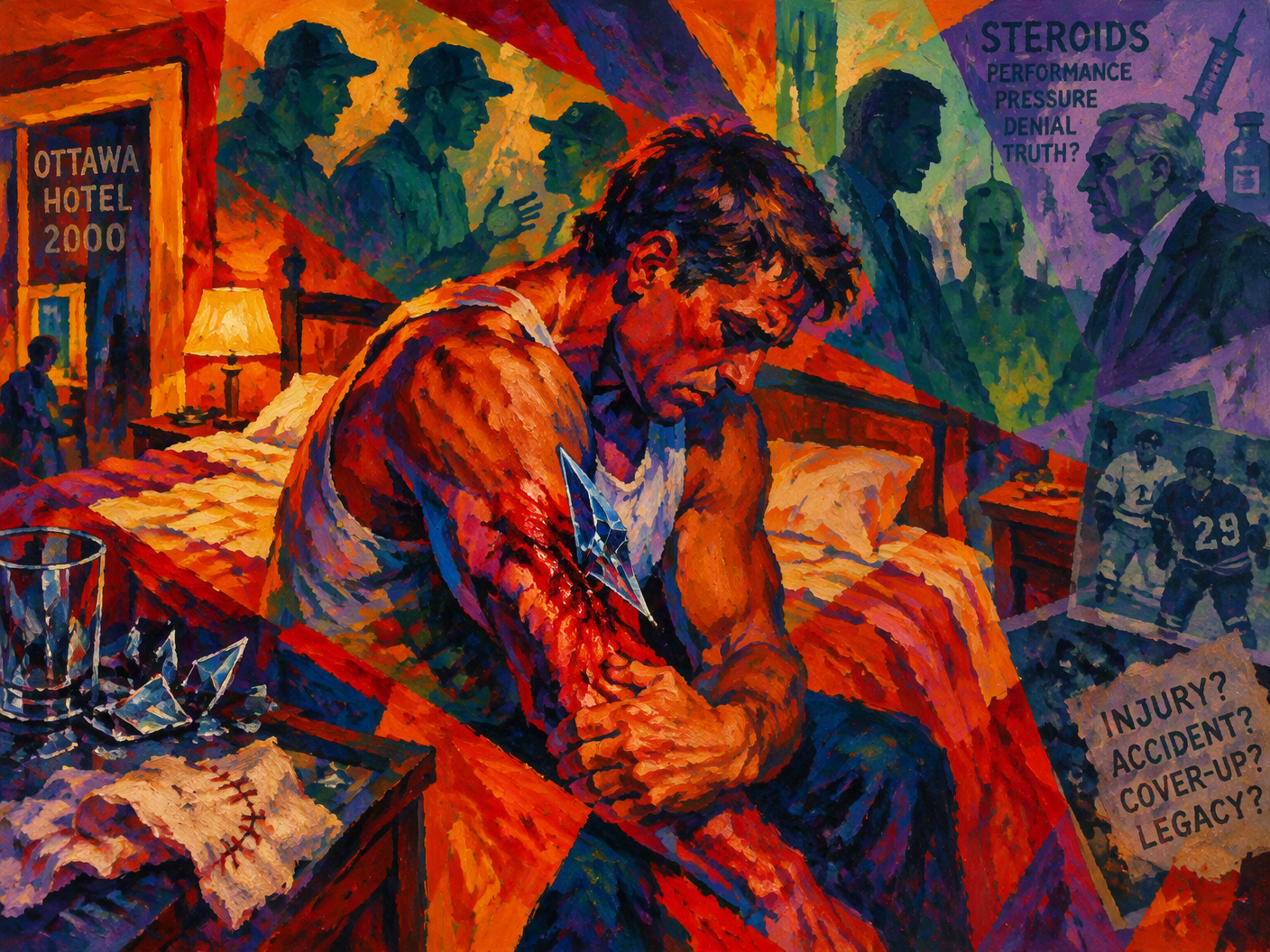
Paxton Crawford left an Ottawa hotel room in July 2000 with an injury that required eight stitches. He had spent the previous day pitching seven innings of a no-hitter, then said he fell out of bed during the overnight stay and landed on a water glass. The explanation was unusual because the object involved was ordinary and the injury was not sustained on a field, mound, or training room. Crawford was then moving between the Boston Red Sox and their Pawtucket affiliate, a young pitcher close enough to the major-league roster for every disruption to matter.
The Ottawa incident became the first fixed point in a story that would not acquire its broader meaning until years later. Crawford’s account placed the cause inside a hotel room: a fall, a bed, and a glass that broke beneath him. The injury itself was public and measurable. The explanation was his. Nothing in the later public account converted the episode into a proven intentional act, and no criminal case followed it. What remained was a strange interruption in a pitcher’s season, preserved because the circumstances were difficult to reconcile with the routine injuries of professional baseball.
Crawford’s career continued. He pitched for Boston in 2000 and 2001, years that later became central to his account of drug use. In June 2006, he publicly admitted using Deca-Durabolin and Winstrol, two anabolic steroids. He also said he had used human growth hormone and amphetamines from 1999 through 2001. The admission reached backward across the period that included his Ottawa injury and his time with the Red Sox organization, connecting a private medical claim to the larger question of how a young pitcher had been managed, monitored, and protected.
The substances Crawford named were not a vague reference to a culture he had encountered from a distance. He identified specific steroids and described his own use of performance-enhancing and controlled substances. His statement was public, direct, and retrospective. It was not a positive laboratory test or a criminal conviction. Its force came from Crawford placing his own conduct into the years when he was developing and appearing in the major leagues, giving the public a personal account of what he had taken and when.
Crawford also made a broader allegation. He said other Red Sox players used drugs and openly encouraged him to do the same. That claim shifted the focus from one pitcher’s conduct to the people around him: teammates, organizational supervisors, and the club culture that would have governed access, silence, and response. If true, the allegation described social permission as well as individual choice. It also carried a different burden, because naming a personal history did not by itself establish the conduct of unnamed or named teammates.
Current and former Red Sox players rejected Crawford’s description of an open drug culture in the clubhouse. Their criticism established a conflict, not a resolution. Crawford supplied a retrospective account of encouragement and use; the players who answered him denied that the clubhouse operated that way. Neither response created a formal finding against the other. The dispute exposed the divide between a former player’s testimony about an environment and an institutionally verified conclusion about how that environment functioned.
A separate disciplinary event gave Crawford’s later admission an earlier administrative marker. In August 2004, while playing for the Chattanooga Lookouts, he received a 15-day suspension for violating the league’s alcohol and drug abuse policy. The suspension occurred two years before the public admission and outside his Boston major-league appearances. It did not resolve the Ottawa injury or prove every substance Crawford later identified, but it established that drug-policy discipline had already entered his professional history before he spoke publicly about steroid, growth-hormone, and amphetamine use.
The sequence therefore moved through three different forms of public knowledge. Ottawa produced a physical injury and Crawford’s explanation for it. Chattanooga produced a formal league suspension under an alcohol and drug policy. The 2006 disclosure produced Crawford’s own account of substance use and his allegations about teammates. These were not interchangeable events. An eight-stitch injury was not proof of drug use; a policy suspension was not a complete explanation of the substances he named; and a player’s allegation about teammates was not an institutional finding.
The public history acquired another official marker on December 13, 2007, when Crawford was named in the Mitchell Report. The reference placed his name within a later baseball investigation into performance-enhancing drugs. It did not erase the distinctions among his own admission, the 2004 suspension, and the disputed clubhouse allegations. The report’s significance was institutional: Crawford’s story was no longer confined to a hotel injury, a minor-league discipline, or a newspaper interview. His name had entered the league’s larger accounting of steroid-era conduct.
What survives is narrower than the mythology that gathered around it. Crawford suffered an unusual glass injury in Ottawa after a seven-inning no-hitter and required eight stitches. He later acknowledged using Deca-Durabolin, Winstrol, human growth hormone, and amphetamines during a period that overlapped his rise through the Red Sox system. He was suspended for 15 days in Chattanooga, and his name later appeared in the Mitchell Report. The broader claims about an open clubhouse culture remained contested, while the Ottawa injury remained an injury with a stated explanation—not a solved conspiracy.
Investigative Dossier & Evidence
Read the companion investigation notes, verified source claims, and primary documents.
Read the Companion Notes & Evidence Record →