
Violence & Brawls · 500s
The Hippodrome Revolt and Justinian’s Armed Suppression
In January 532, a riot tied to Constantinople’s Blues and Greens grew from a race-day confrontation into an urban revolt that burned much of the capital. Justinian answered with dismissals, palace pressure, and troops sent into the Hippodrome, where the rebellion ended.
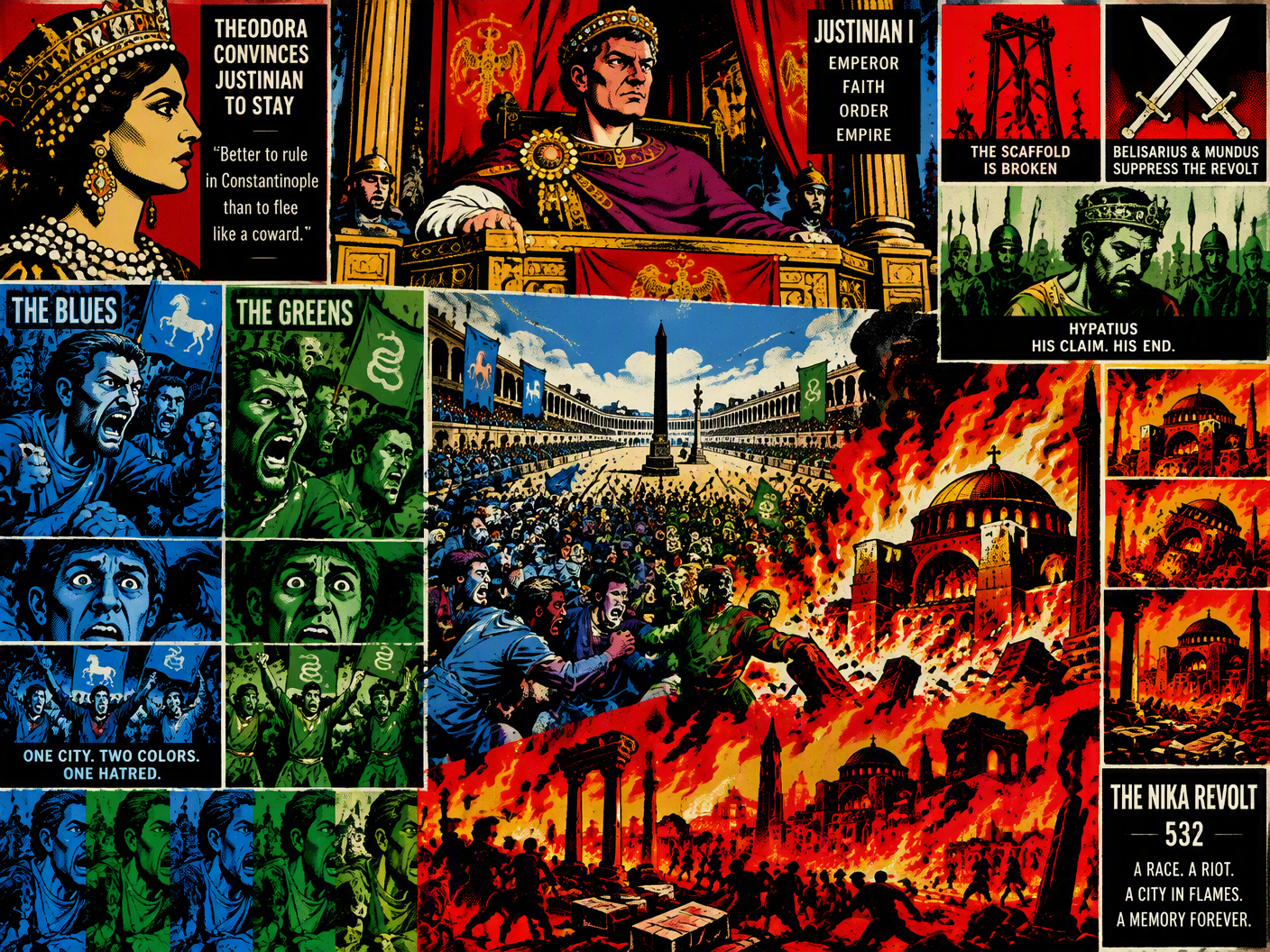
The scaffold broke before the execution was finished. On January 10, 532, a Blue partisan and a Green partisan survived an attempted hanging when the wood and supports gave way. Their survival left the city with two condemned men still alive and two rival factions with another grievance to carry into the streets. Constantinople had been arguing through the Blues and Greens for years, using chariot racing as its public language and the Hippodrome as its chamber of complaint. Five days later, the factions would arrive there together, and the race would become a riot.
On January 13, crowds gathered at the Hippodrome for the races. The grandstands were built for speed and faction, but the crowd brought demands instead. The disorder opened in the presence of Justinian, who watched from the palace box above the track. The emperor was close enough to see the public anger and powerful enough to be its target. The Blues and Greens, usually opponents divided by color and loyalty, turned their pressure toward the government. What began around the races moved quickly beyond the racecourse.
The demands reached into Justinian’s own administration. John the Cappadocian, the city prefect, was dismissed. Tribonian, the quaestor, was dismissed with him. Justinian made the concessions while the crowd pressed from the Hippodrome and the city’s temper worsened. These were not symbolic names pulled from a distant office. They were men attached to the emperor’s handling of the capital, and removing them gave the crowd something it could carry away as a victory. It did not end the disorder. It taught the crowd that pressure could move the palace.
The concessions failed to close the breach. The Hippodrome remained the center of the crisis, a public space connected by roads and doorways to the palace quarter and the rest of Constantinople. Rival race factions had found a common cause, though no single grievance explains the whole revolt. Popular anger, factional rivalry, and court politics overlapped in the same crowded place. The city did not need one clean cause. It had a mass gathering, an exposed government, and men willing to turn a demand into a challenge against the emperor.
Then the fires began. Rioters burned much of Constantinople, and the Hagia Sophia was destroyed in the unrest. Streets that carried processions and officials became routes through a damaged capital. The fire altered the scale of the dispute. Justinian was no longer dealing only with shouting factions at the races or officials whose dismissal might satisfy them. Buildings, neighborhoods, and lives were caught inside the emergency. The violence had moved from an argument over authority to a fight over whether authority still existed.
Inside the palace, flight became one of the choices before Justinian. Theodora dissuaded him from leaving. Her intervention kept the emperor in Constantinople while the revolt continued outside the palace quarter. Justinian remained the man who had dismissed John the Cappadocian and Tribonian, but the concessions had bought no settlement. The next decision would be harder and less reversible. He could continue yielding to the crowd, abandon the capital, or send soldiers into the place where the uprising had first gathered its force.
The crowd then placed another name above the riot. Part of it proclaimed Hypatius emperor. Hypatius was not merely another participant in a street disturbance after that declaration. He became a claimant installed by the crowd in the same city where Justinian still held the palace. Pompeius was drawn into the same episode. The proclamation gave the revolt a rival figure and gave the imperial government a direct contest for power. The Hippodrome, built to stage races before thousands, had become the setting for a transfer of sovereignty.
Justinian answered with soldiers. Belisarius and Mundus led imperial troops into the Hippodrome during the suppression. The movement was direct: armed forces entered the public arena where the factions had assembled, and the gathering was broken by force. The generals did not negotiate a new list of officials at the track. They carried the emperor’s decision into the crowd. The same place that had allowed the Blues and Greens to act together now confined the revolt to a space the government could surround and strike.
Hypatius and Pompeius were captured by the imperial troops. The claimant who had been raised by part of the crowd was removed from the contest, and the palace recovered control of the capital. Heavy loss of life followed the suppression. The episode was not erased by the capture of its leaders; Constantinople had already been burned, and the Hagia Sophia lay destroyed. Justinian survived the political crisis because the armed response ended the challenge before it could replace him.
The popular figure of an exact death toll has outlived the certainty of the event itself. The scale of the killing was heavy, but the surviving accounts do not independently verify the often-repeated number of 30,000. They do establish the hard outline: January 532 in Constantinople, the Blues and Greens at the center, the Hippodrome as the opening and closing ground, fire across much of the city, and an imperial assault that captured the rival claimant. The numbers blur. The sequence does not.
Justinian remained emperor after the smoke and arrests. His administration had first answered the crowd by dismissing two officials, then answered it with Belisarius and Mundus at the gates of the Hippodrome. Theodora had kept him from flight, while Hypatius’s brief elevation ended in capture. The deeper calculations inside the palace remain harder to measure than the actions in the streets. What can be seen is the residue: a ruined church, a damaged capital, dead citizens, seized leaders, and an emperor still seated where the crowd had demanded that he yield.
Investigative Dossier & Evidence
Read the companion investigation notes, verified source claims, and primary documents.
Read the Companion Notes & Evidence Record →