
Doping & Drugs · 1980s
Rica Reinisch and the East German Steroid Machine
Rica Reinisch won three swimming gold medals at the 1980 Moscow Olympics inside a state-directed doping system that supplied performance-enhancing drugs to elite athletes, including minors. After reunification, convictions, lawsuits, and her own accounts of ovarian cysts, miscarriages, and hospitalizations exposed the human cost, while the precise medical cause of her illnesses remained unresolved.
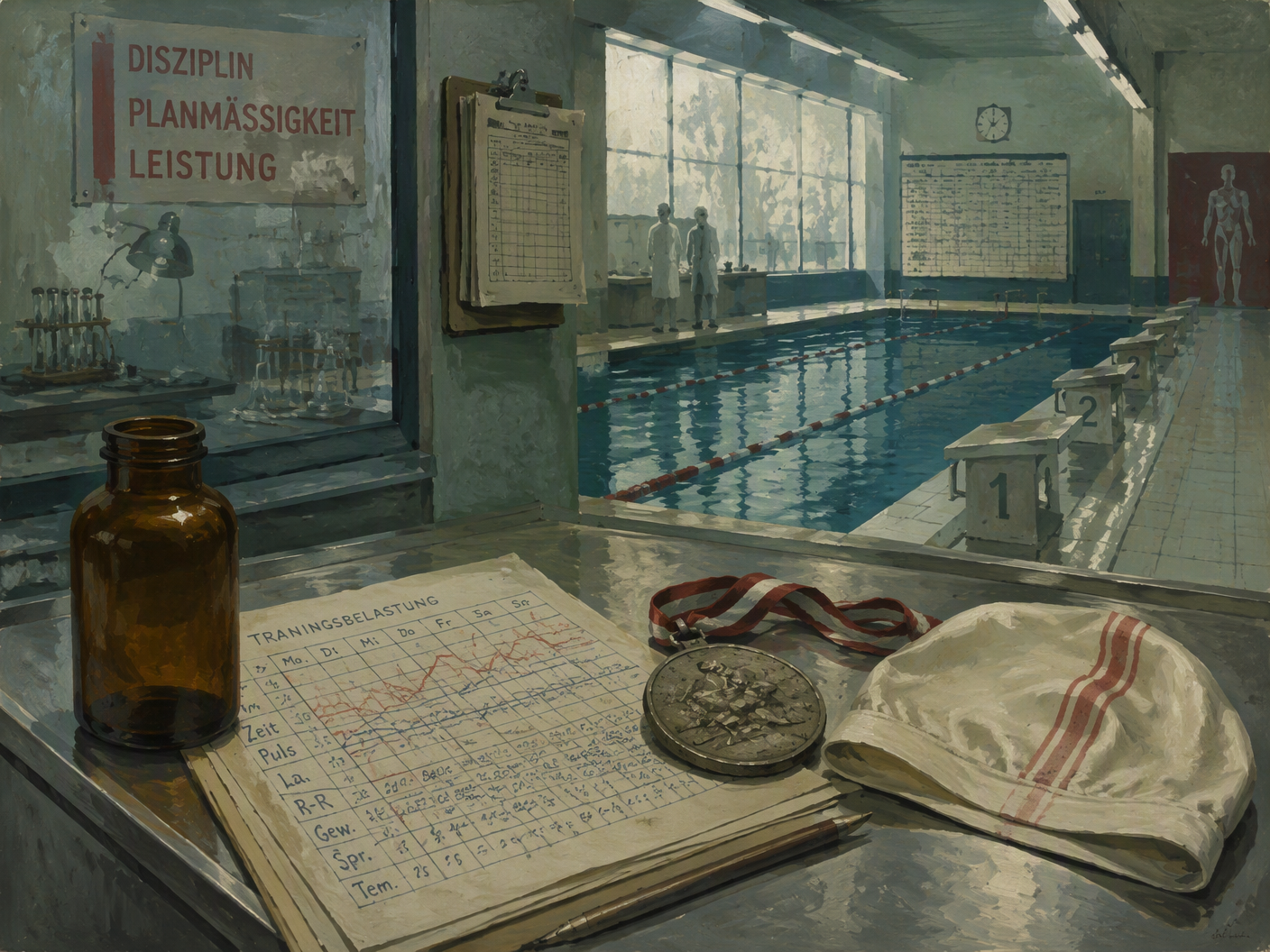
The medals came out of the water before the consequences did. In Moscow in 1980, Rica Reinisch swam through three Olympic finals and won three gold medals for East Germany: the 100-meter backstroke, the 200-meter backstroke, and the 4x100-meter medley relay. She was a teenager carrying the colors of a country that treated international sport as political evidence. The pool rewarded the body that arrived first. Behind that body stood a system that had turned laboratories, sports physicians, coaches, and young athletes into parts of the same national project.
East Germany had built that project deliberately. Elite sport was not merely recreation or personal ambition; it was a state instrument, a way for a small socialist republic to make itself visible against larger nations. The program supplied performance-enhancing drugs to top competitors, and children were drawn into its machinery. The swimmers trained inside a culture of controlled diets, timed workloads, medical supervision, and instructions that could make a tablet seem ordinary. The state wanted medals. The athlete’s body became the place where the political calculation was carried out.
One of the system’s principal chemicals was Oral Turinabol, an anabolic steroid manufactured by the East German pharmaceutical company Jenapharm. Coaches and sports physicians used it in the pursuit of strength, speed, and recovery. Young athletes were sometimes told that the tablets were vitamins. The language mattered. A vitamin belonged to daily life; a steroid belonged to a risk that required consent, explanation, and an adult’s judgment. By disguising the substance, the program narrowed the space in which a child could ask what was being placed inside the body.
Reinisch’s rise was swift. At the Moscow Games, she won the 100-meter backstroke and then the 200-meter backstroke, races in which a fraction of a second could separate an Olympic champion from the rest of the field. She also helped East Germany win the 4x100-meter medley relay. Three times, the ceremony placed a gold medal around her neck. Three times, the flag rose and the anthem filled the arena. To the public, the victories looked like proof of disciplined national excellence. The machinery that had helped produce them remained out of view.
Her swimming career did not last long after Moscow. The pressures of elite competition, the demands placed on a young body, and the political system surrounding the pool belonged to one period of her life; the medical consequences, she later said, followed her into the next. She reported recurring ovarian cysts, miscarriages, and serious health problems after leaving swimming. The Olympic image—a young champion emerging from the water beneath bright lights—could not contain the years that came afterward.
Reinisch later described hospitalizations for gynecological and heart problems and attributed them to the steroids she had received. Her account placed the private cost beside the public achievement. The medal was a permanent object, polished and easy to display. The illnesses were recurring, intimate, and harder to explain. They belonged to operating rooms, examinations, miscarriages, and the uncertain calendar of a body that had been managed for performance before its owner had reached adulthood.
For years, the system endured behind the discipline of the Cold War. Then the state that had organized it disappeared. Reunification opened archives, exposed methods, and moved the story from athletic mythology into police investigations and courtrooms. German proceedings produced convictions of officials and medical personnel who had administered steroids or hormones to athletes, including minors. Suspended sentences and fines could mark individual responsibility, but they could not restore the years when young competitors had been treated as national resources.
The legal reckoning also exposed the limits of retrospective repair. In 2005, 160 former East German athletes pursued damages from Jenapharm for health injuries they connected to the doping program. The pharmaceutical company denied responsibility. The claims carried the weight of a shared history: athletes who had been celebrated as evidence of state power now stood together as adults seeking recognition of what that power had required from them. A medal could prove what happened in an arena. It could not, by itself, prove what happened inside a body decades later.
The Olympic record became another contested room. In 1998, the International Olympic Committee declined to revise the record books or award substitute recognition for disputed East German results, even after German court rulings concerning systematic doping by some East German swimmers. The decision preserved the official results and left the medals attached to the names that had won them. It also kept two questions in the same frame: how extensively the system had operated, and how specifically responsibility could be assigned to any one athlete’s result.
Reinisch’s story remains suspended between those questions. The East German program was real. Oral Turinabol was central to it. Officials and medical personnel were convicted after reunification, and former athletes sought compensation for injuries they associated with the system. Reinisch’s illnesses and her attribution of them to steroid exposure are part of that history. But a state can be proved to have built a drug program without every medical consequence in one swimmer being reduced to a single courtroom answer. The medals remain. So does the body that carried them.
Companion notes
What the East German Doping Record Proves—and What It Cannot Assign to One Body
The sources establish a state-directed program involving minors, identify Oral Turinabol as a principal steroid, and document post-reunification convictions and compensation claims. They also distinguish Reinisch’s reported health history and attribution from independent medical proof of precise individual causation.
The state program and Oral Turinabol
The reference materials on doping in East Germany, the BBC’s reporting on former athletes suing Jenapharm, and the archived ABC News report converge on the central institutional fact: East Germany operated a state-directed performance-enhancement program that included elite athletes and minors. The same materials identify Oral Turinabol as a principal steroid. The BBC account specifically links Jenapharm to manufacturing the drug and describes its misuse by coaches and sports physicians; ABC News describes young athletes being told that tablets were vitamins. [S2], [S3], [S6]
That evidence establishes the existence and structure of the program, not universal participation or uniform knowledge. It does not show that every East German athlete received drugs, or that every athlete understood what a substance was. Those distinctions are important when moving from institutional responsibility to an individual swimmer’s treatment and intent. [S2], [S3], [S6]
Reinisch’s Olympic record and health account
The biographical reference on Rica Reinisch, the BBC report, and ABC News identify her three Moscow gold medals: the 100-meter backstroke, the 200-meter backstroke, and the 4x100-meter medley relay. They also report her later accounts of recurring ovarian cysts, miscarriages, and serious health problems. ABC News says Reinisch attributed hospitalizations for gynecological and heart problems to steroids she had received. [S1], [S3], [S6]
The captured materials preserve those health outcomes as reported experiences and preserve Reinisch’s causal attribution. They do not provide independent medical records establishing the precise cause of each condition. The evidence therefore supports describing what she experienced and what she said about it, while stopping short of assigning definitive medical causation to steroid exposure for every illness. [S1], [S3], [S6]
Post-reunification prosecutions
The doping histories summarized in the East Germany reference material, together with the BBC and ABC News accounts, describe investigations and court proceedings after reunification that produced convictions of officials and medical personnel involved in administering steroids or hormones, including to minors. The proceedings supply a legal foundation for individual wrongdoing within the larger system. [S2], [S3], [S4], [S6]
Those convictions do not establish that Reinisch personally testified against a particular defendant, nor that a court adjudicated responsibility for her individual treatment. The sources support the existence of convictions connected to the system, but they do not convert those cases into a specific judgment about every athlete or every later medical condition. [S2], [S3], [S4], [S6]
Compensation claims and the Olympic record
The BBC reported that, in 2005, 160 former East German athletes pursued damages from Jenapharm over alleged health injuries connected to the doping program. The report also records Jenapharm’s denial of responsibility. The supplied material confirms the claims and the competing position but does not provide their final disposition. [S3]
An archived International Herald Tribune report describes the IOC’s 1998 decision not to revise Olympic record books or award substitute recognition for disputed East German results. The decision followed German court rulings concerning systematic doping by some East German swimmers. It did not amount to an individual adjudication that every medalist, including Reinisch, had been found to have doped. [S2], [S4]
Source key
The associated evidence packet contains visible source URLs, source roles and the complete claim ledger.