
Scandals & Feuds · 1990s
John and Justin Fashanu: Estrangement, Remorse, and a Denial That Endured
John Fashanu later described disowning his brother Justin after Justin came out as gay, then said he blamed himself for Justin’s death. Twelve years later, John publicly denied believing that Justin was gay, leaving a family history marked by grief and contradiction.
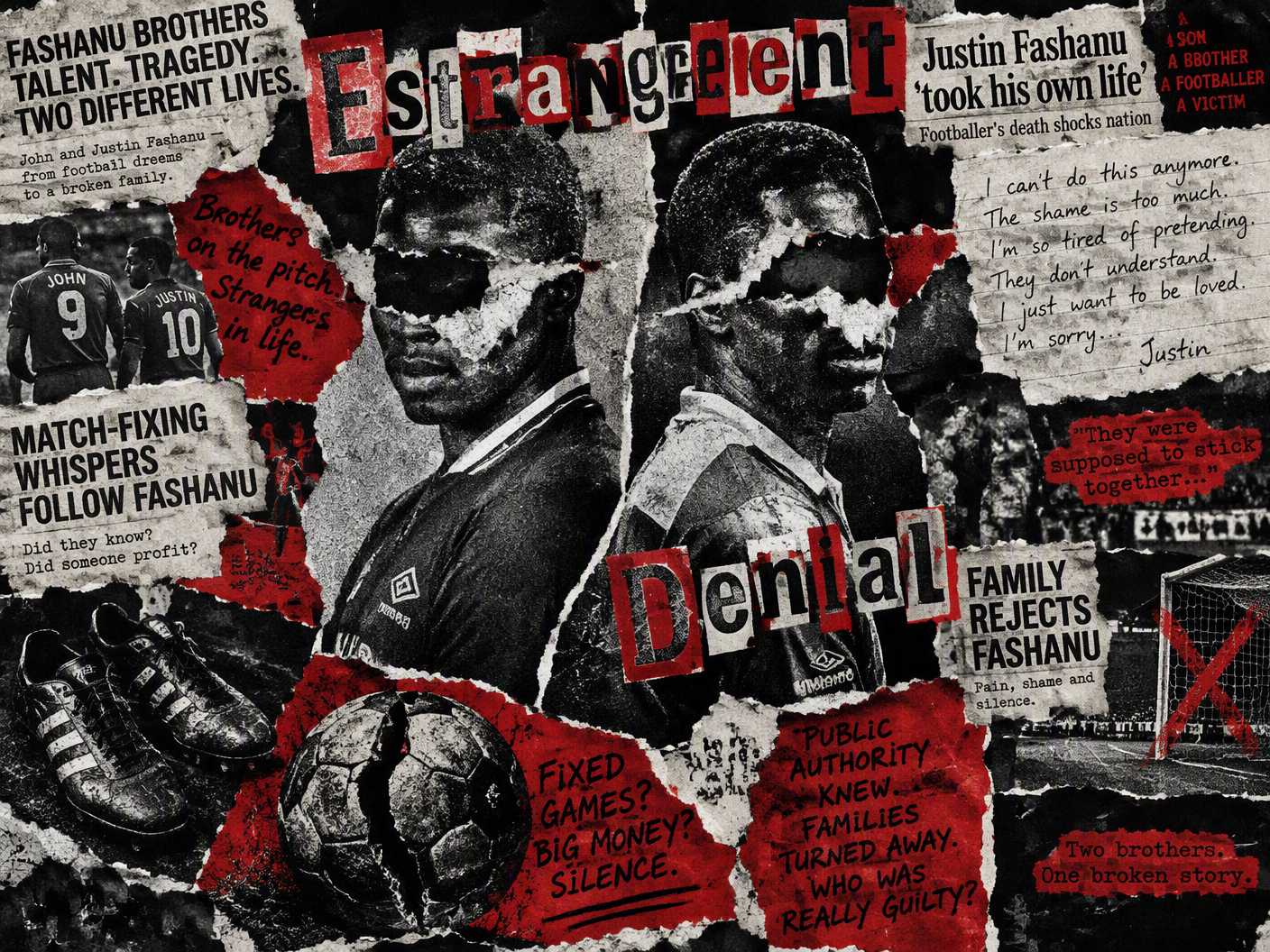
In May 1998, Justin Fashanu was found hanging in a garage in Shoreditch, east London. The death brought private family history into public view: Justin and John Fashanu were brothers, two footballers whose lives had taken different paths through the same sport. Justin had come out as gay in 1990. John later said that he disowned him after the disclosure and that he had not accepted Justin’s sexuality. By the time Justin died, the distance between the brothers had become part of the circumstances John would spend years trying to explain.
Justin left a suicide note. Its stated reason was not a single quarrel or one identifiable event, but the wish to die rather than put his friends and family through any more unhappiness. The note gave the death a final language of burden and release. It did not settle the history between the brothers. John’s later account supplied his own version of that history: he had failed to accept Justin’s sexuality, and the relationship had been damaged before the garage in Shoreditch became the place where Justin was found.
Two years later, John spoke publicly about the telephone call he had ignored. He said he would always blame himself for Justin’s death. The statement joined remorse to a specific missed moment: a call that might have been answered, though no later account could restore the conversation or show what it would have changed. John also acknowledged that he had not accepted his brother’s sexuality. His words did not present the estrangement as an abstract disagreement. They placed responsibility within the family and within his own conduct toward Justin.
The brothers’ shared upbringing was part of the public understanding of their story, but it did not produce a simple adult alliance. Both became professional footballers, and both carried the Fashanu name into a sport whose public culture offered little room for Justin’s disclosure in 1990. Justin’s career made him visible; his sexuality made him an object of scrutiny beyond the field. John’s later description of disowning him established the central fracture plainly, without requiring a dramatic scene or a single decisive exchange to represent years of separation.
John’s own football career continued through confrontations that belonged to another part of his public life. In November 1993, during a Premier League match at White Hart Lane, he clashed with Gary Mabbutt, the Tottenham captain. Mabbutt underwent an operation for a fractured skull. The injury became one of the serious physical incidents attached to John’s playing career, but it was separate from the family dispute that would later define his statements about Justin.
After football, John remained a recognizable public figure, moving into television and carrying the authority and exposure that came with that role. In July 2003, allegations surfaced that he had admitted rigging football matches. John denied wrongdoing. The allegation and denial occupied a separate public controversy, distinct from Justin’s death and from John’s admission that he had rejected his brother’s sexuality. The separation matters in sequence: John’s later public life contained several disputes, but not every dispute belonged to the same story.
The family story returned to view through John’s reflections rather than through a legal proceeding. His 2000 comments connected three facts in his own account: Justin had come out as gay; John had failed to accept that part of him; and John believed his response had left him with lasting guilt. He did not describe himself as a detached witness to the death. He placed his own rejection inside the history of the relationship and said the responsibility would remain with him.
That account later met a direct contradiction. In March 2012, John said that he did not believe Justin was gay. The statement challenged the premise of the remorse he had previously expressed, or at least the public meaning attached to it. Justin’s coming out had been the stated point of rupture; John’s later denial disputed the fact around which that rupture had been described. The brothers’ story therefore acquired an unresolved second layer: grief over rejection, followed years later by a refusal to accept the identity Justin had publicly claimed.
John’s 2012 statement was a personal denial, not an objective determination of Justin’s sexuality. It could not erase Justin’s public disclosure, nor could it revise the words John had used about failing to accept him. The two positions remained in public view together. One expressed estrangement and self-blame after Justin’s death; the other rejected the premise on which that estrangement had been explained. Between them stood the fact of Justin’s death in Shoreditch and the note that described the unhappiness he believed he was causing.
The separate allegations about match-fixing did not become a proven finding in the public material at issue. John denied wrongdoing, just as the White Hart Lane collision established an injury without explaining intent. Neither episode supplied an answer to the question posed by the brothers’ history. The consequential statements came from John himself: that he had disowned Justin, that he had not accepted his sexuality, that he would blame himself for the death, and later that he did not believe Justin was gay.
What endured was not a settled account of causation, but a sequence of public admissions and reversals. Justin came out in 1990 and died in Shoreditch in May 1998. John described the estrangement in 2000, then denied Justin’s sexuality in 2012. The family name remained attached to football, television, injury, allegation, grief, and contradiction. Its most durable record was the gap between John’s recognition of what rejection had meant and his later refusal to affirm the identity at the center of it.
Investigative Dossier & Evidence
Read the companion investigation notes, verified source claims, and primary documents.
Read the Companion Notes & Evidence Record →