
Doping & Drugs · 1990s-2000s
The Ferrara Files: Conconi, EPO Records, and the Case Closed by Prescription
A 1998 police raid at the University of Ferrara uncovered athlete names, blood values, and data linked to Francesco Conconi’s sports-science center. The criminal case and later disciplinary proceedings ended on limitation grounds, leaving a documented system of monitoring and unresolved allegations rather than a merits-based conviction.
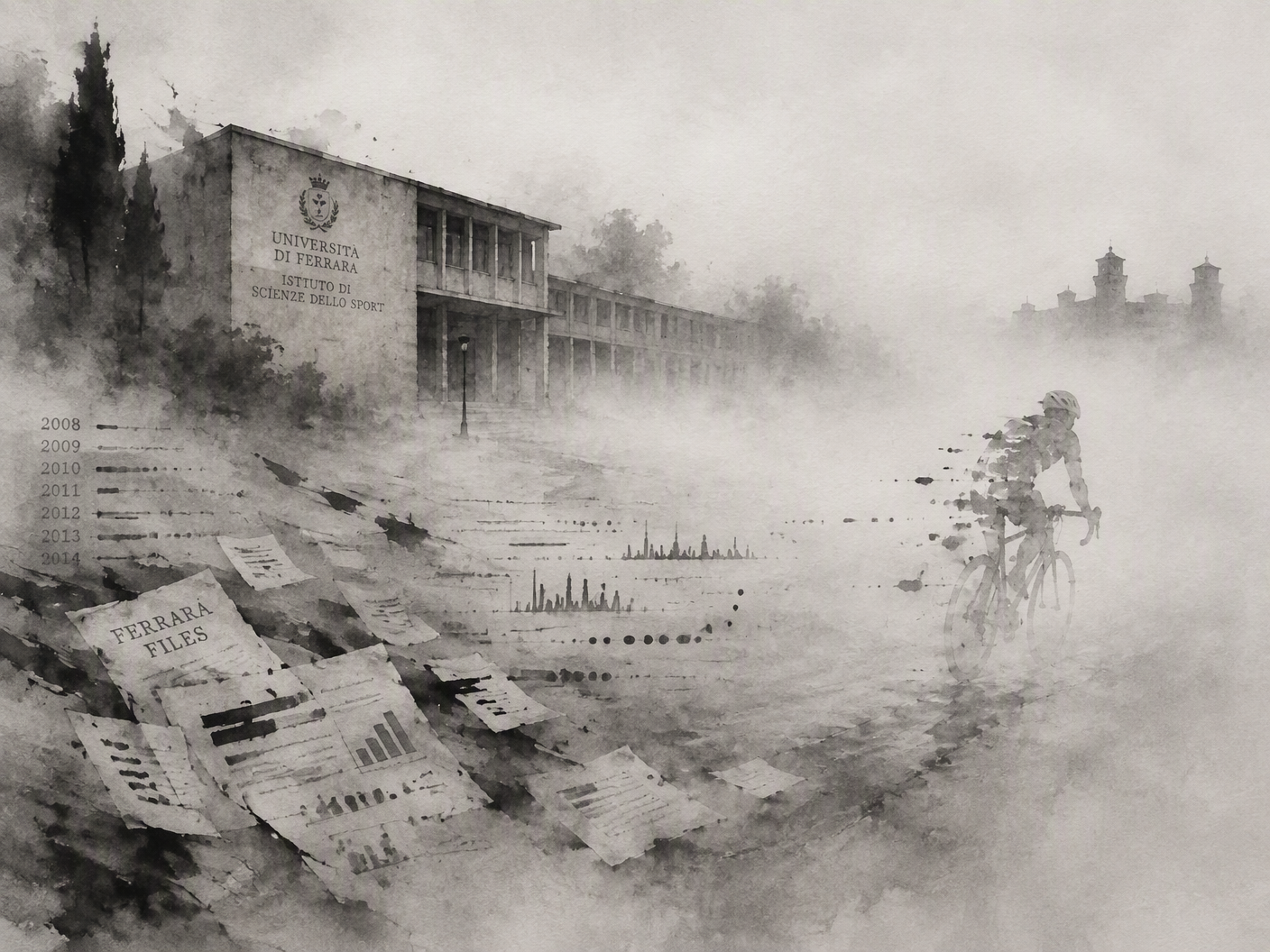
On 19 October 1998, Carabinieri entered the University of Ferrara’s Institute of Sports Science and confiscated its documentation. The seizure placed Francesco Conconi’s center under criminal scrutiny and removed its internal records from the control of the doctors who had generated them. Conconi, a university sports doctor and researcher, had built a practice around athletes, blood testing, and performance data. The files would later carry names, laboratory values, and entries connected to professional cycling. The raid created the case’s physical center: not a rumor about doping, but a university archive taken into police custody.
The material connected three doctors to the Ferrara inquiry. Conconi was the principal figure associated with the institute. Ilario Casoni and Giovanni Grazzi were identified as collaborators and later named as defendants. Their work, as the judgment eventually characterized it, included monitoring athletes’ health, conducting blood tests, and analyzing the resulting data. That description gave the case an institutional setting. The relevant activity did not occur only at a roadside checkpoint or inside a team vehicle; it was organized through a sports-science center whose files tracked the bodies of elite competitors over time.
By late 1999, the confiscated computer files had entered public view through reports about hematocrit fluctuations among riders linked to Conconi. The names included Ivan Gotti, Pavel Tonkov, Marco Pantani, and Claudio Chiappucci. Hematocrit measures the proportion of red blood cells in blood, a value relevant to endurance performance and to the use of erythropoietin, or EPO. The figures gave the archive a second life. Police possession became public controversy, and a set of laboratory numbers began to carry implications far beyond the university where they had been recorded.
The numbers did not carry a single meaning. A fluctuating hematocrit could place an athlete inside a pattern of medical attention, but it did not by itself establish that the rider had used a banned substance. The distinction became central as the names circulated. Pantani, Gotti, Tonkov, and Chiappucci appeared in discussions of the files because their values had been tracked, not because the figures alone supplied a complete account of what happened to each athlete. The archive showed measurement and association. It did not convert every entry into a proven doping offense.
In January 2000, Stephen Roche’s name added another strand to the case. Files seized from Conconi’s headquarters contained an entry alleging EPO administration in 1993. Roche denied using EPO. His denial placed a direct conflict beside the document: an athlete rejecting the meaning assigned to his name, and an institutional file that appeared to assign one. The allegation concerned a defined year and a defined substance. It was not a general claim about Roche’s career, but an entry tied to the period later examined by the Ferrara court.
The court’s eventual account focused on a narrower period, from January through July 1993. Within that window, the judgment described Giovanni Grazzi as the only one of the three doctors identified as having administered EPO. The athletes named in that description were Guido Bontempi, Claudio Chiappucci, Mario Chiesa, Stephen Roche, and Rolf Sorensen. The names transformed the case from an inquiry into laboratory practice into a question about specific medical acts involving specific riders. Yet the legal status of that description remained separate from a conviction.
Francesco Conconi, Ilario Casoni, and Giovanni Grazzi faced the Ferrara proceedings as defendants. On 19 November 2003, Judge Franco Oliva acquitted all three by reason of prescription. The ruling did not make a merits-based finding that the underlying conduct had been disproved. It ended the criminal case because the applicable limitation period had expired. The court also stated that the conduct under review was not punishable as a doping offense under the law then in force. Time and statutory reach determined the outcome.
That outcome fixed the boundary between what the case exposed and what it legally established. The Ferrara center had possessed records containing athlete names and blood-test values. Its work had involved health monitoring, blood testing, and data analysis. The judgment had set out a 1993 period and identified Grazzi in connection with EPO administration to five riders. But the defendants were not convicted after a trial on the substantive allegations. The court’s language preserved the conduct within the case history while prescription prevented punishment.
The administrative process continued after the criminal judgment. On 24 June 2004, the CONI anti-doping prosecutor archived disciplinary cases involving the listed athletes because the disciplinary limitation period had expired. The decision closed a separate route to sanctions. It did not resolve every question raised by the seized files, and it did not turn the presence of a name or blood value into proof of EPO use. It applied a procedural deadline. The same pressure that had shaped the Ferrara criminal result—elapsed time—now governed the sporting authorities.
The Ferrara episode therefore left behind two forms of official closure. The court acquitted Conconi, Casoni, and Grazzi by prescription, while CONI archived the athletes’ disciplinary cases for the same basic reason: the limitation period had run out. Neither decision erased the university’s seized archive or the names written into it. Neither established that every athlete identified in the files had used EPO. What remained was a documented system of testing and tracking, a set of allegations tied to a 1993 window, and institutions that reached their final decisions after the law’s clock had become decisive.
Investigative Dossier & Evidence
Read the companion investigation notes, verified source claims, and primary documents.
Read the Companion Notes & Evidence Record →