
Doping & Drugs · 2000s
Mohammad Asif’s Dubai Detention and the IPL Steroid Ban
Mohammad Asif’s 2008 detention in Dubai began with an airport search and ended with dropped charges, an entry ban, and no criminal conviction. Months later, the Indian Premier League confirmed a positive steroid test and suspended the Pakistani fast bowler for one year, adding a separate sanction to an earlier PCB doping suspension.
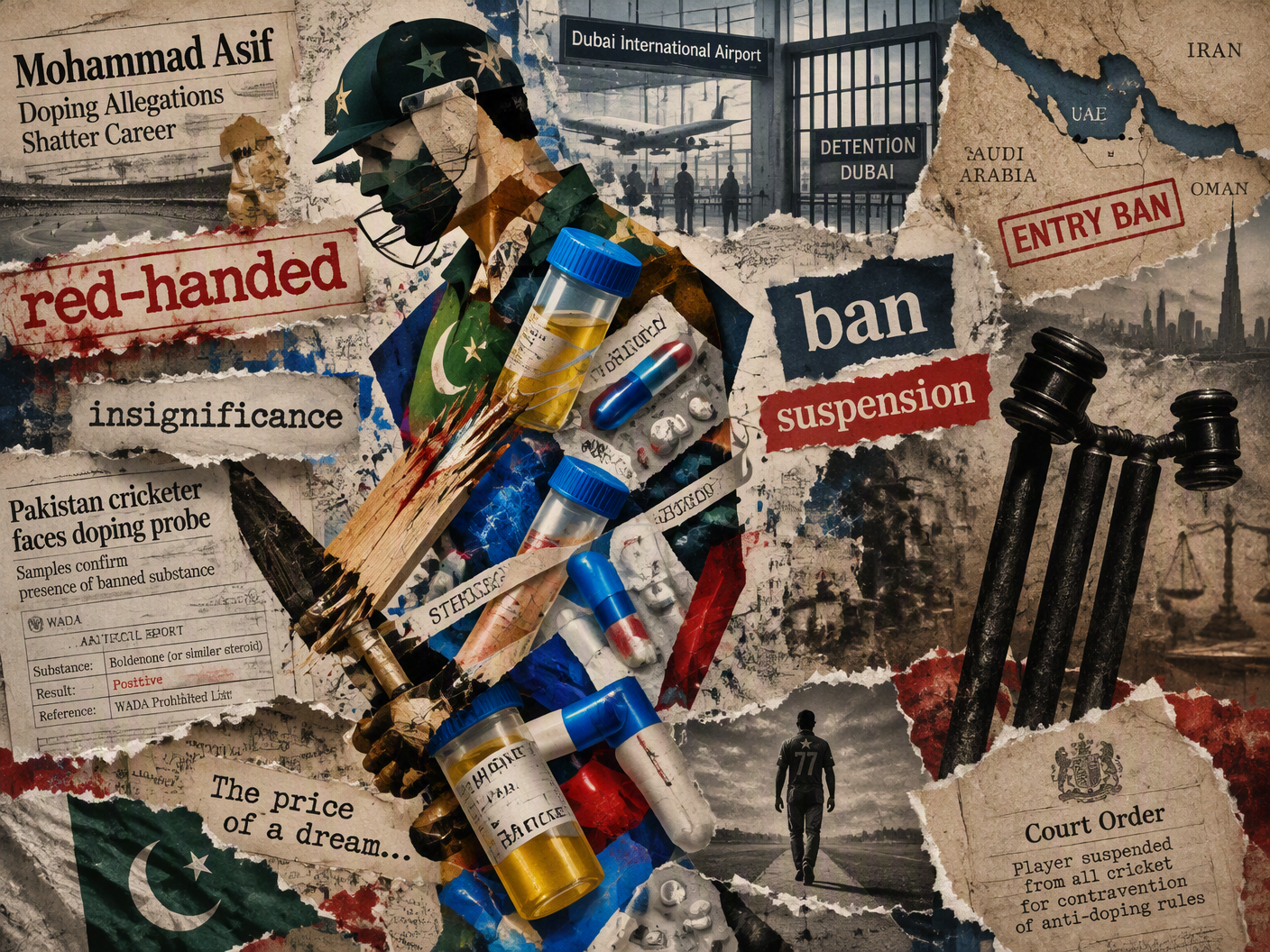
On 1 June 2008, Dubai authorities detained Mohammad Asif at Dubai International Airport on suspicion of possessing illegal drugs. An unknown substance was found in the Pakistani fast bowler’s wallet. A urine sample was taken and sent for analysis. The airport detention converted a celebrated cricketer’s private movement through the United Arab Emirates into a prosecutorial matter, with the substance and the laboratory result placed at the center of the case. For Asif, the immediate consequence was custody. For cricket authorities, it was another disciplinary problem attached to a player already carrying a doping history.
The Dubai public prosecutor ended the case eighteen days later. On 19 June, the charges against Asif were dropped, and the prosecutor described the dismissal as a matter of “insignificance.” The same authority said Asif had been caught red-handed, a phrase that preserved the force of the initial accusation even as the prosecution abandoned it. The legal outcome was limited but concrete: Asif was not convicted of drug possession, and the Dubai episode did not produce a criminal judgment against him. He was barred from entering the United Arab Emirates again.
The disposition left two different facts standing beside each other. Dubai authorities had detained Asif after finding an unidentified substance and obtaining a urine sample. The prosecutor then dropped the charges and imposed an entry ban rather than taking the case to conviction. The identity of the substance in the wallet did not become part of the public resolution. Neither did the Dubai detention become a proven criminal possession offense. The episode ended administratively, with restriction replacing prosecution and suspicion remaining separate from a finding of guilt.
Asif’s earlier record made the airport detention harder for cricket’s governing bodies to treat as an isolated interruption. On 16 October 2006, the Pakistan Cricket Board suspended him after he failed a drug test for nandrolone, an anabolic steroid. That suspension belonged to a national cricket disciplinary process, not to the Dubai prosecution. It nevertheless established a prior regulatory response to a banned substance. By the time Asif returned to the international sporting conversation in 2008, administrators were dealing with a player whose career had already crossed the boundary between performance and prohibited chemistry.
The next sanction came from the Indian Premier League. During the 2008 tournament, the league disclosed that one player had tested positive for banned substances. On 14 July, the player was identified as Asif. The announcement shifted the public focus from a criminal suspicion at an airport to a formal anti-doping matter inside a major professional competition. The two episodes were not the same proceeding. Dubai had involved an alleged possession offense; the IPL had a drug-testing result and its own disciplinary authority. Both, however, placed Asif under an official restriction.
The IPL took months to convert the positive test into a final public sanction. On 11 February 2009, it confirmed that Asif had tested positive for steroids and imposed a one-year ban. The suspension was set to end on 21 September 2009. That decision supplied the clearest institutional conclusion in the sequence: the league treated the test as a violation of its anti-doping rules and removed Asif from competition for a defined period. It did not turn the Dubai detention into proof of the same conduct.
The sequence exposed how different authorities could act on the same athlete without producing one unified judgment about him. The PCB had suspended Asif for nandrolone in 2006. Dubai prosecutors had detained him over suspected drug possession, then dropped the charges and barred his return. The IPL had later confirmed a steroid positive and imposed its own one-year ban. Each office possessed a distinct power: the board could suspend, the prosecutor could charge or dismiss, and the league could exclude a player under its competition rules.
The penalties also carried different meanings. A criminal charge concerns conduct defined by state law; a league suspension enforces the conditions of participation; a national board’s ban protects the integrity of its competitions. Asif’s Dubai case ended before conviction. His IPL ban rested on a confirmed steroid test. His PCB suspension rested on the earlier nandrolone result. Treating those events as interchangeable would erase the decisions that actually occurred: a prosecutor dismissed one case, while cricket administrators sanctioned two separate testing violations.
Asif’s disciplinary history later widened beyond drugs. On 5 February 2011, an International Cricket Council tribunal banned him for seven years, with two years suspended, in the Pakistan spot-fixing case. That proceeding concerned the manipulation of cricket events, not the Dubai detention or the IPL steroid result. It nevertheless added an international governing body to the list of institutions that had restricted his career. The tribunal’s sanction was longer and structurally different from the one-year IPL ban, reflecting a separate case, separate allegations, and a separate disciplinary finding.
By then, Asif’s career had been marked by interventions from three levels of authority. The PCB acted after the 2006 nandrolone test. Dubai acted after the airport detention in June 2008, dropping its charges while barring him from the country. The IPL acted after confirming a steroid positive, suspending him through 21 September 2009. The ICC later imposed a seven-year ban, with two years suspended, for spot-fixing. The lasting consequence was not one continuous prosecution but a succession of separate decisions that narrowed where Asif could play and under what rules.
Investigative Dossier & Evidence
Read the companion investigation notes, verified source claims, and primary documents.
Read the Companion Notes & Evidence Record →