
Violence & Brawls · 2010s
The Drone, the Flag and the Unresolved Arrest at Serbia–Albania
A remotely operated drone carrying a nationalist banner turned a Euro 2016 qualifier in Belgrade into a confrontation involving players, fans and two governments. A year later, Ismail Morinaj claimed he had flown it and was arrested with three other men, but the supplied record contains no charging document, conviction or final judicial finding establishing that he was the pilot.
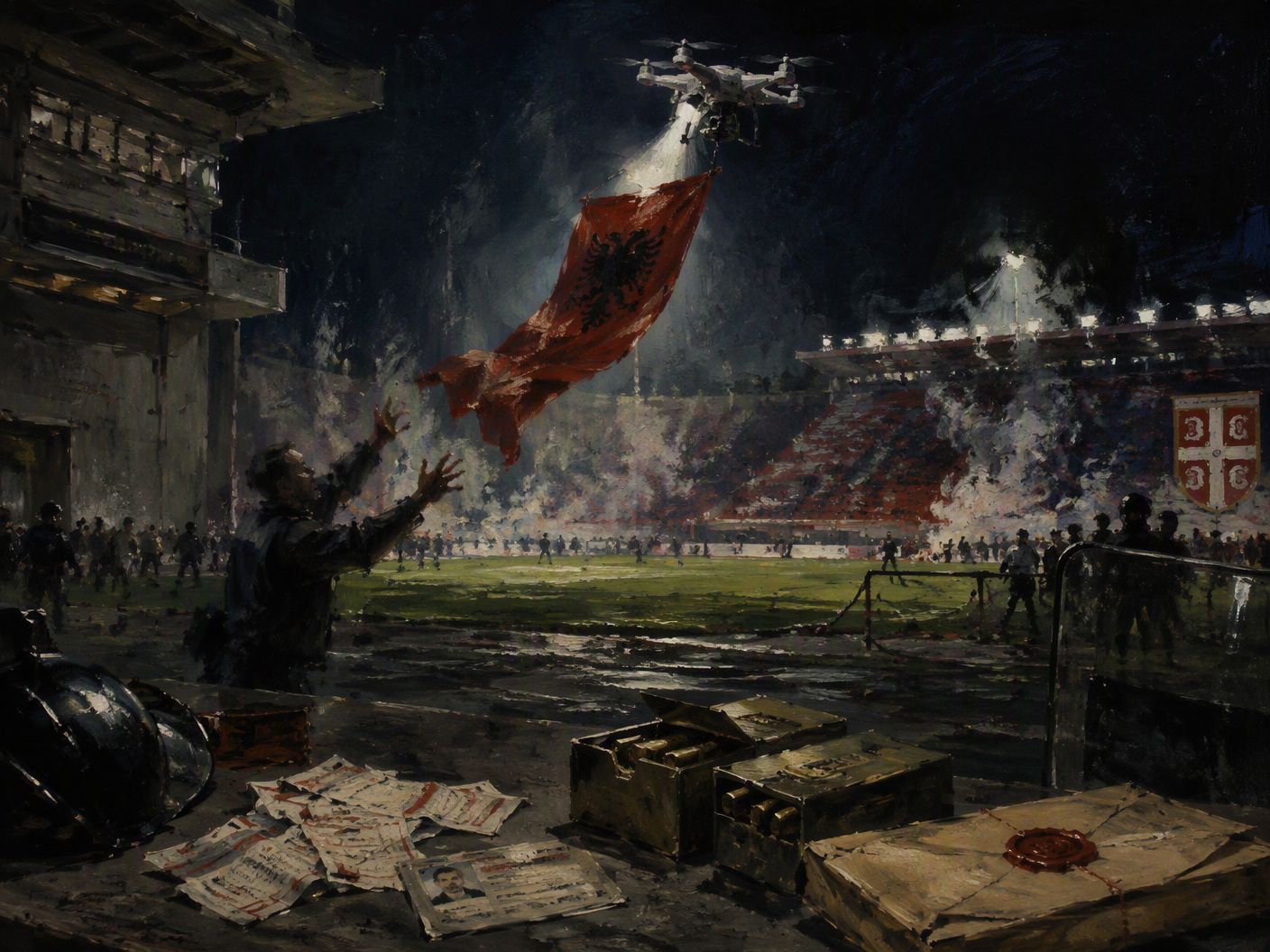
The drone appeared above the Belgrade pitch on the night of 14 October 2014, small enough at first to seem like a technical nuisance and deliberate enough to become something else. Beneath it hung a nationalist banner, suspended over a European Championship qualifier between Serbia and Albania. The match had already carried the pressure of a political border. Now the border entered the stadium from the air, rotating under the floodlights while thousands of spectators watched the object cross the space above the players.
Stefan Mitrovic reached for the flag when the drone came within range. The Serbian defender seized the fabric and pulled it down, bringing the message into the hands of the players below. His action transformed a remote provocation into a physical encounter on the field: a player, a flag and a machine now occupied the same instant. The drone had been untouchable while it hovered overhead. The banner was not. Mitrovic took hold of it, and the match moved toward the crowd.
The response came quickly. Fans and players became involved in violence, and the contest was swallowed by the confrontation surrounding it. Bodies moved across the pitch; the boundary between spectators and participants broke down. A football match designed to contain national rivalry within ninety minutes could no longer hold it there. The drone had delivered its symbol without touching the ground. The struggle over that symbol produced the visible conflict: players drawn into disorder, fans involved in violence, and a sporting event converted into a diplomatic dispute.
The consequences extended beyond the stadium gates. Serbia and Albania were left arguing over the meaning of the incident, the conduct that followed and the responsibilities attached to a match that had become an international confrontation. The machinery of football could impose fixtures and rules, but it could not keep politics outside the turnstiles. In Belgrade, a remote-controlled aircraft had required no passport, no ticket and no permission from the officials below. It crossed into the match carrying a message, and the dispute followed it across the region.
For the next year, the person at the controls remained part of the story without appearing at its center. The drone had been seen. The banner had been seized. The violence had unfolded in public. The operator was elsewhere, hidden behind distance and the anonymity of a device designed to be controlled from the ground. That separation gave the incident its particular shape: the act was spectacular, but the person who executed it was absent.
On 7 October 2015, as Albania prepared to host Serbia in the return fixture, Ismail Morinaj said he had flown the drone over the Serbian stadium the year before. His claim placed a human name behind the machine and recast the episode as an act with an alleged operator rather than an unexplained intrusion from above. The claim also arrived at a moment when the rivalry was preparing to repeat itself, with the previous match's images still attached to every security briefing and political calculation.
Albanian police arrested Morinaj and three other men during a security operation on the eve of the match. The arrests brought the unresolved drama of the Belgrade night into the present tense. Police said they seized two handguns, ammunition and thirty-six match tickets. The objects suggested preparation and danger to the authorities responsible for protecting the fixture, while the arrests placed four men inside a security operation shaped by the memory of violence one year earlier.
The return match was treated as a security problem before a ball was kicked. Albanian authorities deployed more than 2,000 police officers. Identification checks and searches were imposed, and traffic restrictions altered the movement around the stadium. The city was organized around prevention: barriers, inspections, controlled access and the expectation that a symbolic gesture could again become a physical confrontation. The measures showed how far the first match had traveled from the ordinary administration of a football fixture.
Morinaj's statement gave the public a possible pilot, but it did not provide the same certainty as the image of Mitrovic pulling down the flag. The act on the pitch was visible and immediate. The alleged act behind the controls belonged to a different category: a claim made after the event, followed by an arrest during preparations for its sequel. Between those two moments lay the central gap in the story—the difference between identifying oneself with an act and proving that one performed it.
The Serbia–Albania qualifier remains defined by that gap. A machine crossed the stadium, a player grabbed its banner, violence followed, and the dispute moved from the grass into diplomacy and police planning. A year later, authorities responded with arrests, weapons, ammunition, tickets and an extraordinary security deployment. But the person who claimed responsibility remained attached to the incident through his own account, not through a final court finding. The drone's flight lasted minutes. Its political and human afterlife lasted far longer.
Companion notes
What the Belgrade Drone Incident Establishes—and What It Does Not
The incident, the on-field reaction, the ensuing violence and the 2015 security operation are supported by the supplied materials. Morinaj's statement is a reported self-attribution, and the packet contains no charging document, conviction or final judicial finding establishing that he piloted the drone.
The Belgrade Incident
The two Wikipedia reference entries—one on the Albania–Serbia rivalry and one on the specific Serbia–Albania qualifier—describe the same central sequence: a remotely operated drone carrying a nationalist banner appeared over the Belgrade match on 14 October 2014, and Stefan Mitrovic grabbed the flag. The Guardian's contemporaneous institutional archive account reported the drone episode and Mitrovic's intervention as well. The Wikipedia entries are not independent reporting streams: they belong to the same publishing ecosystem and may reproduce overlapping material. The Guardian is a separate publication, but its account supports the event's broad outline rather than independently proving every detail carried by the reference entries. [S1], [S2], [S5]
The supplied materials establish that violence involving fans and players followed the drone incident and that the episode generated diplomatic fallout between Serbia and Albania. They do not assign sole responsibility for every act of violence or establish Mitrovic's intent beyond the physical act of grabbing or removing the flag. More specific descriptions of the banner's political imagery appear in the Wikipedia material, while The Guardian supports the broader characterization of the banner as nationalist. [S1], [S2], [S5]
The Alleged Pilot
The Guardian's 7 October 2015 report identifies Ismail Morinaj as a man who claimed he had flown the drone over the Serbian stadium in 2014. That wording is procedurally important. The source documents a self-attribution; it does not supply a forensic identification, an independently verified flight log, or a judicial finding that Morinaj controlled the aircraft. [S5]
The same report places Morinaj and three other men under arrest during an Albanian police security operation on the eve of the 2015 return match. The record contains no charging document, trial judgment, conviction, or final court determination establishing criminal responsibility for the drone incident. The arrest is therefore an established police action, not proof that Morinaj was the pilot or that the other men participated in the 2014 event. [S5]
Weapons, Tickets and Security
The Guardian attributed the seizure of two handguns, ammunition and thirty-six match tickets to Albanian police. The source does not establish ownership of the weapons, their intended use, whether they were connected to the drone incident, or what later judicial process followed. Those boundaries prevent the seized objects from being converted into proof of a wider conspiracy. [S5]
The report also described the preventive response for the return fixture: more than 2,000 police officers, identification checks, searches and traffic restrictions. These measures are documented as decisions by Albanian authorities. The supplied packet does not independently evaluate their necessity, effectiveness or proportionality, and it does not establish that the security operation resolved the unanswered question of who piloted the drone. [S5]
What the File Leaves Open
The official CAS materials listed in the source set are relevant to the broader UEFA dispute but are not accompanied here by extracted passages that establish the drone pilot's identity or a criminal outcome. The same limitation applies to the additional ESPN citation listed with the arbitration materials. Within the supplied record, the strongest conclusion is therefore narrow: the drone incident and its aftermath occurred, Morinaj claimed responsibility, and police later arrested him with three others. [S3], [S4], [S6]
No source in the record closes the evidentiary chain from Morinaj's statement to verified control of the aircraft. There is no provided conviction or final court finding concerning the alleged pilot. The unresolved identity is not a minor detail: the visible act, the political consequences and the later security response are documented, while the person behind the controls remains a claim attached to an arrest rather than an adjudicated conclusion. [S5]
Source key
The associated evidence packet contains visible source URLs, source roles and the complete claim ledger.