
Scandals & Feuds · 1950s
The 1955 Le Mans Crash and the Race That Continued
On 11 June 1955, a chain of braking, swerving, and evasive movement at the Circuit de la Sarthe became the deadliest accident in the history of the 24 Hours of Le Mans. Pierre Levegh died, 83 people were killed and 120 injured, while the race continued and France moved toward a temporary suspension of motor racing.
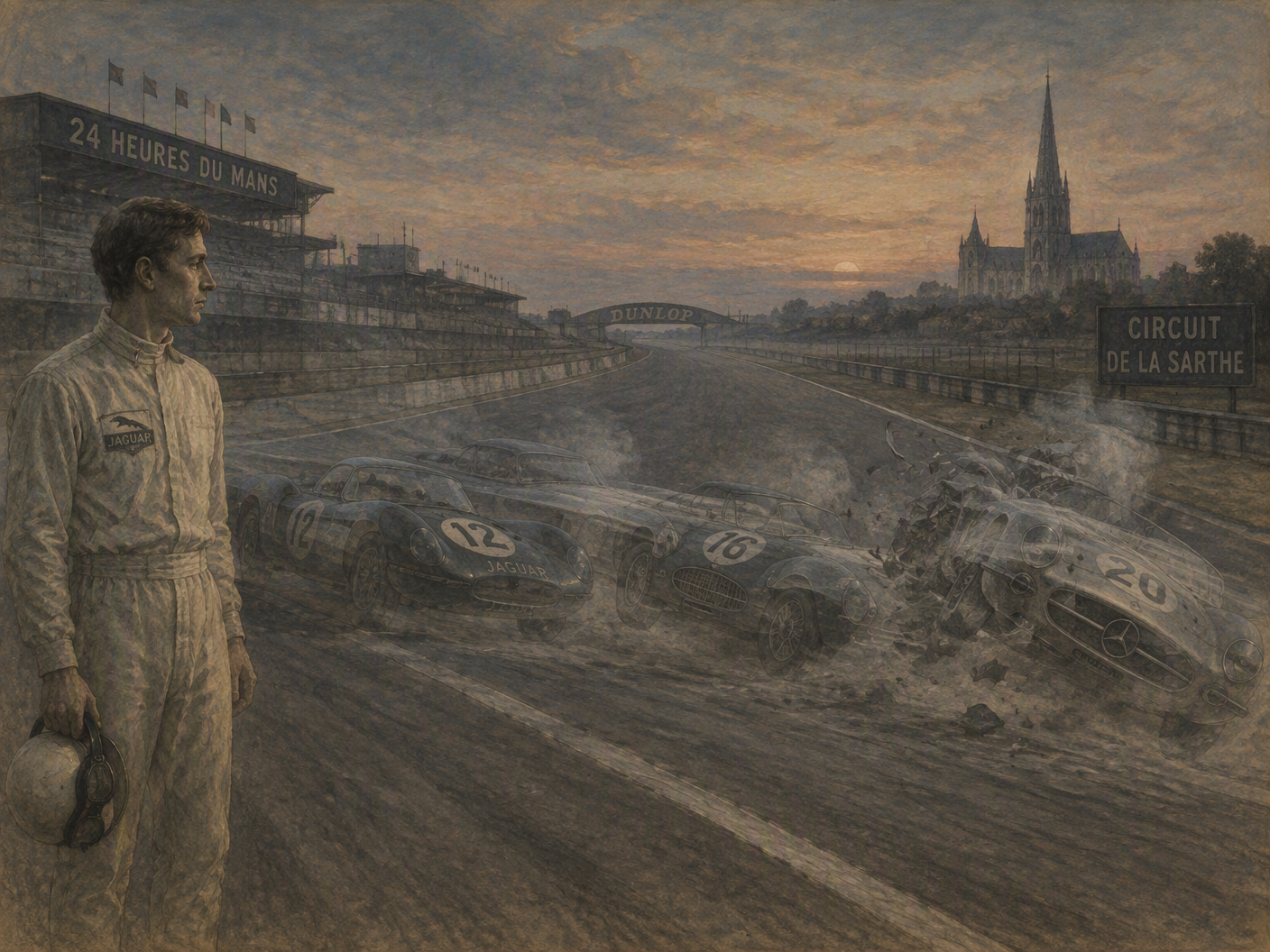
At 6:26 p.m. On 11 June 1955, the 24 Hours of Le Mans changed from a contest of speed into a mass-casualty event. The collision occurred at the Circuit de la Sarthe in Le Mans, where racing cars passed close to the spectator areas at high velocity. Pierre Levegh, driving for Mercedes-Benz, was caught in the crash and died. The collision killed 83 people and injured 120. What followed would be determined not only by the impact itself, but by the decisions made in the seconds before it and by the institutions that chose how the race would proceed afterward.
The sequence began with an ordinary demand of endurance racing: a car needed fuel. Mike Hawthorn, driving a Jaguar, received a signal from his pit crew to stop. He braked in the racing line. The instruction belonged to the practical economy of the race—fuel, timing, position—but its execution brought several cars into the same narrow section of track at once. The people directing Hawthorn knew the race as a series of laps and pit decisions. Within moments, those decisions had become part of a collision that neither the drivers nor the spectators could control.
Lance Macklin was driving an Austin-Healey behind Hawthorn. As Hawthorn slowed, Macklin braked and swerved to avoid him. The movement carried the Austin-Healey across the path of the approaching Mercedes. Levegh’s car entered the developing obstruction, and the collision escalated into a multi-vehicle crash. The reconstruction preserved in the historical record does not reduce the event to a single dramatic gesture. It is a sequence: a pit signal, a braking car, an evasive maneuver, and a high-speed approach that left too little room for correction.
The impact killed Levegh and sent the consequences beyond the drivers themselves. The Circuit de la Sarthe was both a racing course and a public venue, with spectators positioned near the action. The disaster therefore struck people who had come to watch as well as those who had entered the race. Eighty-three people died, and 120 were injured. The numbers describe the scale, but not the division of responsibility among the moving cars, the track arrangement, and the officials who had permitted the event to operate under its existing conditions.
The race did not stop. Race officials kept the 24 Hours of Le Mans running after the collision, even as the dead and injured were being dealt with around the circuit. The decision had an immediate institutional logic: officials considered the continuing race a way to keep roads open for ambulances and emergency vehicles. It also created the defining contradiction of the aftermath. A public catastrophe had taken place inside the event, yet the event itself remained in motion.
Mercedes-Benz withdrew after the crash. The factory team’s departure separated its conduct from the decision of the race administration to continue. Other competitors remained on the circuit, carrying the contest through the night and toward its scheduled conclusion. In the hours that followed, the question was no longer limited to how Levegh’s Mercedes had entered the collision. It extended to the design of the course, the proximity of spectators, the responsibilities of race organizers, and the limits of a sporting institution built around uninterrupted speed.
The immediate public response moved through mourning and official examination. A memorial Mass was held at Le Mans Cathedral for the victims. The service placed the dead within the civic life of the town, beyond the categories of driver, mechanic, official, or spectator. At the circuit, investigators and race authorities had to reconstruct the sequence involving Hawthorn, Macklin, and Levegh. The inquiry did not assign sole blame to one driver. Its importance lay in preserving the event as a chain of actions rather than converting a complicated collision into a simple verdict.
That unresolved question became part of the disaster’s long afterlife. The recorded sequence established Hawthorn’s pit signal, his braking, Macklin’s attempt to avoid him, and Levegh’s fatal involvement. It did not settle individual driver blame in an uncontested judicial finding. Nor did it establish claims that Mercedes had used a lethal fuel additive. Those allegations survived as conspiracy theories, not as findings of the official inquiry. The distinction mattered because the public wanted a culprit, while the surviving reconstruction showed a convergence of movements and conditions.
French authorities responded beyond the circuit. After the disaster, the French government imposed a temporary ban on motorsports until safety standards improved. The suspension recognized that the consequences could not be addressed solely by withdrawing one team or memorializing the dead. Racing required an arrangement among drivers, officials, manufacturers, and spectators, and that arrangement had failed at Le Mans. The ban created pressure for changes in the conditions under which motor racing could be staged, even though the precise allocation of responsibility for the collision remained disputed.
The 1955 Le Mans disaster therefore endured in two forms. It remained a precisely located crash at the Circuit de la Sarthe, beginning with a pit instruction and an evasive maneuver and ending with Levegh’s death and the deaths and injuries of spectators. It also became an institutional boundary: Mercedes-Benz withdrew, the race continued, a cathedral held the mourners, and France temporarily halted motor racing while safety standards were reconsidered. The lasting record is not a single driver’s verdict. It is the documented collision between racing’s demand for continuity and the public cost of allowing it to continue.
Investigative Dossier & Evidence
Read the companion investigation notes, verified source claims, and primary documents.
Read the Companion Notes & Evidence Record →