
Scandals & Feuds · 1994
The Corked-Bat Switch That Trapped Albert Belle’s Team
On July 15, 1994, an umpire confiscated Albert Belle’s bat at Comiskey Park after a challenge from White Sox manager Gene Lamont. The bat examined by officials contained cork, but a later confession revealed that Cleveland teammate Jason Grimsley had entered the umpires’ room and replaced it, turning a league equipment violation into an episode of concealed access, mismatched evidence, and disputed knowledge.
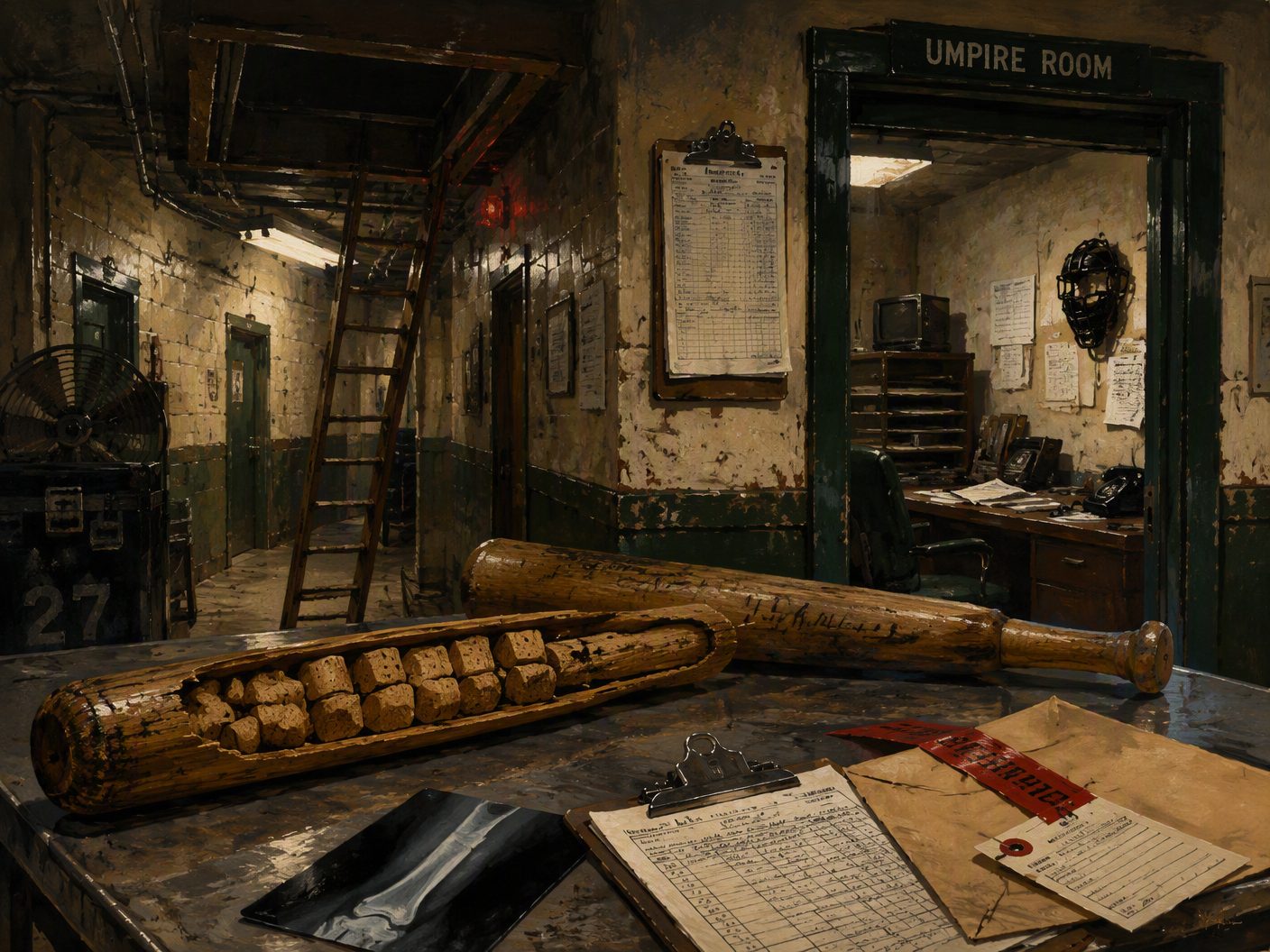
The bat disappeared before anyone could finish deciding what it was. On July 15, 1994, at Comiskey Park, White Sox manager Gene Lamont challenged the bat Albert Belle had been using for Cleveland. The game continued under the hard glare of the Chicago afternoon, but the bat left the field in the hands of umpire Dave Phillips, who confiscated it for inspection. Belle’s name was attached to the equipment, and the question of what lay inside it moved with the bat from the field into the officials’ custody. The dispute had begun with a piece of wood. It would soon become a problem of custody.
Phillips retained the bat while the suspicion moved through the park. The rule at issue concerned whether the equipment had been altered, but the captured accounts do not establish the technical details of that alteration or its competitive effect. Belle did not personally admit that he had used the bat. What existed that afternoon was a challenge from the opposing manager, an umpire’s decision to take the bat out of play, and a question that now belonged to the league rather than the batter’s next at-bat. The object had left Belle’s hands, and the officials’ examination would determine what could be established about it.
At some point after the confiscation, the bat under official control was no longer the same bat Belle had carried. Jason Grimsley, a Cleveland teammate, later said that he reached the umpires’ room through access in the Comiskey Park ceiling or crawl space. The route was not the ordinary path into a locked room. It was a passage through the building itself, above the people working below, allowing Grimsley to reach the evidence and replace it with another bat. The account placed the substitution inside the park’s service architecture, between the moment Phillips removed the bat and the moment officials examined what they believed they had received.
The replacement belonged to Paul Sorrento, another Cleveland player. Its identifying marks eventually exposed the substitution. The name or signature on the bat did not match Belle’s equipment, and the object that had been presented for examination carried the identity of someone else. That mismatch was the small physical error that broke open the larger concealment. In a sport built around individual statistics and recognizable tools—each player’s glove, stance, and bat—the marking on the wood functioned like a misplaced fingerprint. The bat had been moved, but its history had not been erased.
The bat in custody was X-rayed and opened. The examination found cork inside it. For the officials handling the case, the result supplied the substance of the violation, even as the identity of the bat became more complicated. The discovery did not end the matter; it made the question of substitution unavoidable. If the object had been changed, then the examination had established that a corked bat was present in the chain of events, but it had not resolved who had altered which bat, who had known, or how far the knowledge extended inside the Cleveland clubhouse.
Major League Baseball pressed Cleveland for Belle’s original bat. The club ultimately produced it, and the bat was turned over to the league for examination. That second object gave the league the equipment Belle had been using before Phillips confiscated a bat, while the earlier examination remained part of a record involving a substituted piece of wood. The original bat had become a separate object in the story, one that could be compared with the bat already examined. The surviving accounts describe its production and examination, but they do not provide a complete custody file for every stage between the field, the umpires’ room, and the league.
The American League suspended Belle for 10 games in connection with the bat. On appeal, the penalty was reduced to seven. The ruling was administrative, not a criminal conviction, and it addressed Belle’s connection to the equipment violation rather than establishing that he had directed Grimsley’s later substitution. Still, the suspension attached the episode to Belle’s public identity. The slugger’s name remained on the announcement, while the more elaborate machinery of the incident—room access, swapped wood, and delayed disclosure—sat behind the sanction.
For five years, the most consequential movement in the story remained hidden from the public record available at the time. Then, in 1999, Grimsley confessed that he had entered the umpires’ room and switched the bat. His admission supplied the missing action in the sequence: the confiscation, the substitution, the examination, the discovery of the mismatch, and the search for Belle’s original equipment. It also changed the meaning of the corked bat found by officials. The physical evidence had been real, but the object had traveled through hands before the league examined it.
The episode did not settle the question of Albert Belle’s knowledge. In a 2002 account, teammate Omar Vizquel said that Belle’s bats were corked. Belle publicly denied ever using a corked bat. Those statements pointed in opposite directions, but neither independently established what Belle knew about the specific bat taken at Comiskey Park or whether he knew that Grimsley had entered the umpires’ room. The later dispute extended the life of the incident beyond the suspension, keeping the focus on the difference between a player’s equipment, a teammate’s act, and an allegation about intent.
What survived from Comiskey Park was not a single clean scandal but a sequence of compromised objects and competing accounts. Lamont’s challenge began the inspection. Phillips confiscated the bat. Cork was found in the bat presented for examination. Sorrento’s markings revealed that the bat was not Belle’s confiscated equipment. Cleveland produced Belle’s original bat, and the league imposed a suspension that was later shortened. Grimsley’s confession explained the switch; it did not, by itself, answer every question about Belle. The record therefore leaves the central distinction intact: it documents the movement of the evidence more clearly than it establishes Belle’s knowledge of that movement.
Companion notes
What the Comiskey Park Bat Records Establish
The captured record supports the chronology of the confiscation, substitution, cork discovery, original-bat production, and league suspension. It is less conclusive about the underlying league file, the legal status of Grimsley’s entry, and Albert Belle’s personal knowledge or intent.
The confiscation and examination
The Society for American Baseball Research account, the archived CNN/Sports Illustrated report, and the two incident summaries identify July 15, 1994, as the date of the Cleveland–Chicago game at Comiskey Park. They describe White Sox manager Gene Lamont challenging Albert Belle’s bat and umpire Dave Phillips confiscating or retaining it for inspection. Those sources establish the operational event, but they do not record a personal admission by Belle that he used an altered bat. [S2], [S3], [S4], [S5]
The same sources report that the bat in the examination sequence was X-rayed and opened or sawed apart, revealing cork. The captured material does not include the underlying laboratory report, league testing log, or a complete chain-of-custody file. The result is therefore established as a reported examination outcome, while the technical details of the testing and the precise custody record remain unavailable in the supplied evidence. [S2], [S3], [S4]
The substitution and the identifying mark
The 1999 CNN/Sports Illustrated report and the other incident accounts attribute the substitution to Jason Grimsley. They state that he later confessed to reaching the umpires’ room through ceiling, duct, or crawl-space access and replacing the confiscated bat. The replacement is identified as Paul Sorrento’s, with its name or signature exposing that it was not Belle’s bat. The confession is reported five years after the game; the supplied record contains no police report, criminal docket, or adjudication concerning the entry. [S1], [S2], [S3], [S4]
The league response
The incident summaries report that Cleveland ultimately produced Belle’s original bat after league pressure or an order, and that Major League Baseball retained it for examination. They also report an American League suspension of 10 games, reduced to seven on appeal. These facts establish a league disciplinary process and the restoration of the original-bat question. They do not establish a criminal finding, nor do they prove that Belle knowingly directed Grimsley’s substitution. [S2], [S3], [S4]
Later claims about Belle
A 2002 account in the Seattle Post-Intelligencer records teammate Omar Vizquel saying that Belle’s bats were corked, while also reporting Belle’s public denial that he had ever used a corked bat. The incident summary preserves those competing statements. They are attributed later accounts, not independent forensic proof. Neither statement, standing alone, establishes Belle’s knowledge of the particular bat switch or his intent concerning the bat confiscated at Comiskey Park. [S2], [S5]
Source key
The associated evidence packet contains visible source URLs, source roles and the complete claim ledger.