
Tragedy ·
The Death That Stopped Italian Football
After Filippo Raciti died amid violence at the Catania–Palermo derby in February 2007, the federation halted matches indefinitely. Three days later, Catania gathered for his funeral.
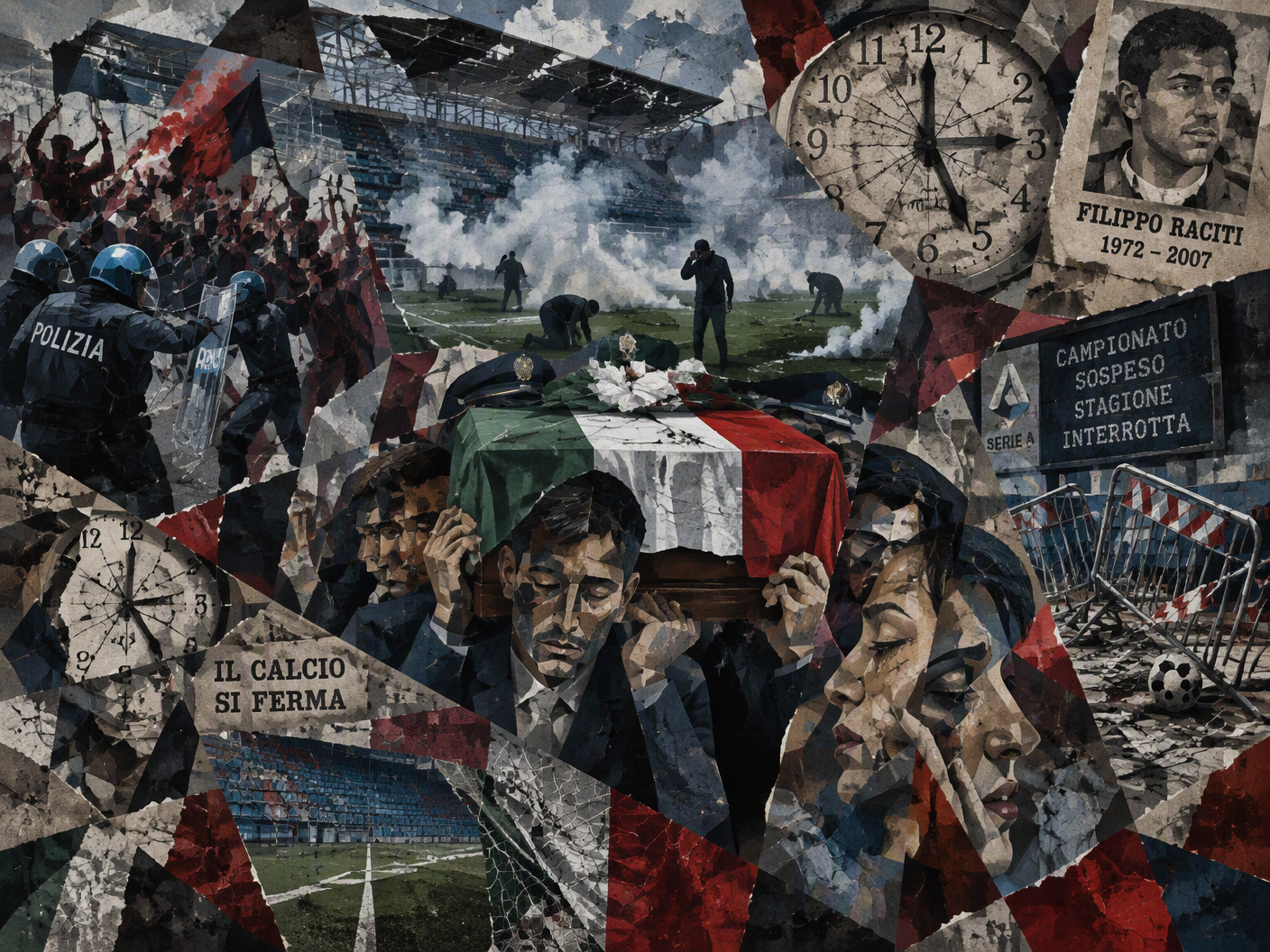
The match in Catania finished; Italian football stopped. On February 2, 2007, Chief Inspector Filippo Raciti, 38, died after violence outside the Sicilian derby between Catania and Palermo. The Italian Football Federation suspended domestic and national-team matches indefinitely. Its commissioner, Luca Pancalli, said a weekend without games would not be enough: “Without drastic measures, we cannot play again.”
The violence had already interrupted the game. Police fired tear gas outside the Angelo Massimino stadium during the second half, and it drifted onto the pitch. Television footage showed players struggling to breathe and pouring bottled water over their faces. The teams went to their dressing rooms, and play stopped for about half an hour. Palermo eventually won 2–1, but fighting continued outside, where rioters threw fireworks and attacked police with makeshift weapons. Fans fled along city streets; hundreds of others were kept inside the stadium as authorities tried to prevent further violence.
Raciti was taken to Catania’s Garibaldi hospital in what its director, Giuseppe Navarria, described as desperate condition. He suffered cardiac arrest. Resuscitation restored some vital functions, Navarria said, but the efforts to save him failed. Raciti was survived by his wife and two children. Early police accounts said an explosive had been thrown into his vehicle, and initial reports attributed his death to it. By February 5, however, a post-mortem had found that a blow from a blunt object caused the injuries that killed him.
Around 100 people, including officers and fans, were reported injured. Prosecutors opened an investigation into Raciti’s killing. ANSA reported that nine Catania fans had been detained, none suspected of killing him. Police defended the security arrangements. “Police did not allow anyone with explosives to enter the stadium,” commander Piero Gambuzza told Sky TG24 News, saying the incidents had occurred outside the ground after the game had begun.
The federation’s suspension reached beyond Serie A to amateur and youth football, as well as scheduled national-team friendlies. “What we’re witnessing has nothing to do with soccer, therefore Italian soccer is stopping,” Pancalli said. He made resumption conditional on identifying stronger measures, rather than setting a date for the next fixtures.
By the following Monday, officials were considering keeping spectators out of stadiums that did not meet recently introduced security requirements. The Olympic committee’s president said clubs that failed to comply with measures including closed-circuit television cameras and turnstiles would not be allowed to host matches. Interior Minister Giuliano Amato warned in an interview with La Repubblica of stadiums left “empty and barred.” These were proposed restrictions and warnings, not a settled account of how football would resume.
In Catania, hundreds of people visited Raciti’s coffin at the police station overnight before his February 5 funeral. Thousands filled the cathedral square, many of them football fans. Mourners clapped as his flag-draped coffin was carried through the square; inside, ministers joined his family and friends for a service broadcast live on Italian television. His 15-year-old daughter, Fabiana, spoke through tears. “You are the very best father,” she said.