
Scandals & Feuds · 1985
Don Denkinger’s Safe Call in the 1985 World Series
With St. Louis three outs from a championship, first-base umpire Don Denkinger ruled Kansas City pinch-hitter Jorge Orta safe on a play television replays indicated was an out. The Royals scored twice, won Game 6, shut out the Cardinals in Game 7, and the call later became part of the broader debate over postseason replay.
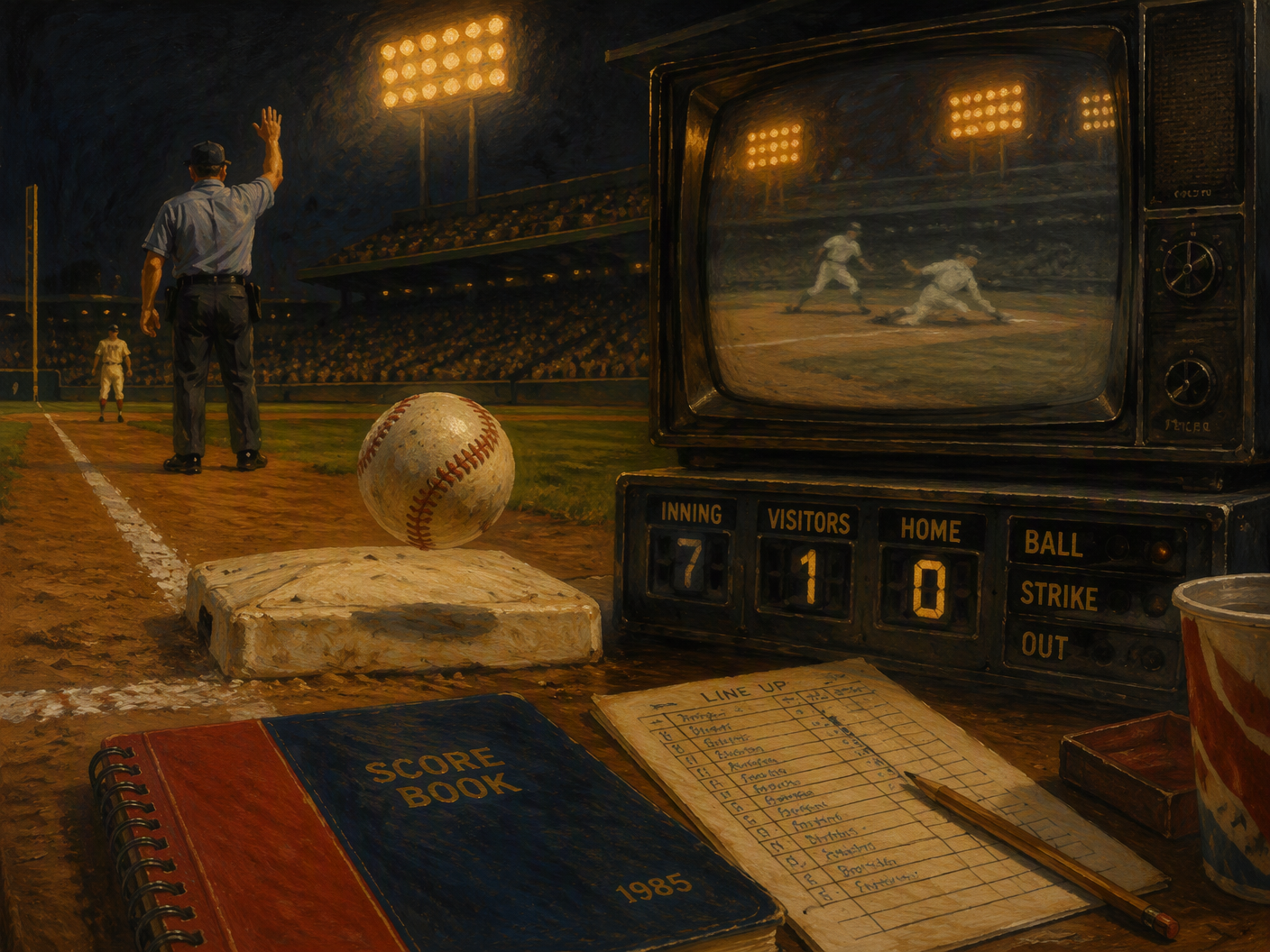
The Cardinals were three outs from the championship when Jorge Orta's ground ball rolled toward first base. It was October 26, 1985, the bottom of the ninth inning at Royals Stadium, and St. Louis held a 1-0 lead in Game 6. Orta, a Kansas City pinch-hitter, ran through the final steps as the ball reached first. Don Denkinger, positioned as the first-base umpire, made the call: safe. The play lasted seconds. Its consequences belonged first to the inning, then to the championship that followed, and eventually to the wider question of whether postseason calls should be reviewable.
On the field, the ruling altered the shape of the inning. Orta remained on first instead of becoming the first out. Kansas City still needed to reach a Cardinals pitching staff that had protected a narrow lead through eight innings. Around the diamond, the game had become a contest of distance measured in outs: St. Louis needed three; Kansas City needed a baserunner, then another break. Denkinger's right arm had settled the first question before the crowd had time to absorb what it had seen.
Television offered a second version almost immediately. Television replays indicated that Orta was out at first, with the ball arriving before his foot reached the bag. The replay did not carry the authority of the umpire's ruling under the rules then in force, and there was no postseason system that could send the televised image back onto the field for an official review. The decision stood. For viewers, the play could be watched again from broadcast angles; for the players and umpires, the inning continued with the disputed runner alive.
The Royals did not win on the call itself. They won the inning that followed. With Orta aboard, Kansas City pressed forward until Dane Iorg came to the plate with the game still within reach. Iorg delivered a two-run single in the bottom of the ninth, bringing home the runs that turned a 1-0 deficit into a 2-1 Royals victory. The winning hit entered the record beside the safe ruling, and the two became fused in public memory even though they were not the same event.
The Cardinals had been close enough to victory for the error to feel like a theft, while the Royals had been close enough to defeat for the ruling to feel like an opening. That distinction mattered to the men who had to finish the game. A baserunner had been given life. A new batter had received an opportunity. Iorg's single completed the comeback. The scorebook recorded Kansas City as the winner, but the replay kept asking a question the scorebook could not answer: what would the inning have looked like if Orta had been called out?
The next evening, the Royals removed the counterfactual from the field with a performance that required no disputed call to explain it. Kansas City defeated St. Louis 11-0 in Game 7. The shutout ended the Series at four games to three and placed the championship in Kansas City. For the Royals, the final margin was enormous. For the Cardinals, the loss remained attached to the ninth inning before it, to the ground ball that television had judged differently, and to the championship that had moved across Missouri.
Denkinger's name became attached to one judgment at first base, but the game contained decisions he had not made. He had not controlled the score, the pitch selection, or Iorg's swing. He had ruled on Orta's arrival at the bag, without the replay tools that would later be used in October baseball. The play could therefore be described in two ways at once: an official decision had sent Orta to first, while television replays indicated that the runner was out. Those two descriptions referred to the same few seconds and remained part of the way the inning was remembered.
At Royals Stadium, the ruling could not be changed after the televised replay became available. The umpire's decision governed the field under the rules then in force, while the broadcast gave viewers another view of the ball and Orta's foot at first base. The two forms of information moved on separate tracks: one directed what happened next in the inning, and the other shaped how the play was examined afterward. The conflict was therefore concrete and limited to the sequence before Iorg's hit, even as it later entered wider discussions about replay in postseason baseball.
Years later, Denkinger supported a different procedure for postseason calls. In 2009, he advocated expanding instant replay so that such calls could be reviewed and corrected. That was his stated position on the use of replay; it did not change the ruling made in 1985, and it did not make the later procedure part of that game. His comments placed the umpire associated with the Orta play on the side of broader postseason review. The position added a later chapter to the story without resolving the alternate question of what a different call would have produced in the ninth inning.
The safe call remained visible in later accounts of the rivalry. At a 2012 event, actor Jon Hamm, a Cardinals fan, wore a Royals jersey bearing Denkinger's name, turning the old play into a public joke with the umpire's name printed across the back. Denkinger later appeared at sports memorabilia shows, including events in St. Louis, where the call remained part of the culture surrounding the Cardinals and Royals. These appearances gave the episode a life beyond the 1985 scorebook: the ruling could be recalled through a jersey, a signing table, or the name attached to the first-base signal.
What remains is not a simple story in which one umpire handed over a World Series. Kansas City won Game 6, 2-1, on Iorg's two-run single and won Game 7 by eleven runs. Television replays indicated that Denkinger's safe ruling at first was an out, and the inning continued after that ruling before the Royals produced the winning hit. Denkinger later advocated expanded postseason replay, but his comments establish his position rather than a verdict on the 1985 counterfactual. The play was brief; the record preserves both the call and the events that followed it.
Companion notes
What the Orta Call Establishes—and What It Cannot Prove
The public record firmly establishes the game situation, Denkinger’s ruling, the replay evidence, and Kansas City’s two-game finish. It does not establish that the call alone determined the championship or that Denkinger acted intentionally.
The Game Situation and the Ruling
The accounts of the 1985 World Series in Wikipedia’s entries for “The Call” and the 1985 World Series consistently place the Cardinals ahead 1-0 entering the bottom of the ninth inning of Game 6. Those sources identify Jorge Orta as Kansas City’s pinch-hitter, describe his ground ball toward the right side, and record Don Denkinger’s safe ruling at first base. The Washington Post provides journalistic corroboration of the game situation and the call’s continuing importance in the rivalry. [S1], [S3], [S5]
The surviving MLB-captured video record, preserved through Ghostarchive, directly shows the play and identifies the ruling. That institutional video is the strongest source for what occurred at first base itself. The surrounding written accounts are useful corroboration, but the evidentiary claim should remain limited to the call and its context rather than expand into an assertion about Denkinger’s intent or competence generally. [S4], [S1], [S3]
Replay Evidence and Causation
The written accounts state that television replays indicated Orta was out at first. Bleacher Report’s retrospective compilation and the Wikipedia accounts describe the replay evidence in those terms, while The Washington Post treats the incident as one of baseball’s enduring blown calls. This establishes a discrepancy between the ruling and the televised replay. It does not establish intentional misconduct, collusion, or any criminal or disciplinary violation by Denkinger. [S1], [S3], [S5], [S6]
The same sources establish that Dane Iorg’s two-run single produced a 2-1 Kansas City victory. They do not prove the counterfactual claim that a correct out call would necessarily have changed the inning, Game 6, or the championship. That boundary is essential: the call preceded the winning hit and changed the available game state, but the record cannot replay the inning under alternate conditions. [S1], [S3], [S5], [S6]
Game 7 and the Championship Result
The result of the Series is independently established. The 1985 World Series accounts record Kansas City’s 11-0 victory in Game 7 and the Royals’ four-games-to-three championship. That result complicates any claim that the Orta ruling alone decided the title: Kansas City completed the Series with a decisive shutout, even though the Game 6 call remained the central point of public argument. [S1], [S3], [S6]
The Replay Debate and Cultural Afterlife
NBC Sports’ 2009 report documents Denkinger’s stated support for expanding instant replay so postseason calls could be reviewed and corrected. The report establishes his position, not an MLB policy change caused solely by the 1985 incident. It also places his comments within a broader concern about postseason umpiring, making the episode relevant to institutional procedure rather than merely to one disputed play. [S7]
The call’s later cultural presence is supported by The Washington Post’s account of Jon Hamm wearing a Royals jersey bearing Denkinger’s name at a 2012 event and by the biographical account of Denkinger’s later appearances at sports memorabilia shows, including in St. Louis. These examples demonstrate continuing public memory, not universal opinion or a measurable consensus among Cardinals and Royals fans. [S2], [S5]
Source key
The associated evidence packet contains visible source URLs, source roles and the complete claim ledger.