
Point Shaving & Fixes · 1960s–1970s
Black Mist: The Bribes, Arrests and Lifetime Bans in Japanese Baseball
A bribery finding against a Nishitetsu Lions pitcher became a wider crisis involving baseball, race fixing and illegal gambling. Police pursued players across several clubs while Nippon Professional Baseball’s executive committee imposed lifetime exclusions.
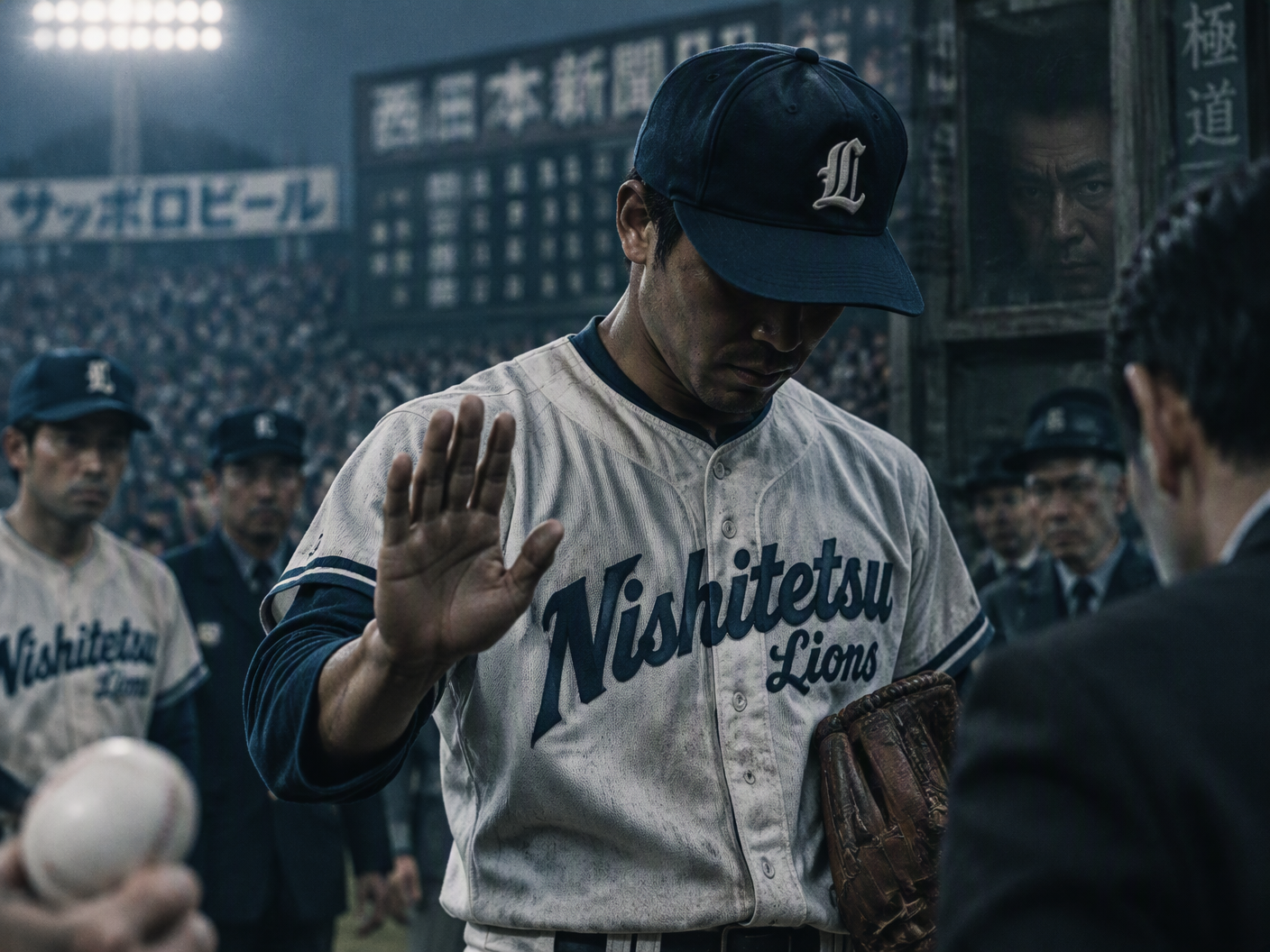
On October 7, 1969, the Nishitetsu Lions found that pitcher Masayuki Nagayasu had taken bribes from a yakuza clan to throw games. An organized-crime group had paid a player to work against the competitive purpose of his employment. The discovery put responsibility directly before the club and, beyond it, the officials who controlled admission to Japanese professional baseball. What became known as the Black Mist scandal began with that concrete transaction: money accepted by a pitcher in exchange for corrupting games he had been entrusted to play.
On November 28, Nippon Professional Baseball’s executive committee banned Nagayasu for life. The committee used its authority over league participation to impose a consequence extending beyond his place with the Lions. He could not simply leave the club and resume his career elsewhere in the league. The payment had crossed the boundary between an outside criminal organization and a player; the punishment operated across the clubs themselves. Within two months of the Lions’ finding, baseball’s governing officials had converted an internal discovery into permanent exclusion from their competition.
The next spring brought police action involving another sport. On April 22, 1970, authorities arrested Chunichi Dragons pitcher Tsutomu Tanaka, Taiyō Whales pitcher Isao Takayama and yakuza member Hirotaka Fujinawa on suspicion of participating in a race-fixing scheme. Two baseball employers and an organized-crime associate now appeared in the same inquiry. The suspected manipulation concerned racing rather than the baseball games the pitchers were paid to play. Black Mist was expanding beyond a club’s ability to inspect its own competition: investigators were pursuing alleged conduct involving players away from their principal sport.
On May 6, police arrested another Chunichi pitcher, Kentarō Ogawa, over alleged participation in flat track fixing. His arrest placed a second Dragons pitcher within the racing inquiry less than a month after Tanaka’s detention. That sequence gave the scandal a reach that Nagayasu’s expulsion alone could not address. Excluding a player from baseball governed where he could work; investigating a race-fixing scheme required police to pursue conduct outside baseball’s schedule and jurisdiction. Club affiliation identified the athletes, but it did not define the limits of the suspected activity.
Baseball’s executive committee continued to exercise its own power. On May 25, it banned Masaaki Ikenaga, Yoshinobu Yoda and Akio Masuda for life. Ikenaga, like Nagayasu, was a Nishitetsu Lions pitcher. The committee’s decision made permanent exclusion a sanction imposed on several men rather than the response reserved for the first player exposed. For each, the immediate professional consequence was plain: the governing body had closed access to baseball without setting a return date. The word “life” placed their future eligibility under an authority far beyond an individual manager’s choice.
The legal proceedings also extended to gambling itself. On July 1, Kintetsu Buffaloes outfielder Masahiro Doi was prosecuted for illegal gambling. His case added another club and another kind of proceeding to the widening scandal. Prosecutors were pursuing a gambling offense, while other players had been arrested on suspicion of fixing races and the executive committee had issued its exclusions. Those actions placed different demands on the men involved: answering a prosecution, facing a police investigation or confronting the loss of permission to continue a professional career.
On September 8, police arrested Yakult Swallows infielder Takeshi Kuwata in the flat track scandal. Nearly a year after the Lions’ discovery, another baseball player was drawn into the racing investigation. The sequence now encompassed pitchers, an outfielder and an infielder employed by several clubs. It also encompassed distinct conduct: accepting bribes to throw baseball games, suspected participation in fixing races and illegal gambling. Black Mist supplied a common name for the crisis, while police, prosecutors and baseball officials acted against particular people through their separate powers.
Half a century earlier, American prosecutors had pursued a baseball-fixing case through an allegation of fraud against the public. In the Black Sox case, they charged players and non-player defendants with conspiring to manipulate the 1919 World Series and obtain money by false pretenses. The accused Chicago players were Edward V. Cicotte, Claude Williams, Joe Jackson, Fred McMullin, Arnold Gandil, George Weaver, Oscar Felsch and Charles Risberg, all employed by the American League Baseball Club of Chicago. The prosecution’s theory connected the alleged agreement among participants to money obtained from people outside it.
That American prosecution framed manipulated competition as a means of extracting money under a false premise. In Japan, the Lions’ finding against Nagayasu exposed the payment at the player’s end: a yakuza clan had bribed him to throw games. The executive committee’s response addressed his continued access to the sport. Police pursued the separate racing allegations, and prosecutors brought Doi’s gambling case. The institutional responses followed different paths because control over a baseball career, authority to arrest and authority to prosecute belonged to different decision-makers.
For the banned players, baseball’s decision reached beyond the period of arrests and prosecutions. A lifetime exclusion had no scheduled expiration; returning required the institution to change the status it had imposed. Ikenaga eventually received that change. He was reinstated in 2005, thirty-five years after the executive committee’s May 1970 decision. By then, the interval itself had become an enduring consequence of the sanction. Reinstatement reopened his formal place in baseball after decades of exclusion. It could change his eligibility, but it could not return the years during which the ban had governed it.
Investigative Dossier & Evidence
Read the companion investigation notes, verified source claims, and primary documents.
Read the Companion Notes & Evidence Record →