
Tragedy · 1990s
The Auburn Sports Arena Fire During the 1996 LSU Game
On September 21, 1996, LSU defeated Auburn 19–15 at Jordan-Hare Stadium while the old Auburn Sports Arena burned to the ground across the street. The fire entered the national broadcast, interrupted the afternoon with a public warning, and left behind an officially undetermined cause.
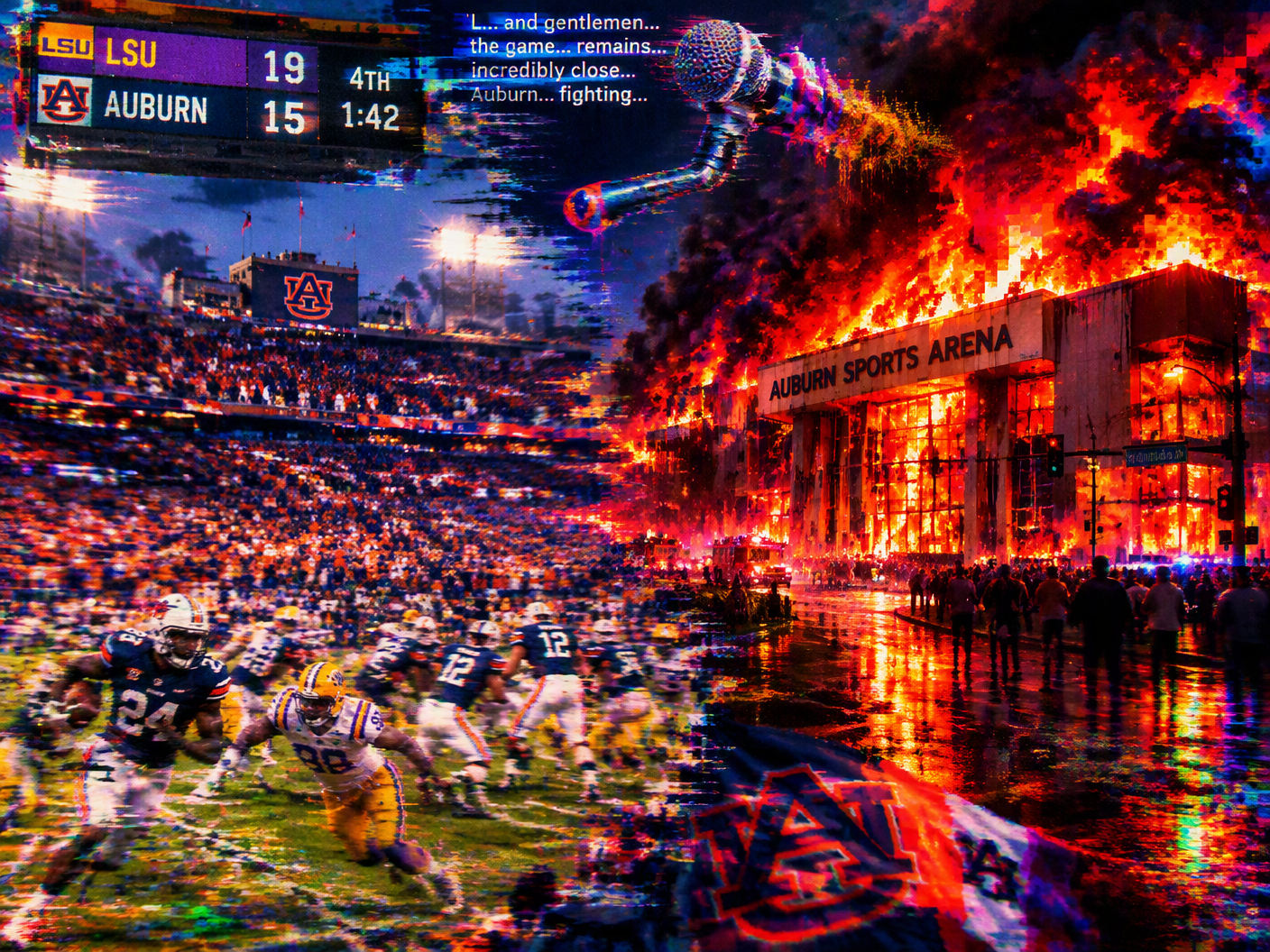
On September 21, 1996, while Auburn and LSU were playing at Jordan-Hare Stadium in Auburn, Alabama, the old Auburn Sports Arena caught fire across the street. The building, known locally as the Barn, burned to the ground as the football game continued. Inside the stadium, the public address announcer told spectators that the flames were outside. The announcement drew a boundary between the contest and the emergency beyond the stadium walls, but the two events could not remain separate for long. The fire was visible, close enough to become part of the broadcast and the game’s permanent public memory.
The afternoon had two centers of attention. On the field, the Auburn Tigers were playing the LSU Tigers in a game that would be decided by four points. Across the street, the Auburn Sports Arena was being consumed. The arena’s older name mattered because the Barn was not an anonymous structure in the campus landscape; it was a recognized Auburn place, and its destruction gave the fire a meaning beyond the loss of a building. What spectators saw was not a distant accident reported after the final whistle. It unfolded alongside the football contest, within the same campus view.
The public address announcement was brief and functional: the flames were outside the stadium. It did not stop the game or turn the football field into the scene of the emergency. Instead, it gave the crowd a location and a limit. The danger, as presented to spectators, was beyond the stadium. That distinction allowed play to continue while the burning arena became an object of attention in its own right. The fire and the game therefore proceeded in parallel, joined by proximity rather than by any documented change to the contest’s rules or schedule.
The television audience saw the same collision of ordinary competition and sudden destruction. ESPN’s national broadcast showed the fire during the game, carrying the burning arena beyond Auburn and into the wider sports audience. The broadcast made the episode difficult to file as a local interruption. Viewers could follow the football score while seeing that another institution—an arena associated with Auburn—was disappearing across the street. The image supplied the event’s enduring shape: a rivalry game under way, a campus building burning, and no clean sequence in which one event waited for the other to finish.
For the people inside Jordan-Hare Stadium, the warning came from the public address system rather than from a formal interruption of play. The announcer identified the flames as being outside, and the game remained the organizing fact for the crowd. That arrangement reflected the circumstances of the afternoon as they were understood in real time. The stadium had a football contest to conduct, while the fire was an adjacent emergency. Nothing in the documented outcome shows that officials later treated the blaze as a reason to revise the game’s administration.
Across the street, the old arena did not survive the fire. It burned to the ground during the contest, reducing a familiar Auburn structure to the central physical loss of the afternoon. The event’s scale was therefore not limited to smoke or a temporary blaze visible from the stadium. The Barn was destroyed while the teams played. That simultaneous destruction explains why the fire remained attached to the game in later accounts: the building’s end and the football result belonged to the same September afternoon.
The cause proved less definite than the image. The fire was officially classified as undetermined. Investigators considered a grill placed too close to the building by tailgaters the most probable cause, but probability did not become a final official attribution. No conclusive ignition source or responsible party entered the public account as settled fact. The distinction is important because the episode has the outline of a familiar tailgating accident, yet its official conclusion remained open. The Barn burned; the reason it ignited did not receive the same certainty.
That uncertainty did not diminish the physical fact of what spectators had witnessed. A building across from the stadium had burned away during a nationally visible college football game. The public explanation could point toward a grill set too close by tailgaters, but the official status remained undetermined. Auburn’s campus emergency and Auburn’s football afternoon were thus preserved in different forms: one as a destroyed arena with no conclusive cause, the other as a completed contest with a score that required no later interpretation.
On the field, LSU finished with a 19–15 victory over Auburn. The narrow margin gave the game its competitive result, but the fire gave the afternoon its unusual historical burden. LSU’s win could be entered in a schedule and compared with other scores. The arena’s destruction could not be reduced so easily. It was a parallel event that remained visible during play, entered the national broadcast, and followed the game into later rivalry memory. The two facts were connected by time and place, not by a documented ruling that the fire altered the outcome.
The final arrangement of the story is therefore precise. Jordan-Hare Stadium hosted the Auburn–LSU game on September 21, 1996. LSU won 19–15. Across the street, the old Auburn Sports Arena—the Barn—burned to the ground while the contest was in progress. The public address announcer told fans the flames were outside, and ESPN showed the fire to a national audience. Investigators regarded a tailgater’s grill placed too near the building as the most probable source, while the official cause remained undetermined. The score endured as a result; the fire endured as an unresolved event attached to it.
Investigative Dossier & Evidence
Read the companion investigation notes, verified source claims, and primary documents.
Read the Companion Notes & Evidence Record →