
Scandals & Feuds · 2018
The Camera Feed and Trash-Can Signals MLB Found in the Astros’ Sign-Stealing Operation
MLB found that Houston used a live center-field camera feed to decode opponents’ signs during the 2017 regular season and postseason, with electronic sign-stealing methods continuing during part of 2018. The league’s findings led to organizational sanctions, but did not identify the 2018 American League Championship Series as a specific setting for the conduct or establish its effect on that series.
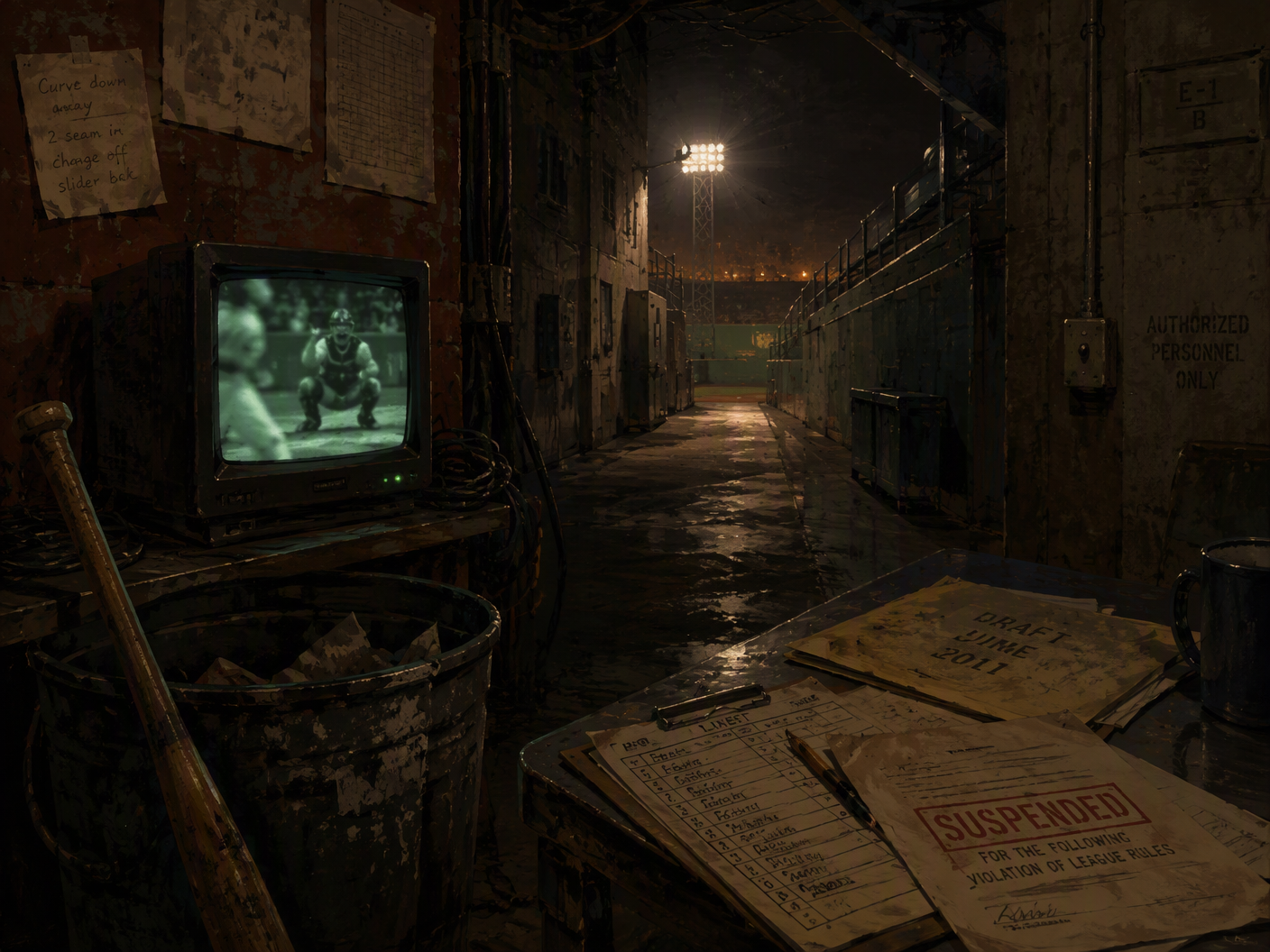
The signal began with a camera pointed from center field toward the catcher. Somewhere behind the action, Astros personnel watched the live feed and translated the sequence of fingers into a pitch: fastball, slider, changeup. The information traveled back toward the dugout, where a bat or another object struck a trash can. One sound could mean one pitch. The batter did not need to see the catcher’s hand. He needed only to listen for the answer before the ball left the pitcher’s hand.
Baseball has always been built around concealed information. A catcher hides the signs because the next pitch is a private negotiation between two players, a small piece of knowledge that can determine whether a hitter is early, late, fooled, or ready. The Astros moved that negotiation into an electronic room. Their advantage was not a stolen glance from a runner on second base. It was a live camera, a decoding process, and a crude percussion system that converted technology into sound.
The system operated during Houston’s 2017 regular season, then followed the club into the postseason. The Astros were no longer merely trying to win games inside the rules of ordinary sign stealing; MLB found that personnel used the center-field feed to identify opposing signs in real time. The postseason brought brighter lights, fuller stands, and a national audience, but the machinery remained close to the field: camera image, decoded sign, hard knock against metal, hitter waiting in the box.
Mike Fiers, who had pitched for Houston, later described seeing the camera-assisted operation in 2017. Danny Farquhar, then with the Chicago White Sox, separately described observing the system from the other side of the sport’s invisible boundary. Their accounts brought two different vantage points to the same mechanism: a camera watching the catcher, information moving toward the dugout, and a signal intended to reach the hitter before the pitch arrived.
The possibility had not been entirely invisible to opponents. Before the 2017 World Series, Dodgers personnel had heard speculation that Houston might be using methods beyond the ordinary gamesmanship of reading signs from the bases. Los Angeles president of baseball operations Andrew Friedman said the club had nothing definitive at the time. Suspicion existed in the corridors of the sport, but suspicion did not stop the Series, and it did not yet expose the system that MLB would later describe.
The operation did not end with the 2017 season. MLB found that electronic sign-stealing methods continued during part of 2018, extending the life of the system into another season and another competitive landscape. The finding reached into 2018, but it did not identify the American League Championship Series as a particular scene of the conduct or establish how the system affected that series. The boundary mattered because October suspicion had begun to outrun what investigators could attach to a specific game.
By then, the central question was no longer whether a clever player had stolen a sign. It was who had built an environment in which a camera could become part of the competitive equipment. The answer reached beyond the batter’s box to the organization’s hierarchy: the general manager, Jeff Luhnow; the manager, A.J. Hinch; and the employees who operated within a club that had made information a form of industrial advantage.
In January 2020, MLB suspended Luhnow and Hinch for the 2020 season and fined the Astros $5 million. The league also removed Houston’s first- and second-round selections in both the 2020 and 2021 drafts. The punishment reached into the future: not only the people who had occupied the dugout and front office, but the young players the organization hoped to acquire years later would feel the cost of what had happened beside the trash can.
The Astros then fired Luhnow and Hinch. Their departures were an organizational decision, separate from the suspensions imposed by MLB, but they carried the same institutional message: the operation had become inseparable from the leadership that had presided over the club. The championship banners did not disappear. The machinery behind the competitive advantage had been named, penalized, and removed from the structure that had housed it.
The players occupied a different legal and investigative position. MLB gave them immunity in exchange for cooperation and did not discipline them. That decision did not mean players had stood outside the operation; it meant the league chose testimony over individual punishment while investigating a workplace whose chain of responsibility ran through coaches, managers, executives, and players. The immunity protected the evidence-gathering process, while leaving the public with an uncomfortable division: the people closest to the signals could speak without suspension, and the organization paid for the system.
A later allegation carried the story toward another season. Claims circulated that Astros players had used wearable buzzer devices in 2019, a more intimate version of the same fantasy: information arriving beneath the uniform, hidden from everyone watching the game. MLB found no evidence that such devices had been used during that season. The finding separated the confirmed camera-and-signal operation of 2017 and part of 2018 from a later theory that became attached to the scandal’s afterlife.
What remained was a system whose physical simplicity made its institutional failure harder to obscure. A camera saw what the pitcher and catcher meant to keep private. Someone decoded it. Someone made the sound. Someone in the batter’s box waited for the answer. The penalties came years after the first signals, and the 2018 ALCS remained without a documented placement inside the operation. The scandal’s lasting fact was not that technology had entered baseball; it was that an organization had allowed technology to turn secrecy into a routine part of play.
Companion notes
What MLB Established About the Astros’ Electronic Sign Stealing
MLB’s January 2020 investigation established a camera-assisted sign-decoding system during the 2017 regular season and postseason, with electronic methods continuing into part of 2018. The available evidence does not establish that the system was used specifically during the 2018 ALCS.
The institutional finding
The central conclusion came from MLB’s investigation announced by Commissioner Rob Manfred in January 2020 and summarized in the league’s disciplinary ruling. The finding was institutional rather than merely an unadjudicated allegation: Astros personnel used a live center-field camera feed to decode opposing signs during the 2017 regular season and postseason. The Chicago Tribune’s account of the investigation and USA Today’s contemporaneous reporting describe the same mechanism and the resulting sanctions. [S2], [S4], [S6]
How the relay worked
The evidence distinguishes two stages. The camera supplied electronic access to the catcher’s signs; the relay to hitters used audible signals, including banging a bat or object against a trash can. MLB’s findings and the reporting collected by the Chicago Tribune describe that division between acquisition and communication. Former Astros pitcher Mike Fiers and former White Sox pitcher Danny Farquhar provided separate witness accounts of the camera-assisted system during 2017. Their observations support the mechanics they described, but they should not be expanded beyond those observations. [S2], [S4], [S5], [S6]
The 2018 boundary and the World Series suspicion
MLB found that electronic sign-stealing methods continued during part of the 2018 season. Neither the cited MLB summaries nor the supporting reporting identifies the 2018 American League Championship Series as a specific location of the conduct or establishes its effect on that series. Separately, the Los Angeles Times reported that Dodgers personnel had heard speculation before the 2017 World Series that Houston used methods beyond ordinary sign stealing. Dodgers president of baseball operations Andrew Friedman said the club had no definitive evidence at the time. That is evidence of contemporaneous suspicion, not proof that the system operated in that World Series. [S2], [S5], [S6]
Punishment, immunity, and later allegations
MLB suspended general manager Jeff Luhnow and manager A.J. Hinch for the 2020 season, fined the Astros $5 million, and removed the club’s first- and second-round selections in the 2020 and 2021 drafts. The Astros then fired Luhnow and Hinch, an employment decision separate from the league’s ruling. MLB did not discipline Astros players because it granted them immunity in exchange for cooperation. That procedural choice does not establish that players did not participate; it explains why player testimony was obtained without player suspensions. [S2], [S4], [S6]
The sanctions were administrative and organizational. The cited sources do not report criminal charges or a criminal conviction arising from the sign-stealing operation. MLB also reported finding no evidence that Astros players used wearable buzzer devices during the 2019 season. That conclusion addresses a later allegation and should not be merged with the camera-assisted conduct MLB established for 2017 and part of 2018. [S6]
Source key
The associated evidence packet contains visible source URLs, source roles and the complete claim ledger.