
Tragedy · 1830s
Simon Byrne’s Final Prize Fight and James Burke’s Manslaughter Acquittal
On 30 May 1833, Simon Byrne and James Burke fought 99 rounds at Nomansland, Hertfordshire. Byrne collapsed unconscious, died three days later, and left Burke to face a manslaughter prosecution that ended in acquittal.
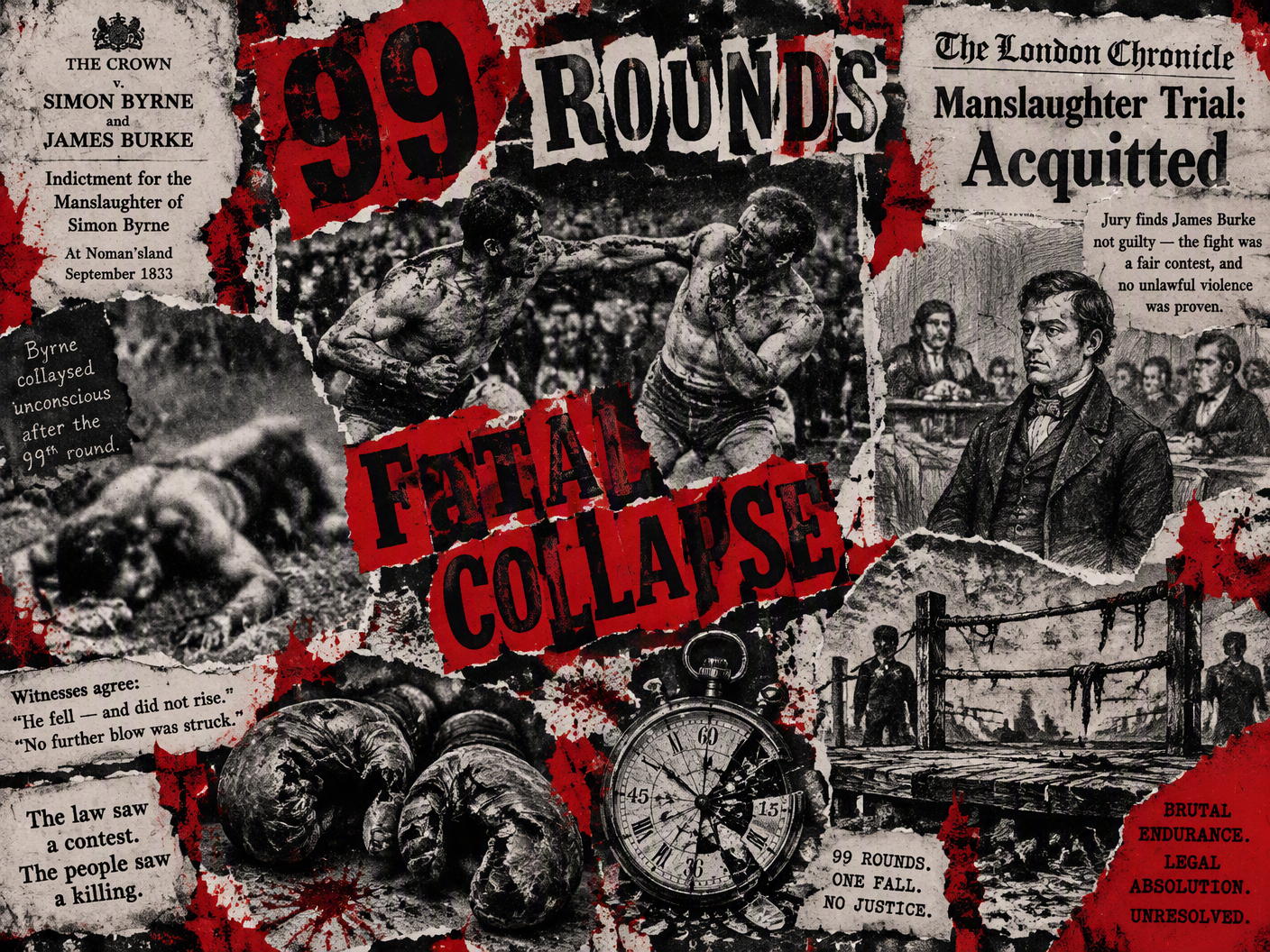
On 30 May 1833, at Nomansland in Hertfordshire, Simon Byrne and James Burke entered the ring for a bare-knuckle prize fight that would carry one man to death and the other into a criminal court. They were not separated by a brief exchange or a single decisive blow. The contest continued for 3 hours and 6 minutes, passing through 99 rounds before Byrne collapsed unconscious in the last of them. The fight ended there, but its consequences moved on: first to an inn in St Albans, then to a death three days later, and finally to a prosecution at Buckingham.
Byrne was an Irish prize fighter whose livelihood depended upon the public willingness to pay for prolonged physical contests. Burke was his opponent, and the terms of their meeting belonged to the prize-fighting culture of early nineteenth-century Britain, where bare hands, agreed stakes, and endurance formed the visible structure of the event. The fight was conducted at Nomansland on a single day, but its duration gave it the character of an extended ordeal. Round followed round until the contest had occupied more than three hours.
The surviving detailed account places the decisive moment in the 99th round. Byrne collapsed unconscious, ending the bout without a conventional continuation. That point matters because later retellings compressed the fight into different numbers, sometimes placing its conclusion in the 27th or 28th round. The fuller account preserves a contest of 99 rounds and 3 hours and 6 minutes. Within that chronology, the central fact is fixed: Byrne remained in the fight until he lost consciousness in its final round.
After the fight, Byrne was carried to The Woolpack inn in St Albans. Tom Spring, a prominent boxing figure who had been in Byrne’s corner, attended him after the bout. The movement from the fighting ground to the inn marked a change in the nature of the event. At Nomansland, Byrne’s condition had been part of a contest governed by rounds and decisions. At The Woolpack, those arrangements no longer offered a way forward. He had been removed from the ring, but he had not recovered consciousness.
The interval between the fight and Byrne’s death lasted only three days. On 2 June 1833, he died in St Albans. His reported cause of death was brain damage, also expressed as congestion of blood in the brain. The language belonged to the medical vocabulary of the period, but the sequence required no elaborate interpretation: a fighter endured a long bare-knuckle contest, collapsed unconscious in its 99th round, was carried away, and died soon afterward.
Byrne’s death altered the legal position of everyone connected to the bout. The contest could no longer be treated only as a sporting engagement that had ended with an injured participant. James Burke was arrested and later tried for manslaughter. The charge placed the fatal outcome before a criminal court, where the question was not simply whether Byrne had been badly hurt, but whether Burke bore legal responsibility for his death under the law then in force.
The trial took place at Buckingham on 11 July 1833, more than a month after the fight. By then, the event had acquired two separate histories. One belonged to the prize ring: the location, the rounds, the duration, and Byrne’s collapse. The other belonged to the courts: an arrest, a manslaughter charge, and the examination of Burke’s responsibility. Those histories met in the courtroom, but they did not end at the same conclusion.
Burke was acquitted of manslaughter. The verdict established the legal result of the prosecution: he was not convicted for Byrne’s death. It did not erase the fight, the collapse, or the fatal injuries that followed. Nor did the acquittal convert the death into an accident with no human actions attached to it. It settled the criminal case in Burke’s favor while leaving the public memory of the bout tied to the death of the man who had stood opposite him.
The distinction between physical consequence and legal guilt is central to Byrne’s final story. Byrne suffered the injuries that preceded his death, and the reported medical explanation identified damage to the brain or congestion of blood within it. Burke fought him at Nomansland and was later prosecuted. But the court acquitted Burke, and no conviction established that he had committed manslaughter. The event therefore survives in a narrow form: a documented fatal fight followed by a criminal charge that did not produce a guilty verdict.
What endured was not a single uncontested legend about every moment inside the ring. The round count, the duration, and the final collapse provide the firm sequence: 99 rounds, 3 hours and 6 minutes, then Byrne unconscious. The later legal sequence is equally clear: death on 2 June, Burke’s arrest and manslaughter trial, and acquittal at Buckingham on 11 July. Between those points, the surviving accounts do not supply a courtroom finding that Burke was guilty or a complete reconstruction of the blow that caused the fatal injury.
Simon Byrne’s last fight thus remained suspended between two institutions with different ways of measuring an outcome. The prize ring measured endurance until Byrne could no longer continue. Medical language named the injury that followed. The criminal court measured responsibility and returned an acquittal. The fight’s place, duration, and ending continued to be repeated, while the legal aftermath fixed James Burke’s place in the case not as a convicted killer, but as the defendant who was tried and found not guilty of manslaughter.
Investigative Dossier & Evidence
Read the companion investigation notes, verified source claims, and primary documents.
Read the Companion Notes & Evidence Record →