
Scandals & Feuds · 2013
The Break Back That Sent Rafael Nadal Past Novak Djokovic at Roland Garros
Rafael Nadal recovered from a break down in the fifth set and defeated Novak Djokovic 9–7 in the 2013 French Open semifinal at Roland Garros. The match became part of a rivalry whose significance was measured in tournament places, public attention, and the narrow margins of elite competition—not in misconduct or scandal.
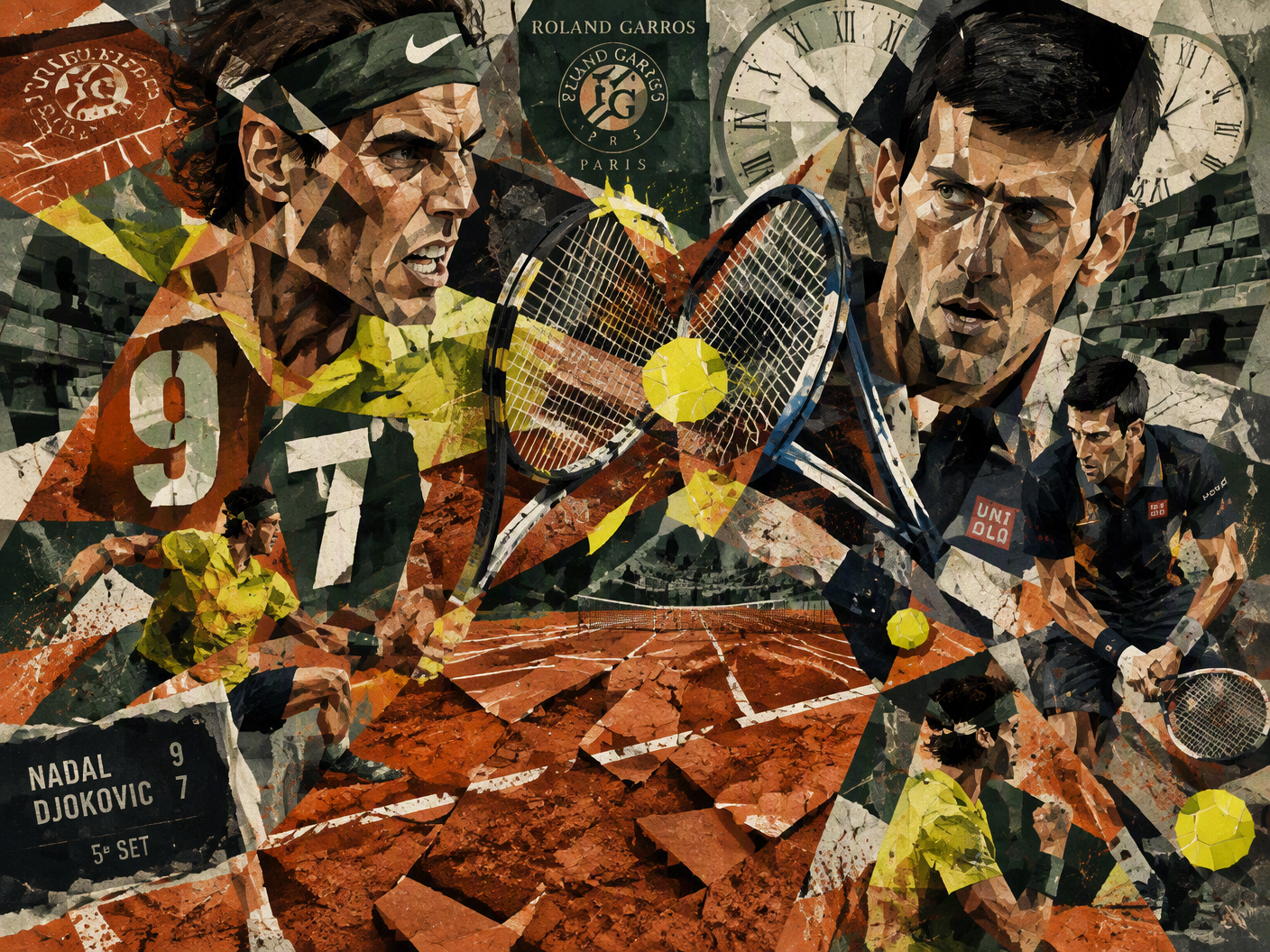
Rafael Nadal entered the decisive set of the 2013 French Open semifinal a break behind Novak Djokovic. Then he broke back. The match continued until Nadal finished it 9–7, closing a five-set contest at Roland Garros and taking the place in the French Open final. Djokovic had pushed the semifinal to its last available stretch, but the tournament gave him no further court. Nadal advanced; Djokovic was out.
That sequence was the human scale of the afternoon: one player trying to recover the ground he had lost, another trying to preserve it, and a score that refused to settle quickly. Nadal’s break back did not end the match. It extended the work. The fifth set carried both men beyond the ordinary length of a professional contest, until 9–7 converted a long exchange of pressure into a simple administrative fact: one name moved forward in the draw, and the other disappeared from it.
Roland Garros made that conversion visible. The French Open is played on clay, a surface that turns the court into a record of repeated movement and makes the semifinal a physical labor process before it becomes a result. The tournament structure reduced that labor to advancement or elimination. Nadal and Djokovic could share the same court for five sets, but they could not share the place waiting beyond it. The bracket treated endurance as a gateway, not as a settlement between equals.
The participants were Novak Djokovic and Rafael Nadal, professional players whose rivalry had already supplied the match with a meaning larger than a single afternoon. Yet the contest did not need invented speeches or theatrical gestures to acquire weight. Its shape was enough. They met in a French Open semifinal in Paris, reached a fifth set, and carried the outcome to 9–7. The significance came through the ordinary rules of the tournament: a court, a score, a winner, and a player who could continue.
Nadal’s position changed twice in the final set. He first fell behind by a break, placing Djokovic in the stronger position. He then broke back, restoring the contest to a level at which neither player could rely on the earlier score. The final margin, 9–7, was not a broad separation created early in the match. It was the accumulated consequence of staying in the contest after the advantage had moved away.
For Djokovic, the loss was not a short interruption in a routine afternoon. He had played Nadal through five sets at the tournament that defined their clay-court rivalry, only to finish on the wrong side of the final set. The result attached itself to his tournament position immediately. A semifinal defeat meant that his route through Roland Garros ended there, while Nadal’s victory carried him into the next stage.
For Nadal, the same scoring system produced a different working life. The break back kept his tournament alive; the 9–7 finish sent him onward. In professional tennis, advancement is not awarded for having endured the same hours as an opponent. It is awarded to the player who wins the last required point. The institution is impersonal in that sense, but the consequences are not: one athlete receives another match, another must leave the tournament after having reached its final four.
The semifinal therefore became part of the larger Djokovic–Nadal rivalry without needing to be inflated into something it was not. It was a high-stakes match at Roland Garros, decided in five sets and finished 9–7. Later descriptions of their French Open meetings placed the 2013 contest within a continuing tradition of difficult, consequential encounters. That language explains its place in sporting memory, but the central event remains more precise than the mythology: Nadal defeated Djokovic and advanced.
Eight years later, the same venue hosted another French Open semifinal between the two players. In 2021, Djokovic defeated Nadal in that semifinal. The change in outcome did not erase the 2013 match; it gave the rivalry a second direction, showing how the same names and the same Paris tournament could distribute victory differently at different moments. Roland Garros became a workplace of recurring demands, where past results could supply context but could not play the next point.
The 2021 semifinal also took place under a curfew-related exception, before 5,000 fans at Roland Garros. That detail placed the rivalry inside a public institution adjusting its doors, hours, and capacity to conditions beyond the court. The setting had changed, but the tournament still converted a long contest into one advancing player and one eliminated player. Public access, scheduling, and elite competition occupied the same grounds, each determining who could be present and how the event could proceed.
The 2013 semifinal ended before that later set of restrictions and before the rivalry acquired its 2021 reversal. Its last movement remained Nadal’s: down a break, back level, then ahead at 9–7. Djokovic left the French Open semifinal with the labor of five sets behind him and no final to play. Nadal carried the opposite consequence—not an abstract legacy, but another tournament place, earned one closing point after another on the clay at Roland Garros.
Investigative Dossier & Evidence
Read the companion investigation notes, verified source claims, and primary documents.
Read the Companion Notes & Evidence Record →