
Scandals & Feuds · 2009
Binghamton’s 2009 Basketball Scandal: The Debit-Card Investigation and Player Arrests
In September 2009, a speeding stop that uncovered marijuana, a debit-card theft inquiry, and Emanuel “Tiki” Mayben’s arrest on crack-cocaine charges converged at Binghamton University. Five players were dismissed, the athletic director resigned, and a later SUNY review examined university oversight while a separate lawsuit brought allegations of sexual misconduct inside the athletic department.
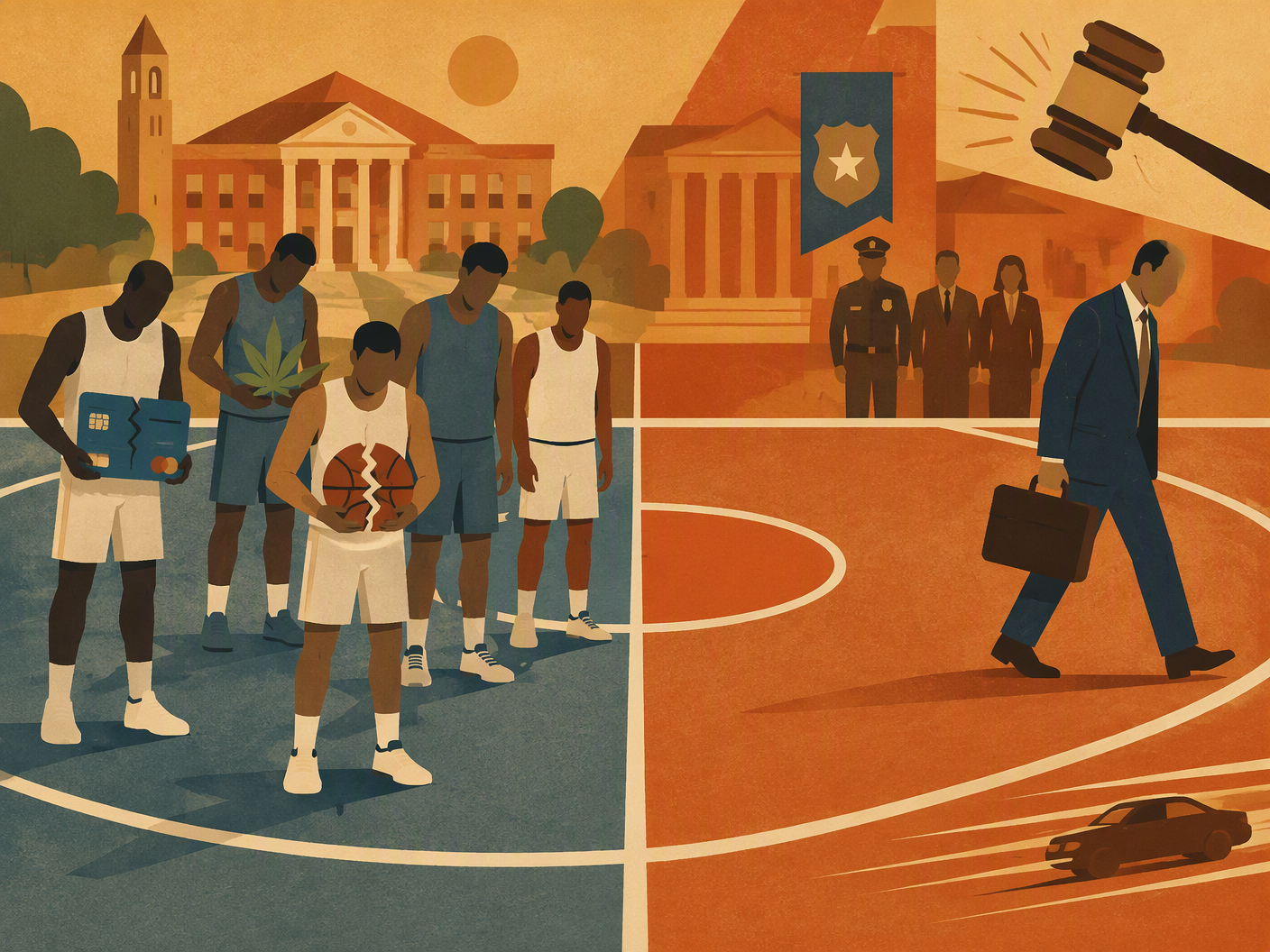
On September 13, 2009, Binghamton University police stopped Emanuel “Tiki” Mayben for speeding. The officers found marijuana in his car and cited him for speeding and unlawful possession of marijuana. The stop created the first police entry in a week that would split a basketball roster, bring criminal charges against a player, and place the athletic department under scrutiny. Mayben was no longer facing only a traffic consequence; the contents of the car had turned an enforcement contact into a campus case with consequences beyond the player himself.
The next day, a Binghamton student reported that her debit card had been stolen and used to buy numerous items, including a television set. University police opened an investigation into the purchases. The inquiry moved from the student’s account to the stores where the card had been used, then to the people connected with those transactions. Store surveillance footage gave investigators a way to trace the purchases, while questioning began to connect the incident to members of the men’s basketball team.
Police questioned Chretien Lukusa and reviewed the store surveillance. They identified D.J. Rivera, Malik Alvin, and Paul Crosby in connection with the debit-card incident. Corey Chandler confessed to police about his role. The investigation therefore carried several distinct forms of information: surveillance, interviews, police identifications, and an admission. Those findings did not arrive as a single public event. They accumulated inside a university police inquiry while the basketball program continued toward a decision about who could remain on the team.
Mayben’s case escalated separately on September 23. University police arrested him and charged him with possessing and selling crack cocaine. The charge placed him in a criminal proceeding while the debit-card investigation remained focused on other players and the university’s internal response. The marijuana citation from the traffic stop and the later drug arrest became linked in the public scandal because they involved the same player, but they were separate steps with different legal consequences: one began with a traffic stop, the other with felony charges.
On September 25, Binghamton dismissed Rivera, Alvin, Crosby, Chandler, and David Fine from the men’s basketball team. Fine’s name had also entered the traffic-stop episode after Mayben told police that the marijuana in his car belonged to Fine. The university’s decision removed five players at once, including the player who had confessed to a role in the debit-card incident and a player connected to Mayben’s account of the marijuana. The dismissals were an administrative action by the university, not criminal verdicts issued by a court.
Five days later, on September 30, athletic director Joel Thirer resigned. His departure shifted the scandal from player conduct to the office responsible for the athletic department. The university had now imposed the most immediate consequence on the roster and lost its senior athletics administrator. Police work had produced arrests, citations, identifications, and an admission; university officials had answered with expulsions from the team and a leadership change.
The sequence mattered because the university was handling different kinds of authority at the same time. Police could stop a car, issue citations, investigate a stolen card, and make an arrest. Coaches and administrators could remove players from a team. A criminal court, operating on a different timetable, would determine whether charges became convictions. Binghamton’s internal response moved first: the roster changed on September 25, and the athletic director was gone by September 30. The administrative consequences did not settle the criminal cases.
The basketball scandal also carried an earlier institutional conflict. On March 18, fundraiser Elizabeth Williams accused associate athletic director Jason Siegel of sexual misconduct connected to a fundraising event. On July 9, Williams sued Binghamton University and two athletic department officials in federal court in Manhattan. Her lawsuit placed the conduct of athletics administrators alongside the later police investigations of players, creating two distinct lines of scrutiny inside the same department.
Williams alleged that Siegel grabbed her breast in an elevator. The allegation belonged to a civil lawsuit, not to the criminal cases involving Mayben or the debit-card inquiry. It nevertheless widened the institutional exposure facing Binghamton athletics. The September arrests and dismissals concerned players and police action; Williams’s complaint concerned workplace conduct and the officials who exercised authority over the department. Each matter carried a different procedure, a different burden, and a different possible consequence.
On February 11, 2010, Judith Kaye released a report on the athletics scandal and university oversight for the SUNY system. By then, Mayben had been arrested and charged, five players had lost their places on the team, and Thirer had resigned. Kaye’s report redirected attention toward the institution that had recruited, supervised, and disciplined the athletes. The question was no longer limited to which players had entered police files. It extended to how Binghamton athletics had been governed before the police arrived.
The final documented consequence was therefore administrative as well as personal. Mayben’s traffic stop led to citations, then to an arrest and drug charges. A stolen debit card led investigators to Rivera, Alvin, Crosby, Chandler, and Fine, and the university answered with five dismissals. Williams’s lawsuit preserved a separate allegation against an athletics official. Kaye’s review left university oversight as the central institutional question, with the consequences of player conduct already imposed and the department’s leadership already changed.
Investigative Dossier & Evidence
Read the companion investigation notes, verified source claims, and primary documents.
Read the Companion Notes & Evidence Record →