
Tragedy ·
The Crash That Reached the U.S. 500 Grandstand
Debris from Adrián Fernández’s car killed three spectators and injured six at Michigan Speedway in 1998. Officials continued the race as an investigation began.
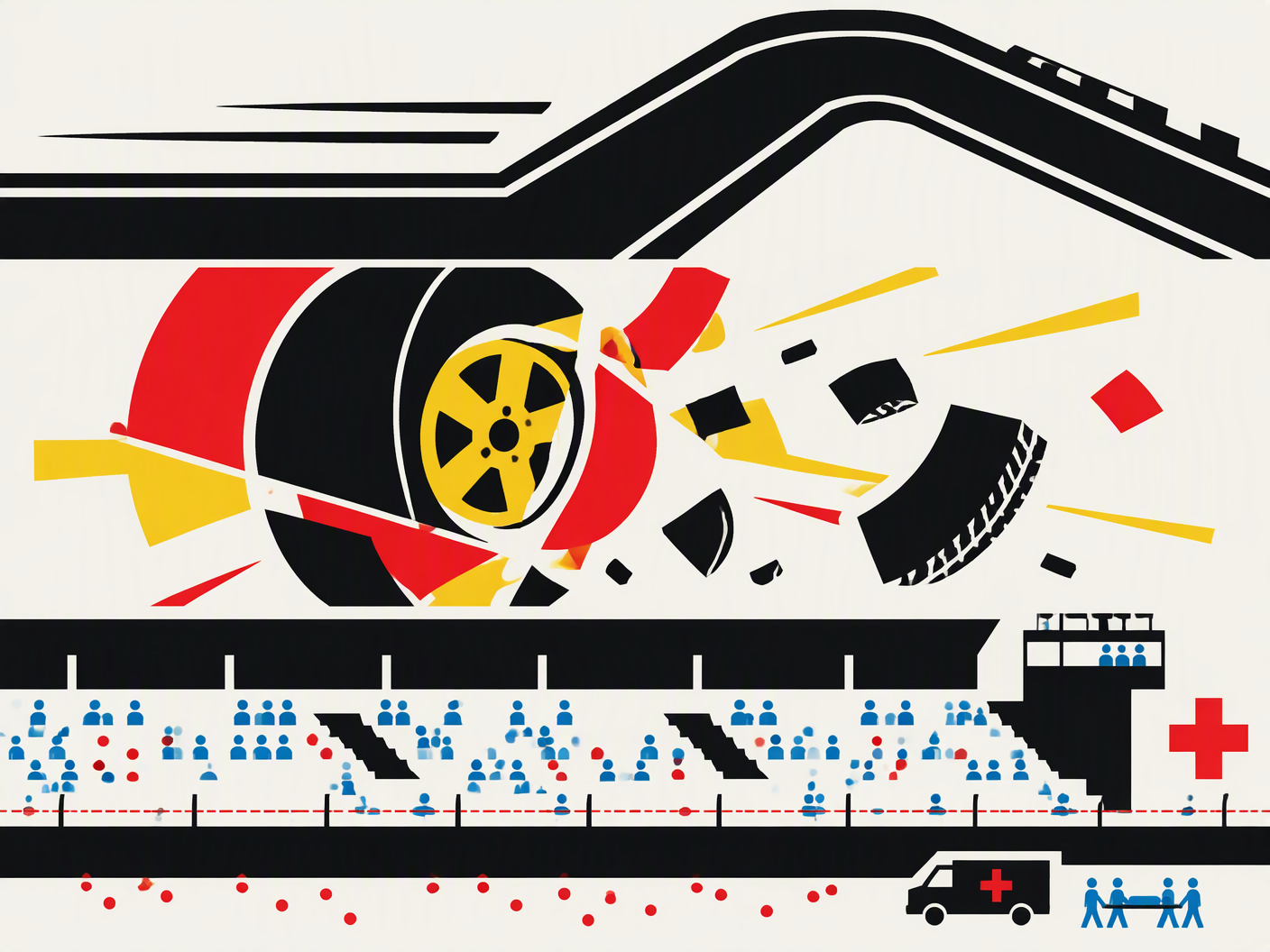
On July 26, 1998, with 150 miles remaining in the CART U.S. 500 at Michigan Speedway, Adrián Fernández crashed into the wall at the fourth turn. His car broke apart. The right front wheel, its assembly and other debris cleared the wall and fencing and flew into the grandstand, killing three spectators and injuring six. Track officials kept the race running.
Gerald and Rich Bramer had stood up after hearing the crash below them. “The next thing I know, a tire was flying in the air right at us,” Gerald told the Associated Press. He said he raised his arm to block the tire as it brushed by him. It struck Rich in the back. Both brothers were among the injured, though neither was seriously hurt.
Another spectator, Becky Lutgen, the news director of Lansing’s WLNS-TV, said she and her boyfriend had been watching Fernández’s car round the bend. They did not see the tire until it hit the stands. “It ricocheted in the stands and came to rest between some rows. It went by so fast,” she said.
Two spectators died instantly, according to the speedway’s chief medical director, Dr. Gregory Baumann. A third died at a track medical facility after resuscitation efforts failed. Officials identified the dead as Michael Terry Tautkus, 49, and Sheryl Ann Laster, 40, both of Milan, Michigan, and Kenneth Dale Fox, 38, of Lansing. Six injured spectators were flown to Foote Hospital in nearby Jackson; four were treated and released.
The affected grandstand area was cleared, and a medical examiner’s investigation began. Witnesses said the debris struck spectators eight to 10 rows up. Greg Penske, president of the company that owned the track, described the barrier: four feet of concrete wall topped by 11 feet of fence and cable. Speedway president Gene Haskett said he could not say how tall a fence would need to be to prevent such an accident. “It’s impossible to say how high something would bounce or fly over,” he said.
Fernández, who had started from pole position and was running third, walked away with bruised knees. He said Paul Tracy had left him too little room entering the corner, while acknowledging that their cars had not touched. “He basically shut me out,” Fernández said. Tracy disagreed. “I don’t feel like I did anything wrong,” he said. He suggested that turbulence from the cars’ speed-reducing rear wing might have caused the crash. Those were the drivers’ accounts, not findings of the investigation.
The crash came on lap 175 of the 250-lap race. With 75 laps left, officials chose to continue the event before a crowd of about 50,000. Greg Moore won. Afterward, he said: “It’s terrible. People come here to watch us race. This definitely puts a damper on the day.”