
Doping & Drugs ·
The Admission That Took Festina Out of the Tour
Roussel acknowledged organised doping; Rijkaert denied involvement. Expelled from the 1998 Tour de France, Festina’s riders threatened to race anyway, then stood down.
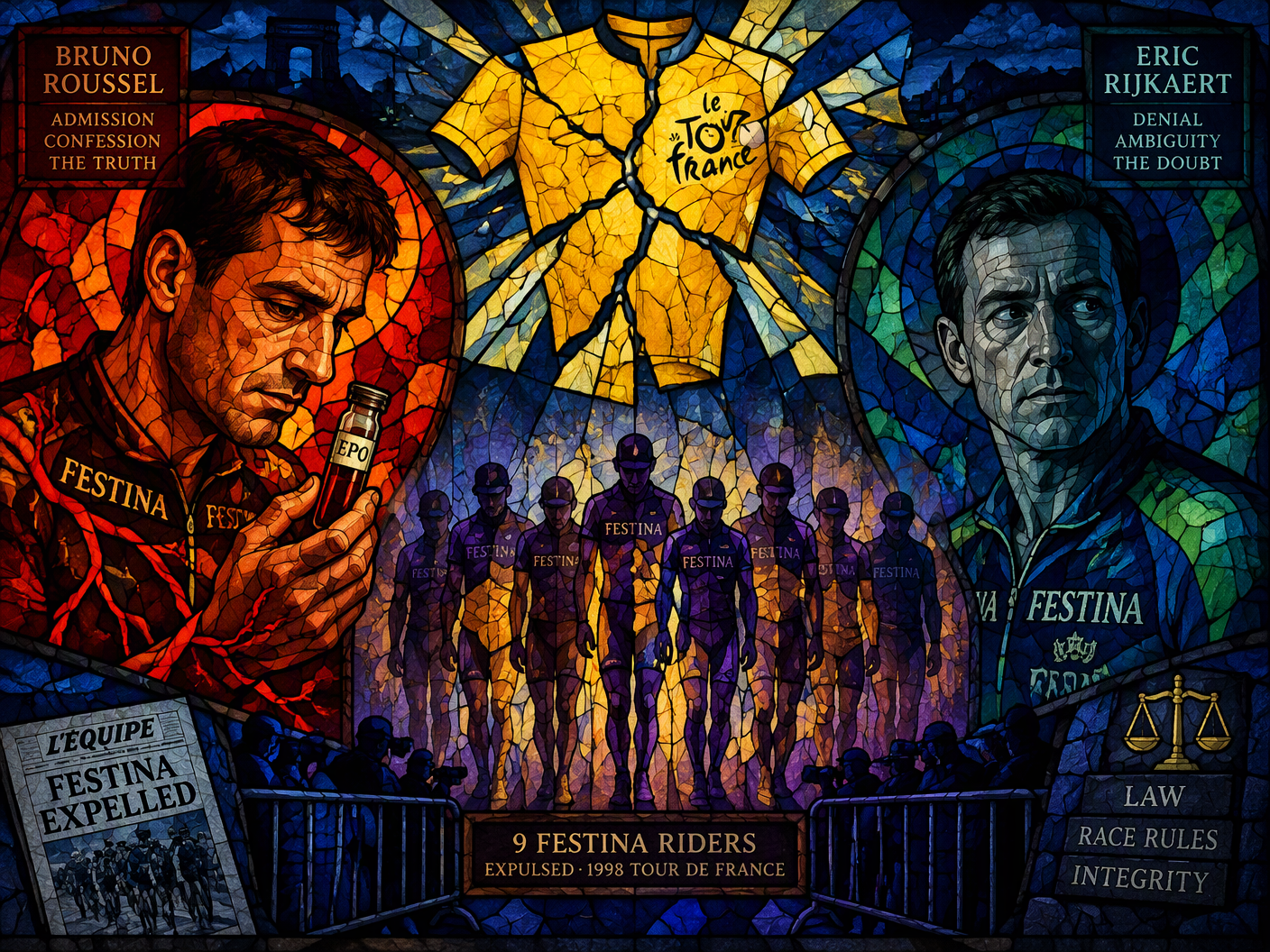
On the night of 17 July 1998, Tour de France director Jean-Marie Leblanc expelled all nine Festina riders after the team’s director, Bruno Roussel, acknowledged an organised doping programme. The riders had insisted they would stay and compete. Their last challenge was to threaten to appear for a time trial whose organisers had already said their results would not count.
The investigation had begun before the race. On 8 July, French customs officers stopped a car driven by Festina soigneur Willy Voet at the Belgian border and found a large supply of performance-enhancing drugs, including EPO. Roussel and team doctor Eric Rijkaert were arrested in Cholet on 15 July. Both were charged under French anti-drugs law on 17 July. The criminal inquiry and the decision over whether the riders could race remained distinct: Lille magistrates had said they could continue in the Tour and be questioned afterwards.
Leblanc had initially resisted expelling the team. Roussel’s cycling licence had been revoked after he failed to respond adequately to inquiries from the French Cycling Federation, but the race director said that alone was insufficient grounds to remove the riders. Before Roussel’s admission, Richard Virenque, Laurent Dufaux and Laurent Brochard held a press conference to insist they would not withdraw. “We all have family and friends and we don’t like to be treated like if we were criminals,” Dufaux said. Brochard pointed to their victories and said they had never tested positive.
The statement issued by Roussel’s lawyer, Thibault de Montbrial, changed the terms of that defence. It acknowledged a coordinated supply of drugs under medical supervision. “The objective was to improve performances under strict medical control in order to avoid the unauthorised personal supply to cyclists causing grave attacks on their health which could have been the case in the past,” the lawyer said. The explanation presented medical control as a safeguard; it also admitted that improving performance was the purpose.
Rijkaert denied involvement. He said Voet had acted on his own, ordering the products and transporting them to France. That denial stood alongside Roussel’s acknowledgment of an organised programme. The drug supply also raised a danger that medical supervision did not remove: EPO boosts the amount of oxygen carried in the blood but can lead to blood clots.
At an 11 p.m. press conference, Leblanc announced the expulsion in consultation with the UCI, invoking the Tour’s rule against damage to its ethics and morality. He called the decision “difficult but essential.” Michel Gros, replacing Roussel at Festina, said the riders had been made scapegoats. He could not deny that drugs might have been supplied, but alleged that the “entire pack” was involved in doping.
Virenque maintained that he knew nothing about the programme. “You can work with people and not be aware of everything about them,” he said. He initially threatened to bring a lawyer to the starting line to witness any attempt to prevent the riders from racing. Festina’s cyclists said they would appear for Saturday’s time trial despite the ban.
Leblanc told them their results would be ignored. After meeting him near the start of the stage on 18 July, the riders abandoned the threatened challenge and decided to take no further part.