
Scandals & Feuds · 1997
The Hotel-Room Sting That Put Frank Gifford in the Globe’s Pages
In 1997, Globe magazine arranged a New York City hotel-room encounter between Frank Gifford and Suzen Johnson, then published photographs and stories drawn from the operation. The episode turned a private meeting into a national tabloid spectacle and became part of the public history of Gifford’s marriage and broadcasting career.
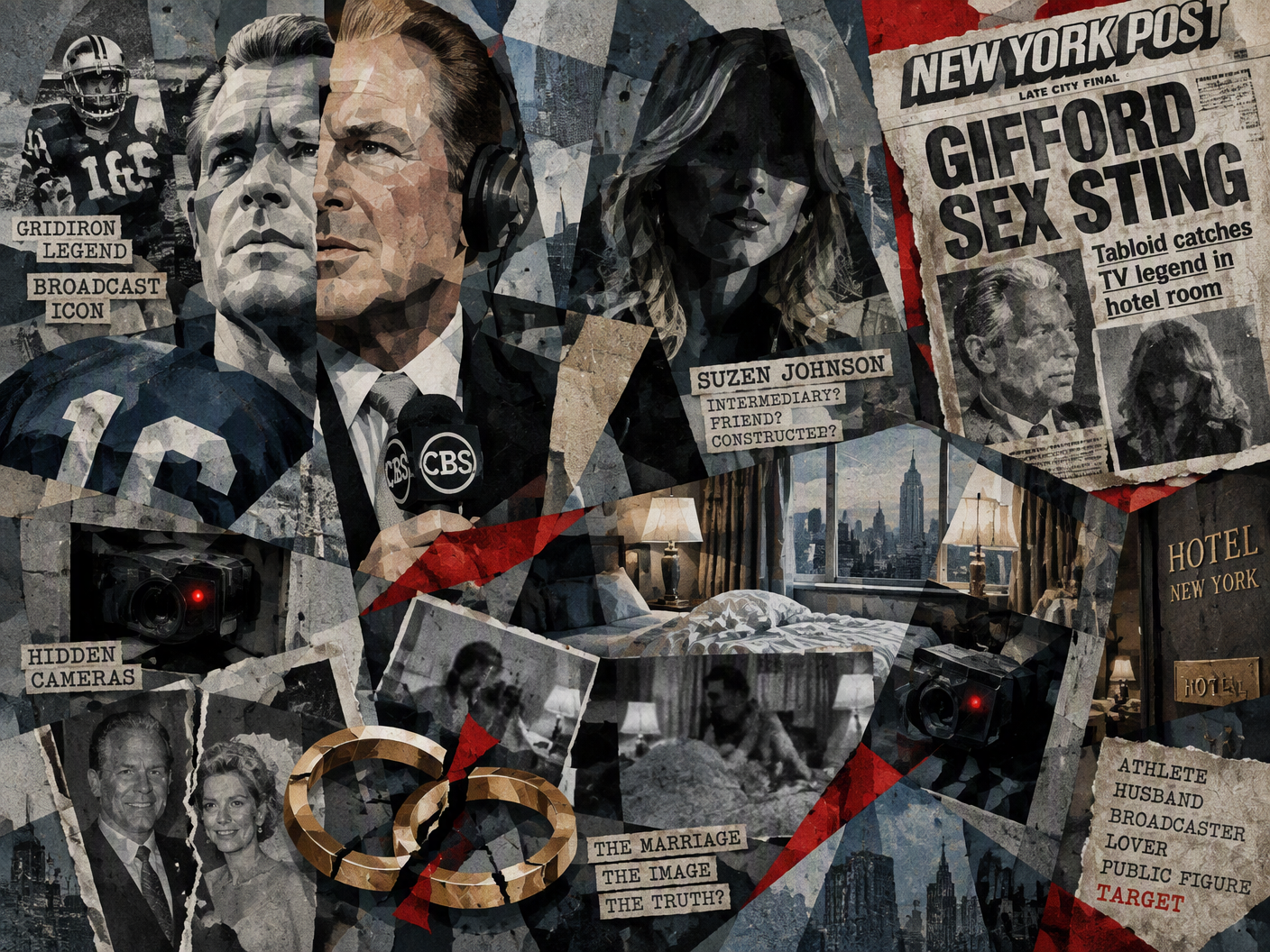
In 1997, Globe magazine arranged for Suzen Johnson to meet Frank Gifford in a New York City hotel room. Johnson was not simply introduced to him; she was recruited to approach him, befriend him, and draw him into an encounter prepared for publication. The room had been secretly equipped with videotape systems. By the time Gifford entered it, the central decision had already been made elsewhere: the meeting would serve not only as a meeting, but as material.
Gifford occupied an unusual place in American sports culture. He had been a New York Giants player and had later become a television sportscaster, a public figure whose name moved easily between football broadcasts, household conversation, and celebrity coverage. The Globe operation depended on that visibility. A private encounter involving an unknown man might have remained private. An encounter involving Gifford could be converted into photographs, headlines, and a story that traveled beyond the hotel room.
Johnson’s role was central to the arrangement. She was brought into contact with Gifford as the human bridge between the publication and its target, while the room itself was prepared to capture what followed. The setup gave the Globe control over the circumstances before the public ever saw the result. The publication did not wait for an accidental scene to arrive; it organized the meeting, supplied the setting, and placed recording equipment inside it.
That distinction shaped the episode’s meaning from the beginning. The Globe’s product would appear as a story about Gifford, but the story had been built through decisions made by the publication and its recruited intermediary. The hotel room functioned as a temporary stage whose audience was absent and whose cameras were concealed. Gifford’s conduct within that setting became inseparable from the way he had been brought there and from the commercial purpose assigned to the encounter.
Afterward, Globe published photographs and stories about Gifford. Images that had been gathered in private were transferred to the pages of a national tabloid, where the encounter could be consumed by readers who had not witnessed the meeting and knew Johnson only through the role the operation gave her. The publication fixed the episode in a form that could be repeated: a photograph, a narrative, a recognizable name, and the suggestion that the room had revealed something essential.
The public significance of the story also came from Gifford’s family life. Frank Gifford and Kathie Lee Gifford had married in October 1986, and their marriage formed part of the context surrounding the tabloid’s publication. The hotel-room story therefore entered more than a celebrity news cycle. It pressed against an established marriage and against the carefully familiar image of a couple whose lives were already visible to television audiences.
For Gifford, the episode crossed two forms of public identity at once. The former football player had spent years being assessed through athletic performance; the broadcaster had built a second career through speech, judgment, and regular presence in American homes. Globe recast him through a different kind of exposure. The subject was no longer the player’s work or the broadcaster’s commentary, but a private encounter selected, arranged, and presented as a measure of character.
The publication also exposed the unequal control held by the people inside the room. Johnson was paid to participate, while Gifford became the named subject of the resulting story. The exact amount attached to Johnson’s role circulated in conflicting forms, but the arrangement itself was clear: the tabloid financed an approach, equipped the location, and converted the encounter into saleable content. The person who initiated the contact and the person whose name filled the headline did not hold the same power over what followed.
The argument surrounding the episode reached beyond Gifford and Johnson to the conduct of tabloid journalism itself. Steve Coz, an editor at the National Enquirer, offered the critical distinction that reporting news was different from creating it. That distinction supplied the controversy with its governing question: whether a publication was exposing an event that existed independently, or manufacturing the conditions under which a publishable event could occur.
The marriage endured after the Globe publication. That fact did not erase the hotel room, the recruited intermediary, or the photographs that had carried the encounter into public view. It became part of the later account of Gifford’s life: a tabloid operation attached to a former Giants player and television broadcaster, followed by a marriage that survived the incident. The episode’s lasting form was not a verdict issued by a court, but a set of published images and stories that remained attached to a public biography.
Investigative Dossier & Evidence
Read the companion investigation notes, verified source claims, and primary documents.
Read the Companion Notes & Evidence Record →