
Violence & Brawls · 1989
The Nail Bombs at De Meer and Feyenoord’s Closed-Door Match
Two homemade nail bombs thrown during the 22 October 1989 Ajax-Feyenoord match injured 19 spectators and brought riot police into the away section. Within two days, three Feyenoord fans had been arrested, and Feyenoord was ordered to play its next match against FC Den Haag behind closed doors.
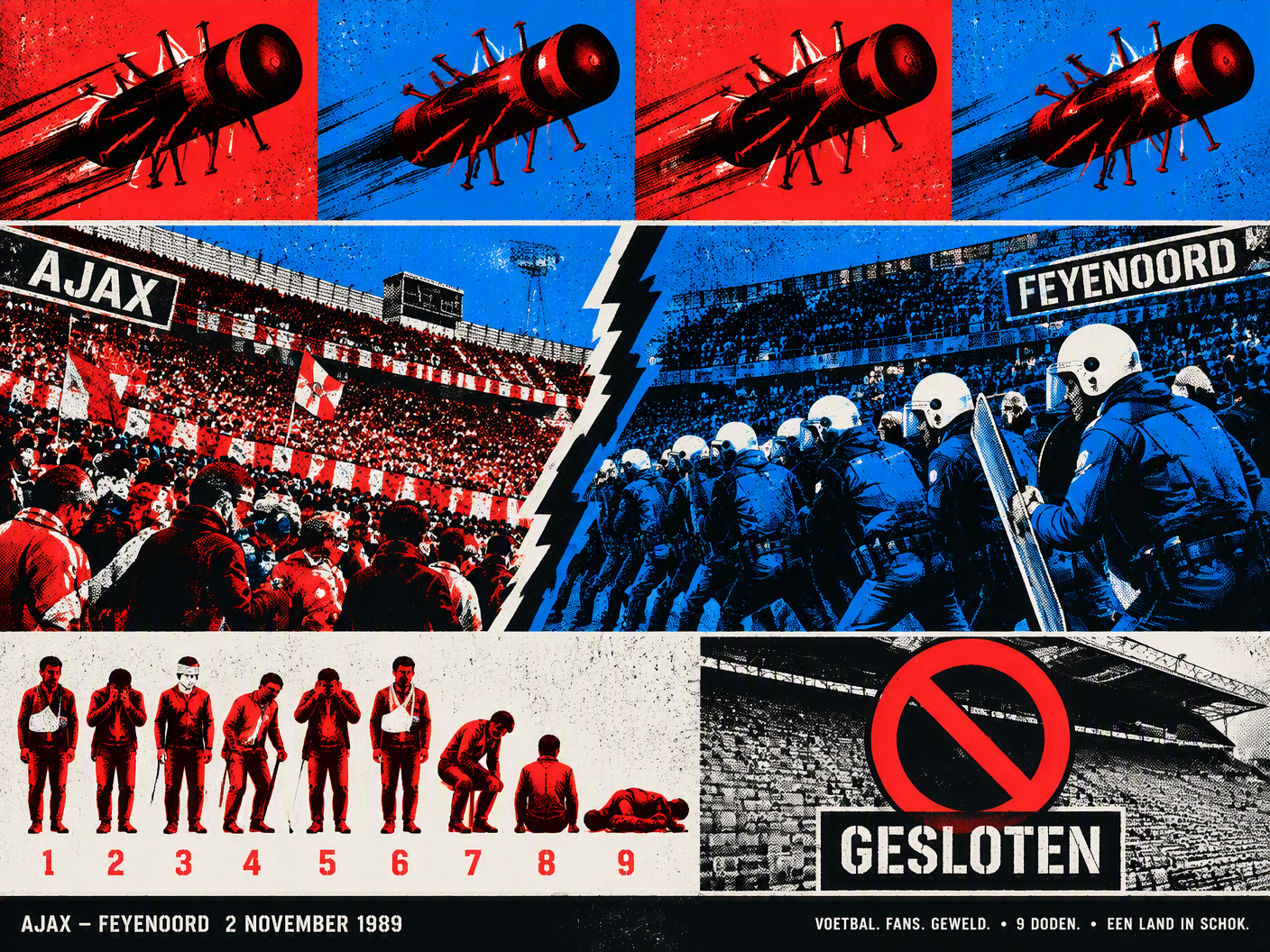
Two homemade nail bombs were thrown into the home section during the Ajax-Feyenoord match at De Meer Stadion in Amsterdam on 22 October 1989. The explosions injured 19 people, including nine seriously. The devices came from the Feyenoord side of the ground, and a Feyenoord hooligan was identified as the person who threw them. The match had been a contest between two Dutch football clubs. It became a police scene without leaving the stadium.
The bombs crossed the division between the supporters. They landed among Ajax fans, not in some distant street after the final whistle. The attack was carried out during play, inside a ground built to hold rival loyalties in separate sections. In a few seconds, the boundary between football and criminal violence disappeared. Nineteen spectators carried the immediate cost. The people who had come to watch Ajax and Feyenoord were now part of an emergency response.
Riot police moved first against the away section. Officers cleared it immediately after the explosions, separating Feyenoord supporters from the home section where the injuries had occurred. The action was direct and physical: one group was removed from its place in the stadium, then driven toward the exits. There was no room for the usual sorting of football arguments from football violence. The bombs had already made that decision.
The police response continued outside the section. Away fans were searched as they left the stadium. Officers were looking for evidence, weapons, or anything else that could connect the departing supporters to the blasts. The search turned the exit into another controlled space. Feyenoord fans did not simply file out after a match; they passed through police hands while the injured remained behind.
The game continued. Ajax and Feyenoord finished the match, and the score was 1-1. That result sits beside the injury count in the event’s public record: a draw on the pitch, 19 people hurt in the stands, and riot police clearing an entire section of the ground. The final whistle did not close the incident. It only moved the work from the stadium to the police station and the offices that governed Dutch football.
By 24 October, police had arrested three Feyenoord fans in connection with the blast. The arrests gave the investigation a human shape, but not a finished ending. Three supporters were in custody after the emergency response at De Meer. The police had moved from clearing and searching to naming suspects through arrest. The attack was no longer confined to a damaged section and an interrupted afternoon; it had entered the criminal process.
The arrests dealt with individual responsibility. Football authorities dealt with the club. Feyenoord was ordered to play its next match against FC Den Haag behind closed doors. The sanction removed the public from the next fixture and placed the cost of the stadium violence on the club’s schedule. The order did not change the score at De Meer or repair the injuries. It changed who would be allowed through the turnstiles the next time Feyenoord played.
That distinction mattered in the days after the attack. Police had searched Feyenoord supporters and arrested three of them. The football authorities had imposed a competition penalty on Feyenoord itself. One response followed the suspected conduct of fans; the other followed the club through its next match. The institutions did not wait for a completed criminal case before acting on the sporting calendar.
The human arithmetic remained plain. Nineteen people were injured when the two homemade devices exploded in the home section. Nine were seriously hurt. The available public account does not turn those injuries into scenery or a statistic that can be folded into the match report. They were the direct result of bringing improvised nail bombs into a football ground and throwing them at spectators.
The attack also left the supporters’ sections with different meanings. The home section held the injured. The away section was cleared by riot police. At the exits, Feyenoord fans were searched. Then three Feyenoord fans were arrested before the week was out. Every step narrowed the distance between the person who carried the devices, the people who had stood near him, and the club whose next match would be played without its crowd.
At De Meer, the match ended 1-1. The police response had begun before the football was over, and the disciplinary response followed before Feyenoord’s next fixture. The score stayed in the books. The injuries stayed with the spectators. Three fans entered the criminal inquiry, while Feyenoord entered its next match behind closed doors, with the turnstiles shut and the usual crowd left outside.
Investigative Dossier & Evidence
Read the companion investigation notes, verified source claims, and primary documents.
Read the Companion Notes & Evidence Record →