
Bizarre & Myths · 1978
The Blizzard That Moved the 1978 Beanpot
During the first-round night of the 1978 Beanpot at Boston Garden, the Blizzard of 1978 dropped more than two feet of snow and stranded several hundred fans inside the arena for days. The tournament survived by moving its championship and consolation games to Wednesday, March 1.
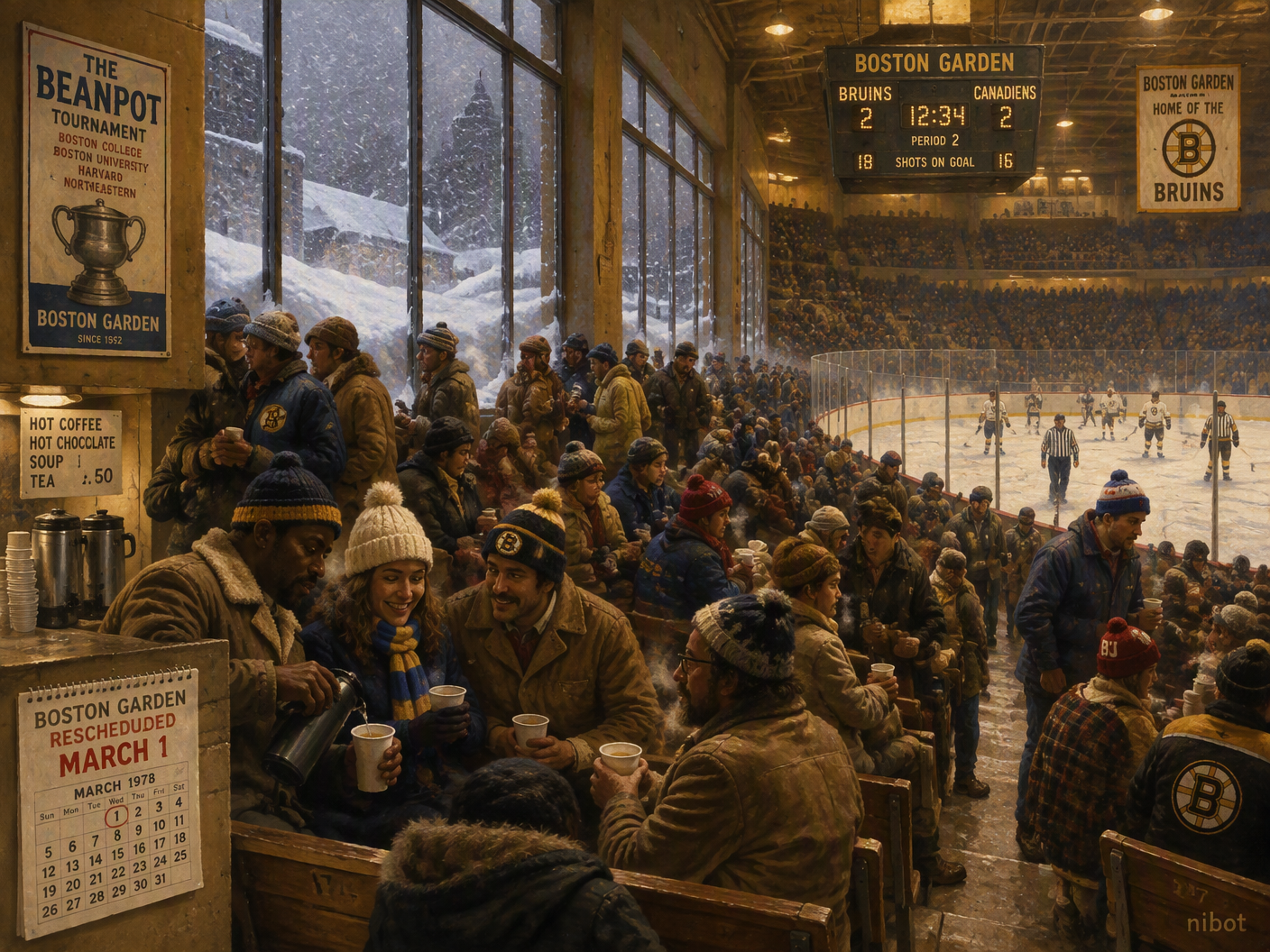
The decision came after the snow had made ordinary movement impossible: the 1978 Beanpot championship and consolation games would not be played on their original schedule. They were moved to Wednesday, March 1, at Boston Garden. The tournament had been interrupted during its first-round night by the Blizzard of 1978, which dropped more than two feet of snow across Boston. Inside the Garden, several hundred fans were left stuck for several days. The Beanpot was not canceled. It was held in place, delayed, and then assembled again around a new date.
The building gave the episode its fixed address. Boston Garden was the home of the annual college hockey tournament, and in 1978 it brought together Boston College, Boston University, Harvard, and Northeastern. Four established institutions shared the event, but the tournament depended on a single arena, a single schedule, and the ability of players, staff, officials, and spectators to reach it. When the storm closed the routes around Boston, the problem was not confined to the ice. It reached every arrangement that allowed the tournament to proceed.
The Beanpot had not begun as a civic institution. In 1952, it was designed as an off-night filler for Boston Arena, a practical event meant to place meaningful college hockey into an otherwise open part of the calendar. Its later importance grew from repetition: the same four schools, the same city, and the concentrated rivalry created by a tournament that could be completed in a short span. By 1978, its schedule was familiar enough that a weather emergency could be measured against an established pattern.
The first-round games were underway when the Blizzard arrived in force. More than two feet of snow fell during the night, transforming the event from a sequence of hockey games into a question of shelter and movement. The fans inside Boston Garden were not simply waiting for the next faceoff. Several hundred remained stuck there for several days as the storm disrupted the city beyond the arena. The surviving account of the night has endured because it joins a familiar sports setting to an unusual practical consequence: spectators came for college hockey and became occupants of a stranded building.
For the teams, the interruption divided the tournament into two sections. The first-round games belonged to the night before the full force of the disruption had been absorbed; the championship and consolation games belonged to the rescheduled Wednesday. That separation altered preparation, travel, arena operations, and the expectations of spectators. The competitors still represented the four Boston schools, but the tournament no longer moved according to its original timetable. A weather emergency had entered the competition’s structure and forced every remaining participant to adjust.
The organizers’ choice was therefore narrower and more consequential than abandonment. They preserved the final two games by assigning them a new date, Wednesday, March 1, and kept Boston Garden as the site. The change treated the storm as an interruption that could be absorbed rather than as an event that erased the tournament. The consolation game and the championship remained distinct parts of the Beanpot, and the institution continued to operate through the delay instead of surrendering its established form.
That distinction shaped the way the episode entered Boston sports lore. The story was not only that snow fell, or that a hockey tournament lost a night on its calendar. It was that the Garden became a place where fans were stranded while the city was buried, and that the competition later resumed under a revised schedule. The phrase “several hundred” identifies the scale preserved in the story, but it does not turn the stranded spectators into a precisely counted population. The event’s meaning rests on the confinement and the rescheduling together.
The March 1 date became the administrative marker of the disruption. It identifies the moment when the tournament’s concluding games were meant to take place after the first-round night had been overtaken by the storm. In a college hockey competition built around four schools and one central venue, the date carried practical consequences. Teams had to return or remain available, arena personnel had to prepare for another set of games, and spectators had to understand that the Beanpot had been postponed rather than removed from the calendar.
The building itself later changed, but the location remained part of the tournament’s identity. Since 1996, the Beanpot has been held at TD Garden, the replacement for Boston Garden. That transition separates the 1978 event from the present venue while preserving its institutional line: the tournament moved with the arena, not away from the city or its four participating schools. The blizzard episode belongs specifically to Boston Garden, where the first-round night was interrupted and the stranded-fans story acquired its durable form.
The 1978 Beanpot survives as a record of adaptation under pressure. A tournament created in 1952 to fill an open night at Boston Arena had become a settled Boston occasion by the time the Blizzard forced its organizers to rewrite the closing schedule. More than two feet of snow interrupted the first round; several hundred fans remained inside the Garden for days; the championship and consolation games moved to March 1. The date changed, the venue endured, and the Beanpot’s place in Boston lore was secured by an inconvenience that became part of the event’s permanent history.
Investigative Dossier & Evidence
Read the companion investigation notes, verified source claims, and primary documents.
Read the Companion Notes & Evidence Record →