
Tragedy · 1900
The 1900 Glassworks Collapse Beside Stanford–California
On November 29, 1900, hundreds of spectators gathered on the roof of the San Francisco and Pacific Glass Works to watch Stanford play California from outside the adjacent stadium. After the collapse, a coroner’s jury attributed the deaths to the spectators and assigned no legal blame to the factory management or the city.
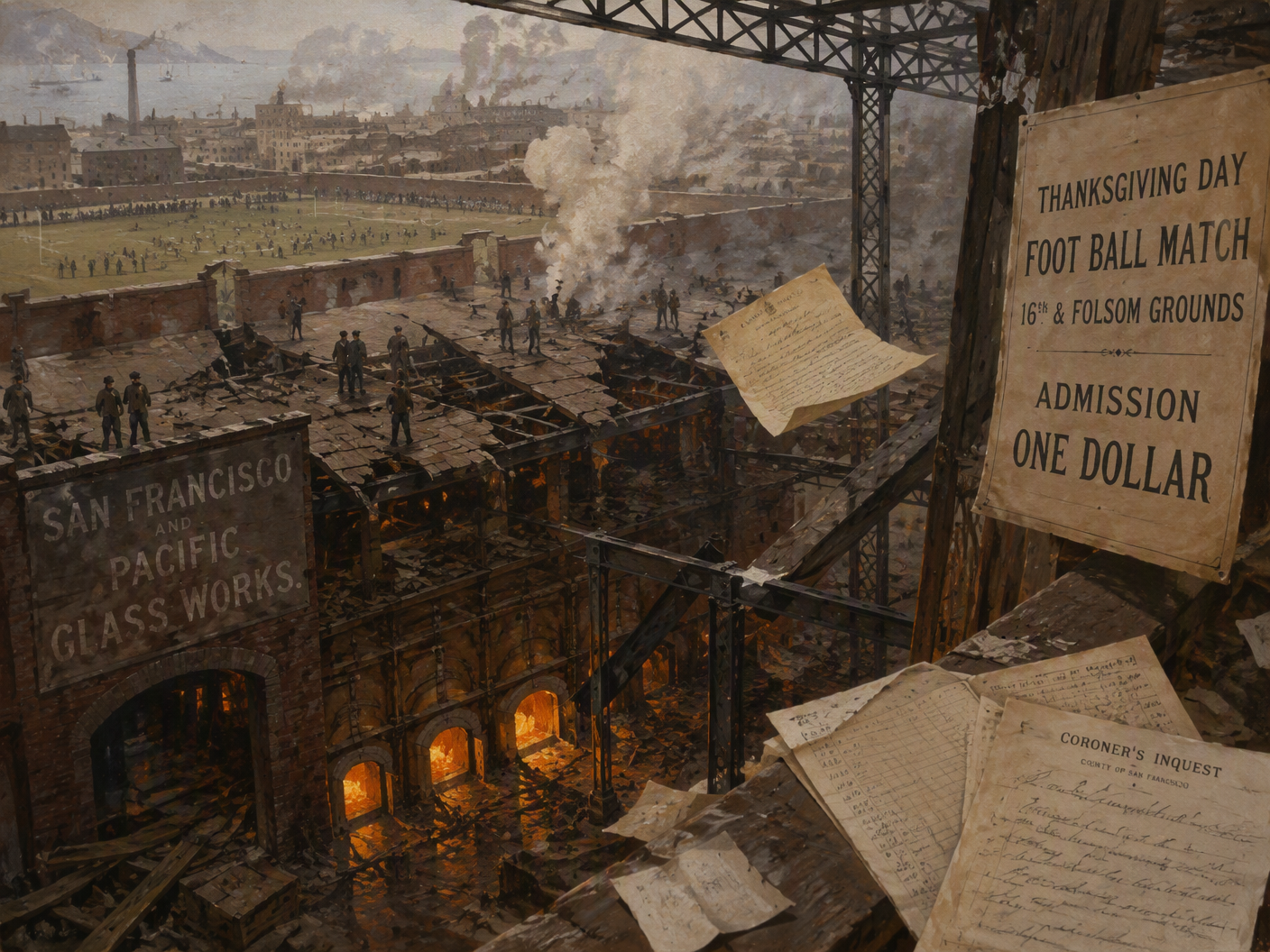
The roof was already crowded when the football game began. On Thanksgiving morning, November 29, 1900, spectators climbed onto the San Francisco and Pacific Glass Works beside the 16th and Folsom Grounds, looking down toward the field where Stanford and California were about to play. Inside the stadium, nearly 19,000 people had paid to enter. Outside, hundreds more had found a higher vantage point—above the factory, beyond the turnstiles, and beyond the one-dollar admission that some could not or would not pay.
The roof offered the kind of bargain that made danger difficult to see. From the industrial structure, spectators could watch the grounds and follow the movement of the players below without standing among the paid crowd. The surviving accounts count the rooftop crowd in different ways: one places it at roughly 400, while others describe a range from 500 to 1,000. Those figures come from separate accounts with different methods of describing the gathering, so they cannot be reconciled into a single headcount. Taken together, they place the crowd in the hundreds. Men and boys spread across the roof and around its ventilator section, converting a working factory surface into an improvised grandstand whose precise load cannot now be fixed.
About twenty minutes after kickoff, the occupied upper structure failed. Some accounts call the failed section the roof; others identify a ventilator structure built into it. The surviving descriptions therefore do not preserve one uncontested technical account of what broke, but they place the failure beneath the gathered spectators and associate it with the weight of the crowd. People fell through the factory’s upper levels from a height described as approximately four stories. The football field remained visible from the grounds, but the game now shared the scene with a rescue effort unfolding inside an operating industrial plant.
Below the broken roof was machinery, heat, and a furnace containing molten glass. Some victims struck the factory floor after the fall. Others landed on or near the furnace and suffered severe burns. Contemporary accounts also described injuries from oil and fire. The collapse did not produce a single uniform kind of wound: the height crushed bodies, while the factory’s working environment added heat and flame to the wreckage.
Factory workers began trying to reach the fallen. Later accounts described testimony alleging that employees sought help from police personnel but did not receive effective assistance. The same accounts carried an allegation that factory watchmen admitted people onto the roof in exchange for payment. Neither claim was established in the surviving material as a proven payment or an adjudicated failure by police. They remain reported allegations attached to the collapse and its aftermath, not settled findings about who caused the deaths.
The dead were not counted in a single final figure that day. By December 4, contemporary reporting placed the toll at 22. Other accounts later gave the disaster a total of 23 after one seriously injured victim died years afterward. The records differed on some ages and casualty details, but the scale of the event remained fixed: a Thanksgiving football crowd had become a list of dead and injured people, many of them young spectators who had come to watch a game from the wrong side of the admission gate.
On the grounds, the game continued. Stanford defeated California, with one contemporary account recording the final score as 5–0. The continuation gave the day a disturbing split screen: football proceeded within the stadium while rescuers worked next door among broken beams, industrial heat, and the consequences of the collapse. The contest produced its official result. The glassworks produced another kind of record—one measured in fatalities, hospital beds, and families waiting for names to be confirmed.
The separation did not end with the final whistle. Student newspapers at Stanford and California gave prominent attention to the football game but did not report the disaster in their immediate game coverage. The institutions’ own athletic narrative preserved the score and the contest while leaving the adjacent catastrophe outside the first account of what had happened. The omission became part of the disaster’s afterlife: the game remained a remembered rivalry, while the people who had fallen through the roof became easier to forget.
The question of responsibility moved into the coroner’s proceedings. A coroner’s jury placed responsibility for the deaths on the spectators who had crowded onto the structure. Its reported conclusion did not assign legal blame to the glassworks management or to the city. In that finding, the crowd itself became the explanation: the people who had gathered were treated as the force that brought the roof down, while the institutions controlling the building and the surrounding public space escaped the formal assignment of responsibility.
The testimony described in later accounts added unresolved questions to that reported allocation. It included an allegation that watchmen charged for access to the roof and a separate claim that police personnel failed to provide effective aid after workers sought help. The accounts report those assertions; they do not establish that money changed hands, that police negligence occurred, or that either episode caused the deaths. One set of claims concerned how spectators reached the roof, another concerned what happened after the fall. The coroner’s jury’s reported conclusion did not formally assign legal blame to either group.
The surviving sources present the 1900 Big Game disaster in different forms rather than one fully consistent account. Some preserve the football score and the continuation of the contest; others emphasize the deaths, injuries, changing casualty totals, and the coroner’s reported allocation of responsibility. The student newspapers’ immediate game coverage did not include the disaster, while later accounts discussed parts of it. Within the material examined here, the firm sequence is narrower: a crowd gathered above a factory, the occupied structure failed, the game continued, and accounts of the event retained different portions of what followed.
Companion notes
What the Record Establishes About the 1900 Glassworks Collapse
The surviving accounts agree on the event’s basic sequence but differ on crowd size, casualty details, and the precise structure that failed. A reported coroner’s jury conclusion assigned responsibility to the spectators, while later accounts described allegations about roof access and police assistance without establishing those claims as adjudicated causes.
The Site and the Crowd
The Stanford Magazine account, SF Weekly’s retrospective investigation, The Mercury News, and the Thanksgiving Day Disaster reference account consistently place the collapse at the San Francisco and Pacific Glass Works beside the 16th and Folsom Grounds. They agree that spectators used the factory roof to watch Stanford–California and that approximately 19,000 people were inside the stadium. The one-dollar admission price is part of the shared explanation for why additional spectators gathered outside. [S1], [S2], [S3], [S4]
The rooftop estimate is less stable. The accounts describe a crowd ranging from roughly 400 people to between 500 and 1,000. That variation does not undermine the central fact that hundreds occupied the structure, but it prevents a precise reconstruction of the load. The sources establish the crowd’s presence and approximate scale, not an engineering measurement of the roof’s capacity or a certified attendance count for the rooftop. [S1], [S2], [S3], [S4]
What Collapsed and What Followed
The Stanford Magazine account, SF Weekly, and the reference history agree that the failure occurred about twenty minutes after kickoff and was associated with the spectators’ weight. Their descriptions are not identical: some refer to the roof, while others emphasize a ventilator structure. The record therefore supports a collapse of the occupied upper structure shortly after the game began, but not a single uncontested technical description of the failed section. [S1], [S2], [S3]
The injury accounts describe a four-story fall into an operating glassworks, with additional harm caused by heat, oil, fire, and a furnace containing molten glass. The sources document severe injuries near the furnace, although exact numbers for people who landed directly on it are estimates. The initial reported death toll reached 22 by December 4, 1900; later accounts describe 23 after a seriously injured victim died years afterward. Age and casualty details vary across the surviving narratives. [S1], [S2], [S3], [S4]
The Coroner’s Allocation of Responsibility
The reported coroner’s jury proceedings are the central procedural record for responsibility. As summarized by the reference history, Stanford Magazine, and SF Weekly, the jury attributed the deaths to the spectators who had crowded onto the roof. It did not assign legal blame to factory management or the city. This was a contemporary coroner’s conclusion, not a modern judicial determination that no unsafe condition, access failure, or public-authority omission existed. [S1], [S2], [S3]
The surviving summaries do not provide a complete transcript or a modern engineering investigation capable of testing every possible institutional failure. They establish what the jury reportedly decided and what it did not decide. They do not establish that the jury’s allocation exhausted the factual causes of the collapse. [S1], [S2], [S3]
Warnings, Allegations, and the Afterlife
SF Weekly and Stanford Magazine each describe testimony that included an allegation that factory watchmen admitted spectators to the roof in exchange for payment. The same accounts describe a separate allegation that police personnel failed to provide effective assistance after factory employees sought help. The available material does not establish that watchmen accepted payment or that police personnel acted negligently. No surviving material cited here shows that a court adjudicated either allegation as the legal cause of the deaths; the claims remain reported allegations rather than established findings. [S2], [S3]
The evidence about student-newspaper coverage is limited to the Stanford and California publications discussed by Stanford Magazine and The Mercury News. Within the immediate game coverage examined in those accounts, the papers prominently addressed the football contest but did not report the disaster. That finding applies to those student publications and that specific coverage, not to every San Francisco newspaper, all contemporary reporting, or later institutional records. Extending it beyond that defined set would require additional evidence. [S2], [S4]
Source key
The associated evidence packet contains visible source URLs, source roles and the complete claim ledger.