
Violence & Brawls · 2000s
The Bench Attack and the 163-Minute Ottawa-Toronto Penalty Game
On March 4, 2003, a Maple Leafs-Senators game in Ottawa included an attack on a player seated on the bench, a later fight, and 163 penalty minutes before Ottawa won 4-1. Three days later, the NHL suspended Darcy Tucker for five games and Tie Domi for three; a separate 2024 incident produced another five-game suspension for Morgan Rielly.
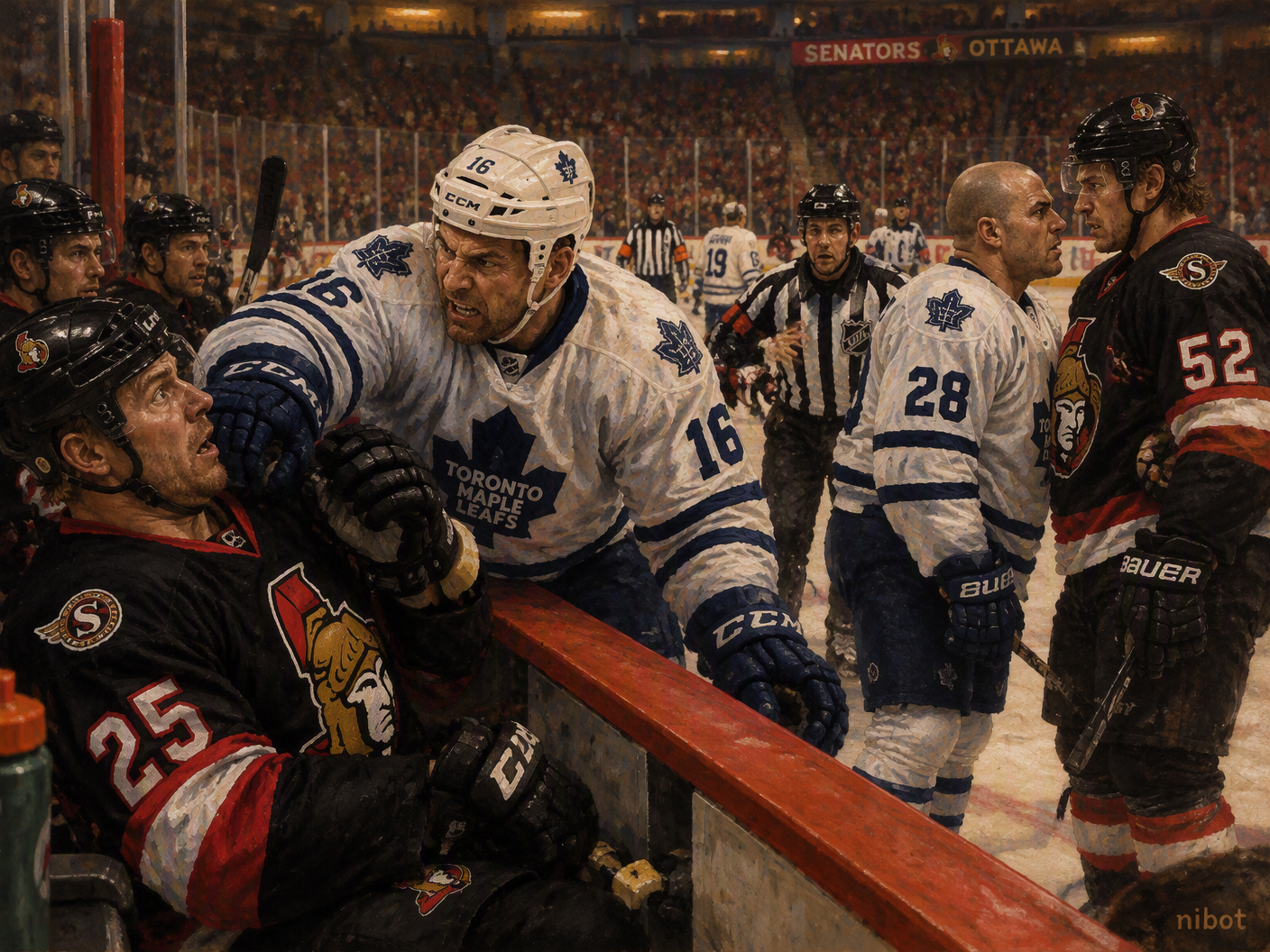
Chris Neil was sitting on Ottawa's bench when Darcy Tucker came after him. The Toronto forward attacked the Senators forward during the March 4, 2003 game, turning a contest between provincial rivals into an incident that extended beyond ordinary contact between players on the ice. Neil was not skating toward Tucker or trading punches in the open playing surface; he was seated with his team when Tucker reached him. The game continued, but its boundaries had changed. A place meant for players waiting to return to work had become the site of an attack.
The setting mattered because hockey divides its workplace into sharply controlled spaces. Players move between the ice, the bench, the penalty box, and the dressing room under rules that assign each location a function. The bench is where a player waits, watches, and prepares to re-enter the game. Tucker's attack crossed that physical arrangement, and the night accumulated consequences that could not be measured by the scoreboard alone. Ottawa defeated Toronto 4-1, but the final margin became only one part of the game's official identity.
By the end of the contest, officials had recorded 163 minutes in penalties. That number represented time removed from the game and labor removed from the teams: players sent away from the ice, line combinations disrupted, and coaches forced to manage a contest increasingly shaped by punishment. Penalties are usually counted as interruptions within a sport built around speed. Here they became the central measure of the evening. The game was still a professional assignment with a result, but the disciplinary ledger had grown larger than the scoreline.
The bench attack was not the only confrontation. Later in the third period, Tie Domi went after Ottawa forward Magnus Arvedson and threw several punches at him. Arvedson was not assessed a penalty on that play. The detail separated the physical exchange from the official distribution of blame: Domi's conduct generated a disciplinary record, while Arvedson did not receive a matching infraction. On the ice, the action unfolded in seconds. In the league's later review, those seconds became evidence for decisions that would keep both Toronto forwards out of future games.
After the game, Tucker said Neil had spit on him. Neil denied the accusation. That dispute entered the aftermath as a competing explanation for the bench attack, but it did not change the documented location of the incident or the league's response to Tucker's conduct. The allegation supplied a reason offered after the fact; the denial rejected it. What remained fixed was the physical sequence: Neil was on the bench, Tucker attacked him, and the explanation became part of the argument surrounding the punishment rather than a settled fact of the game.
Three days later, on March 7, the NHL announced its rulings after a hearing at league head offices. Tucker received a five-game suspension. Domi received three games. The penalties distinguished supplemental discipline from the game penalties imposed in Ottawa. A player could serve time during the contest, then face a separate league judgment after officials reviewed the conduct. That process converted a chaotic night into an administrative decision with a direct economic and professional cost: two Toronto forwards would miss work because the league judged their actions to require punishment beyond the arena.
The suspensions also showed how the league protected its authority over conduct that could not be contained by the final whistle. Toronto and Ottawa could compete for points, territory, and civic loyalty, but the NHL controlled the terms under which players could continue to earn their wages. A suspension removed a player from games without removing the club's obligation to absorb the competitive loss. The authority ran through the player, the team, and the schedule. A confrontation in Ottawa therefore reached into Toronto's next assignments and into the league's claim to regulate its workforce.
The March game remains bounded by what happened on the ice: a bench attack, a later fight, 163 penalty minutes, and a 4-1 Ottawa victory. Those facts do not require a larger emotional theory about the relationship between the clubs. The rivalry can be understood through its incidents and consequences without assigning every player a permanent motive or treating the teams' relationship as a single undifferentiated hostility. Tucker's accusation and Neil's denial belong to the same history, but they do not carry the same status as the recorded attack or the announced suspensions.
More than two decades later, another Ottawa-Toronto game produced a separate disciplinary confrontation. On February 10, 2024, Ottawa defeated Toronto 5-3 after Ridly Greig scored an empty-net goal. Morgan Rielly then cross-checked Greig in the head. The play occurred after the goal, when the result had already moved beyond the immediate contest for possession. The NHL later suspended Rielly for five games. The incident did not rewrite the events of 2003, but it placed another documented act of retaliation and another league suspension within the same Ottawa-Toronto history.
For the people who carried the consequences, the rivalry was never an abstract label. Neil carried the memory of being attacked while seated on the bench; Arvedson was the player Domi confronted while receiving no penalty on that play; Tucker and Domi lost games under the league's rulings. In 2024, Greig became the target of a cross-check after scoring, while Rielly lost five games through a later suspension. The public record leaves a chain of specific bodies, actions, scores, and missed work—not a mythology detached from what those players were required to carry afterward.
Investigative Dossier & Evidence
Read the companion investigation notes, verified source claims, and primary documents.
Read the Companion Notes & Evidence Record →