
Point Shaving & Fixes ·
The Confession and the Unequal Case Against the Louisville Four
In 1877, suspicious play and telegrams led to admissions of exhibition-game fixing. Four Grays were expelled, though claims about league games remained disputed and the evidence against Bill Craver was weak.
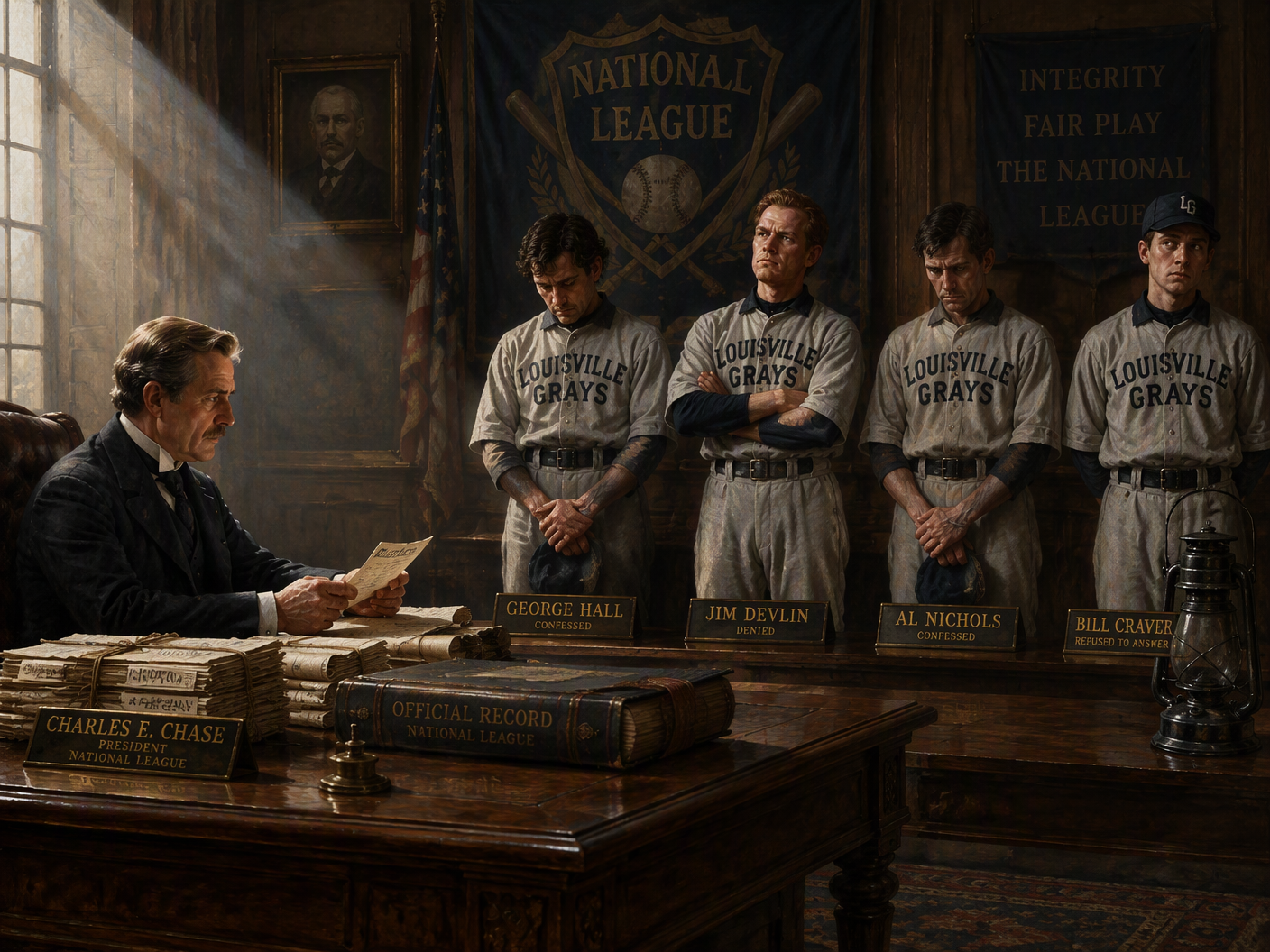
On October 27, 1877, Louisville Grays outfielder George Hall approached club official Charles E. Chase with an offer to confess. Chase had been investigating suspicious play and telegram traffic involving the team. According to Chase’s account, Hall began with a distinction: “I know I have done wrong, but as God is my judge, I have never thrown a league game.” He then asked whether telling everything would persuade Chase to “let me down easy.”
The Grays had entered August leading the National League, then lost ground on an eastern road trip against Hartford and Boston. Their decline attracted scrutiny, but poor results alone could not establish deliberate losing. Louisville Courier-Journal baseball writer John A. Haldeman became suspicious while watching the team. Chase also received an anonymous telegram warning him to “watch your men” before a Hartford game. Louisville lost. Another telegram predicted another defeat; that prediction came true as well.
Chase’s attention turned to substitute Al Nichols, who was receiving a large volume of telegrams. When Chase demanded permission to inspect them, Nichols initially refused, then relented after Chase said refusal would amount to an admission of guilt. The messages were vaguely worded, but two from Brooklyn pool seller P. A. Williams heightened suspicion. Haldeman published carefully worded doubts in the Courier-Journal, and Chase prepared to confront the players.
Chase first pressed pitcher Jim Devlin, demanding a full confession by eight that evening. Before Devlin returned with an answer, Hall came forward. Chase told Hall he already knew everything and could make no promises. Hall took that to mean Devlin had confessed. He admitted throwing exhibition games—non-league contests that clubs used to supplement their income and schedules—and implicated Nichols. The account identifies fixed exhibitions in Cincinnati and Indianapolis involving Hall and Devlin, and another in Lowell, Massachusetts, involving Hall and Nichols.
The participants also cheated one another. Devlin said he received $100 from a gambler named McCloud and gave Hall $25, telling Hall that the payment had been only $50. Yet the scope of their wrongdoing remained disputed. Both Devlin and Hall maintained that they had not thrown league games. Historian Bob Bailey later wrote that Hall’s confession appeared to implicate them in a September 6 loss to Cincinnati, but hard evidence that Louisville deliberately threw the eastern trip or surrendered the pennant was lacking.
Chase summoned the team and asked every player to authorize inspection of telegrams sent and received. Again, he said refusal would be treated as an acknowledgment of guilt. Shortstop Bill Craver alone would not sign without a condition. “You can [open the telegrams] if you will pay me the two months salary you owe me,” he told management. His telegrams remained unopened.
On October 30, Louisville’s board unanimously expelled Hall, Devlin, Nichols and Craver, with strong support from National League president William Hulbert. The identical punishment concealed unequal evidence. The historical account says game-throwing was proved against Hall, Devlin and Nichols; no comparable proof was produced against Craver. Beyond his refusal to authorize access to the telegrams, the case relied on teammates’ complaints about his play and secondhand suspicion. Craver denied all charges and sent an angry protest to the Courier-Journal.
At the league’s annual meeting that December, all four were permanently expelled from professional baseball. Craver’s denial did not spare him. Louisville tried to assemble another team without the banned players, but on March 8, 1878, the club submitted its resignation to the National League.