
Scandals & Feuds · 1970s
The Transcript Fraud That Cost Southwestern Louisiana Two Postseasons
The University of Southwestern Louisiana was found responsible for more than 125 NCAA violations, including an altered recruit transcript and surrogate entrance examinations. The NCAA first recommended expulsion before imposing a two-year postseason ban on the basketball program.
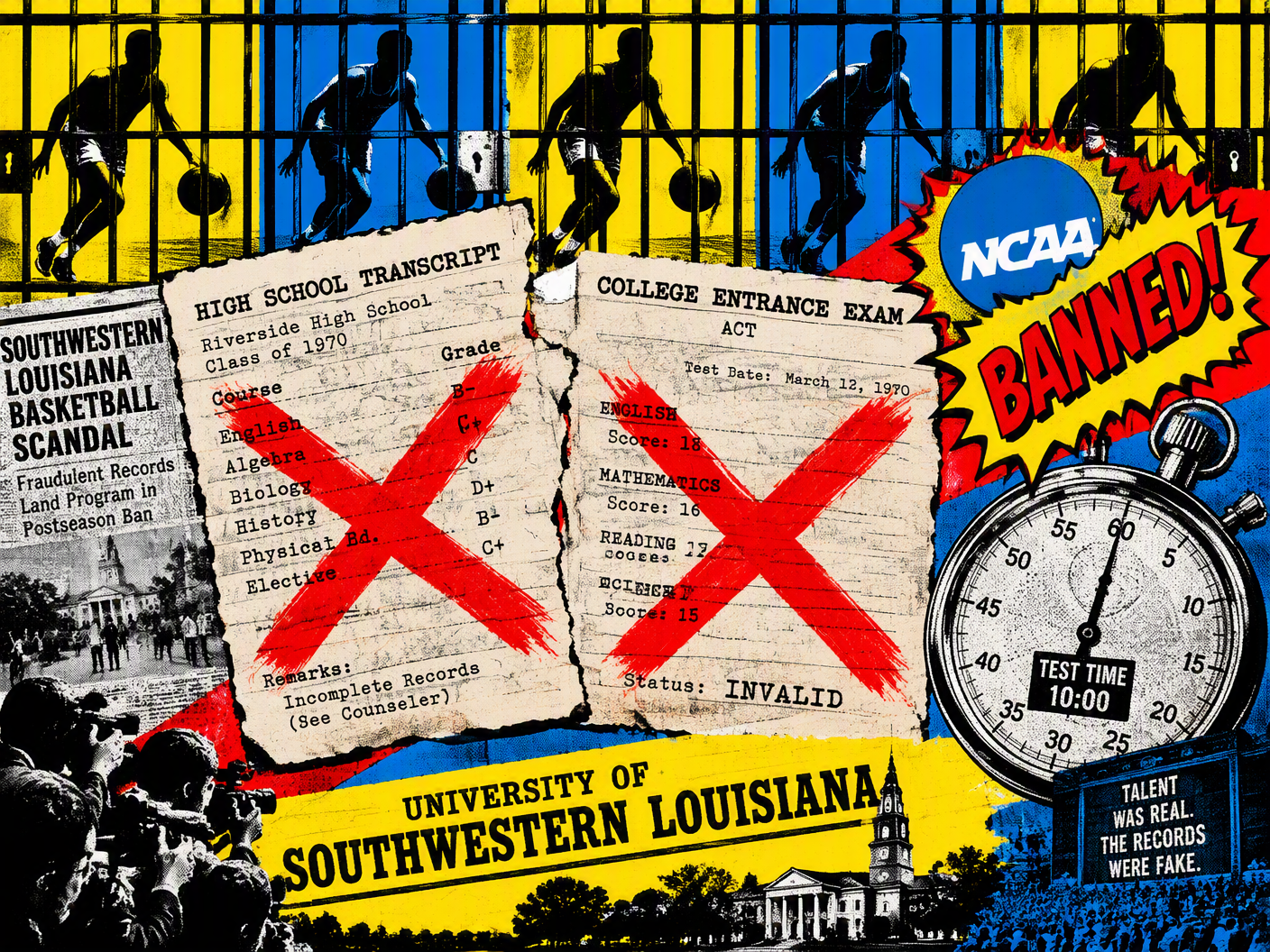
In August 1973, the basketball program at the University of Southwestern Louisiana stood beneath a floodlight it could not switch off. The NCAA had finished examining the machinery around the team, and the count had climbed past 125 violations. This was no single illicit handshake, no stray envelope passed under a table. The investigation reached into academic records, recruiting procedures, and the quiet scaffolding that turned teenagers into college athletes. In Lafayette, the basketball operation was no longer merely chasing wins. It was confronting an institutional verdict large enough to threaten the university’s place in the NCAA itself.
The number carried its own electrical charge. More than 125 violations meant repetition: one shortcut feeding another, one compromised safeguard opening the door to the next. The program’s public face was basketball—sneakers cutting the floor, whistles snapping through the gym, the hard white glare of competition—but the case moved through offices and paperwork. Eligibility lived in transcripts and examination scores before it ever reached the court. The athletic department had permitted a system in which the appearance of qualification could matter as much as qualification itself, and the NCAA Committee on Infractions now pulled that system into the light.
One piece of the academic fraud was brutally simple. An assistant coach altered a recruit’s high school transcript. A document designed to carry a student from one institution to another became a surface for manipulation, its grades no longer fixed evidence but adjustable material. The alteration contributed to the academic fraud allegations that drove the case. Somewhere between the high school file and the university’s recruiting process, the transcript stopped serving the student’s history and began serving the program’s appetite. Ink, in this episode, was not passive. It was an instrument of eligibility.
The examination scheme reached even deeper. Several boosters arranged for surrogates to take college entrance examinations in place of prospective recruits at Southwestern Louisiana. The recruit’s name could remain attached to the score while another person supplied the answers. The ritual of testing—desk, booklet, pencil, timed silence—became theater, a credential manufactured by substitution. Boosters did not simply cheer from the edges of the program; they helped construct the pathway by which recruits could enter it. The people who were supposed to measure readiness had been removed from the room, replaced by stand-ins carrying someone else’s future.
The violations therefore formed a chain between recruitment and competition. A transcript could be altered. An entrance examination could be taken by a surrogate. A recruit could be moved closer to the roster through paperwork that had been bent before the first practice began. The court remained the visible destination, but the decisive work happened earlier, in the offices where eligibility was assembled. That is the institutional tension at the center of the scandal: the team could appear to be competing under the rules while the machinery that admitted its players had already crossed them.
When the NCAA Committee on Infractions confronted the scale of the case, it initially recommended expelling the University of Southwestern Louisiana from the association. Expulsion would have severed the school from the governing structure of college athletics, stripping away the permission to compete inside the NCAA system. The recommendation transformed the scandal from a basketball penalty into an existential threat. The university was not merely being told to sit out a few games or surrender a trophy. Its entire relationship with the national competition was placed on the table, under the hard institutional light of punishment.
The recommendation also revealed how the NCAA understood the violations: not as isolated misconduct by one employee or one enthusiastic booster, but as a crisis serious enough to justify removing the institution altogether. The athletic department had overseen a program in which academic fraud and recruiting abuses could reach the eligibility pipeline. The language of expulsion carried a cold finality. It threatened the school’s future inside the sport, while the team’s ordinary calendar—practices, games, travel, the next opponent—was suddenly dwarfed by a decision made outside the gym.
The final punishment stopped short of expulsion but still emptied the postseason from the program’s horizon. The NCAA imposed a two-year postseason ban for the 1973-74 and 1974-75 basketball seasons. The team could continue its regular-season existence, but the tournament door was locked. No bracket, no postseason run, no late-season surge carrying the program into the national theater. For players, coaches, and supporters, the schedule became a corridor with a sealed exit. Every game could be played; none could lead to the destination that made the season nationally consequential.
That punishment carried a peculiar psychological weight. A regular season offers motion—buses, gyms, sweat, the repetitive violence of drills and games. A postseason ban creates absence. It removes the final stage before the season begins and leaves everyone moving toward a boundary already drawn. The sanction covered two consecutive seasons, 1973-74 and 1974-75, converting the NCAA tournament from an ambition into a forbidden object. The players inherited the consequences of an eligibility system they did not control, while the athletic department absorbed the institutional cost of the practices that had brought the ban down.
The scandal’s central objects were ordinary enough to disappear into a filing cabinet: a high school transcript, an entrance examination, a recruit’s eligibility record. Yet those objects carried the entire program’s credibility. Once the transcript was altered and examinations were taken by surrogates, the boundary between recruiting and academic certification collapsed. The university had sought athletes who could enter the program; the process used to prove that they belonged had been compromised. More than 125 violations gathered around that failure, and the NCAA answered by threatening expulsion before choosing a two-season exile.
By 1975, the ban had completed its work. Southwestern Louisiana’s basketball program had endured two seasons without the postseason, the tangible result of violations that began before the ball went up and extended far beyond any single game. The arena could still hold its noise. The uniforms could still carry the university’s name. But the tournament was gone, and with it the clean public story of competition. In its place remained the paper trail: altered grades, substituted examinations, boosters pressing from behind the curtain, and an athletic department forced to live with the cost of manufacturing eligibility.
Investigative Dossier & Evidence
Read the companion investigation notes, verified source claims, and primary documents.
Read the Companion Notes & Evidence Record →