
Violence & Brawls ·
How Disco Demolition Cost the White Sox a Game
After an explosion and a crowd invasion left Comiskey Park unplayable, a postponement became a White Sox forfeit.
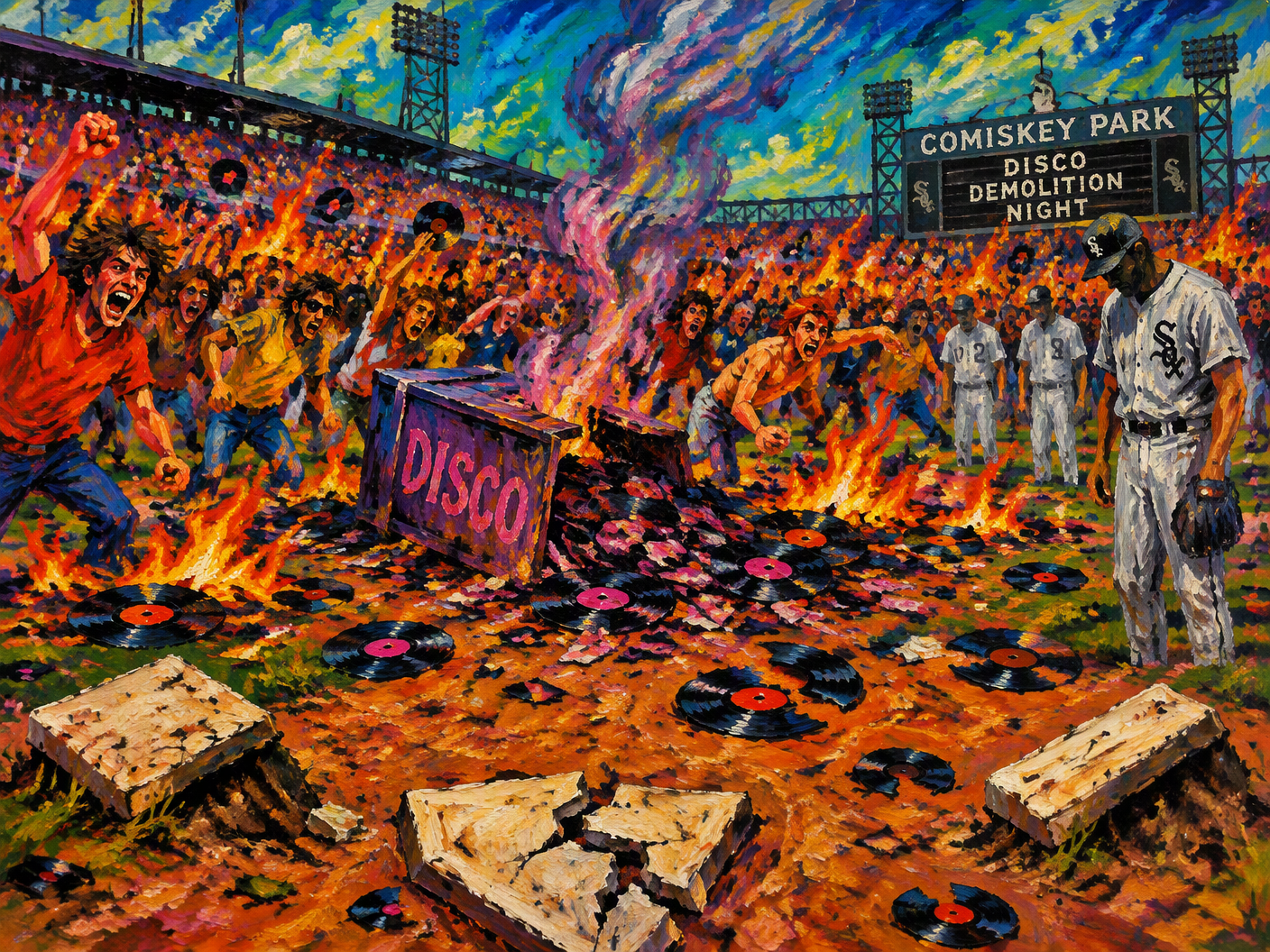
The records were supposed to be destroyed, not the playing field. On July 12, 1979, Chicago disc jockey Steve Dahl set off explosives in a crate of disco records between games of a White Sox–Detroit Tigers doubleheader at Comiskey Park. Thousands of spectators poured onto the field, leaving it unplayable. The question became whether to postpone the second game or charge the White Sox with a forfeit.
Dahl and White Sox promotions director Mike Veeck had devised Disco Demolition Night to draw people to a ballpark struggling with attendance and to promote Dahl’s station, WLUP. Dahl had lost his job at WDAI after it switched to an all-disco format, then taken his campaign against the music to the rock station. Anyone bringing a record for destruction could enter Comiskey for 98 cents.
The promotion drew far more people than its organizers expected. Recorded attendance was 47,795, above the park’s listed capacity of 44,492. Veeck and the station staff had hoped for 20,000; security had been hired for 35,000. Recalling the turnout in 2019, Dahl said, “I remember being surprised that that many people showed up.”
Trouble began before the explosion. Collection boxes overflowed, leaving some spectators with records at their seats, while security personnel dealt with the crush at the gates. Records, beer, lighters and firecrackers reached the field, repeatedly stopping play. Detroit nevertheless completed a 4–1 victory in the first game.
Then Dahl detonated the collected records in center field. The blast left a crater in the grass and sent flames and vinyl fragments into the air. Spectators entered the field, lit fires, toppled the batting cage and removed bases. Detroit pitcher Jack Morris recalled: “They charged the field and started tearing up the pitching rubber and the dirt. They took the bases. They started digging out home plate.” Appeals over the public-address system did not disperse the crowd. Riot police arrived, and Chicago police arrested 37 people.
Umpire supervisor Nestor Chylak met with the umpiring crew, White Sox owner Bill Veeck and Tigers manager Sparky Anderson. Detroit television commentator Al Kaline also attended. Kaline said those at the meeting were “afraid of somebody getting hurt, and also, the fact that home plate was uprooted from the ground and it has not been measured, it has not been properly put back in.”
Crew chief Dave Phillips called American League President Lee MacPhail, who ordered the second game postponed until Sunday. Anderson objected. Citing the rule book, he argued that the White Sox were responsible for the field conditions and that the result should be a forfeit. The next day, MacPhail informed Bill Veeck that the White Sox had lost the second game by forfeit. Detroit’s victory was recorded as 9–0.
Mike Veeck had been on the field when Dahl set off the explosives. Looking back nearly 40 years later, he said, “I never left second base. … I was just standing there thinking about what my next job would be, because I knew that my life as I knew it right then was over.”