
Point Shaving & Fixes · 1940s
William D. Cox, the Phillies Bets, and Judge Landis’s Lifetime Ban
William D. Cox bought the Philadelphia Phillies in 1943 and became Major League Baseball’s youngest owner. Months later, an accusation from manager Bucky Harris led Judge Kenesaw Mountain Landis from an internal inquiry to an indefinite suspension and a lifetime ban after Cox admitted making “sentimental” bets on his own team.
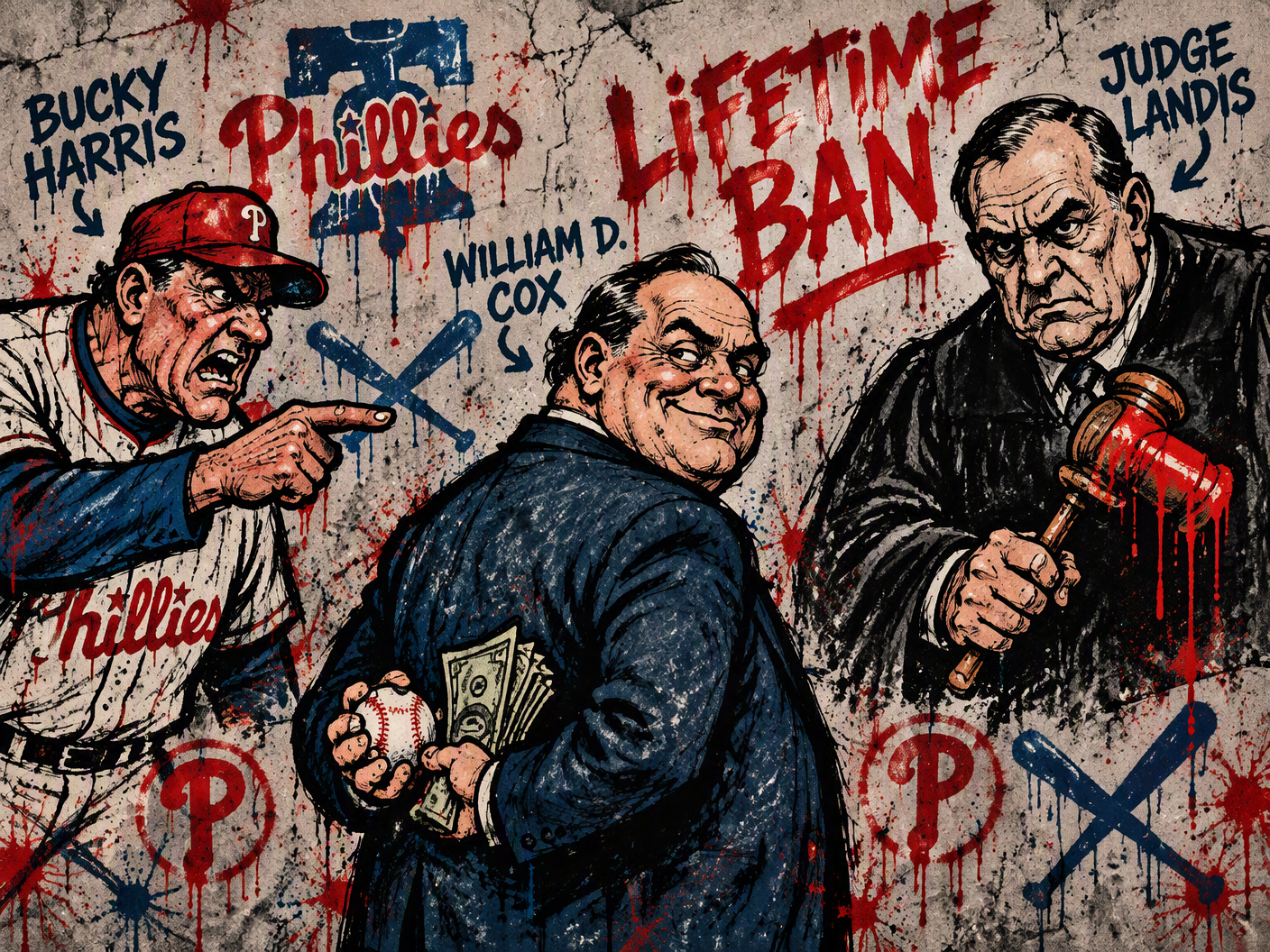
On July 28, 1943, Phillies manager Bucky Harris told William D. Cox that he had evidence the club’s owner was betting on Philadelphia games. The accusation placed the owner on the wrong side of the league’s central boundary: the person who controlled the team was also wagering on its performance. Cox had acquired the Phillies only months earlier. Harris’s intervention moved the matter beyond private suspicion and toward the office of Judge Kenesaw Mountain Landis, the commissioner who possessed authority to determine whether Cox could remain in baseball.
Cox’s ownership began in March. He purchased the Philadelphia Phillies and immediately occupied a position that carried operational control, financial interest, and access to the club’s internal affairs. He was also the youngest owner in Major League Baseball at the time of the takeover. The distinction made him a notable figure in the sport’s ownership class, but it did not give him a separate standard of conduct. The league’s integrity rules applied to the proprietor as they applied to the players whose games generated the wagers.
The accusation came from inside the organization. Harris was not describing a distant rumor when he confronted Cox; he told the owner that he possessed evidence of betting on the Phillies. The surviving account does not itemize every wager, stake, or game, but the allegation was specific enough to reach Landis. That transfer of authority mattered. A manager who challenged an owner risked the club’s internal hierarchy, while the commissioner could investigate the conduct as a league-level threat.
Landis opened an investigation into the accusation. His intervention converted the dispute between Harris and Cox into a formal disciplinary question: whether a team owner could bet on the club under his control and still retain the confidence of Major League Baseball. Cox initially denied wrongdoing. The denial placed his conduct in direct conflict with the charge Harris had brought forward, and it left Landis to assess the accusation through baseball’s own governing authority rather than through a criminal prosecution.
The investigation eventually produced a change in Cox’s account. After first denying wrongdoing, he admitted making what were described as “sentimental” bets on the Phillies. The word softened the motive without removing the act. Cox presented the wagers as an expression of attachment to his team, but ownership made that attachment structurally different from a fan’s interest. He was not merely observing the club’s fortunes. He owned the institution whose games formed the subject of his bets.
That admission supplied Landis with the central fact needed for discipline. The issue was not whether Cox had claimed to influence a particular game, nor whether every wager could be reconstructed from a ledger. The issue was the combination of ownership and betting on the owner’s own team. Cox’s changing position—from denial to acknowledgment—also gave the commissioner a direct account of conduct that had begun as an internal accusation.
On November 23, 1943, Landis suspended Cox indefinitely. The order removed the Phillies owner from baseball without yet fixing the final duration of the punishment. An indefinite suspension preserved the commissioner’s control while the matter moved toward a hearing. Cox’s ownership had begun less than a year earlier; by late November, his continued participation in the sport depended on a disciplinary process led by the same official who had opened the investigation.
Landis held the hearing in New York on December 4. Harris testified, and Cox faced the commissioner after the suspension had already separated him from baseball. The hearing gave formal shape to a conflict that had started inside the Phillies organization in July. Harris had brought forward the accusation, Cox had changed his account, and Landis had imposed an interim punishment. The remaining question was whether Cox could return to the club or remain permanently outside the sport.
Landis answered that question by ordering Cox banned for life from baseball. The decision ended Cox’s ownership career in the sport and converted the indefinite suspension into permanent exclusion. Cox became the first non-player banned from baseball by Landis. The distinction between player and owner had not protected him; it had made the case a test of whether baseball’s disciplinary authority reached the people who possessed its clubs as well as those who played for them.
The punishment was administrative, but its consequence was absolute. Cox was not sentenced by a criminal court in the documented episode. Baseball itself removed him from the institution he had purchased, after an investigation into betting on his own team and an admission that he had made “sentimental” wagers. The surviving account leaves the individual bets only partly specified, yet the chain of decisions is clear: a March acquisition, a July accusation, a November suspension, and a December lifetime ban.
Cox’s brief tenure exposed the limit Landis placed on private ownership. A proprietor could buy a franchise and direct its business, but he could not treat the team’s games as a personal betting instrument without placing his standing before the commissioner. Harris’s accusation triggered the inquiry; Cox’s admission narrowed the dispute; Landis’s order established the consequence. On December 4, 1943, the youngest owner in the major leagues became its first non-player expelled for life by Judge Landis.
Investigative Dossier & Evidence
Read the companion investigation notes, verified source claims, and primary documents.
Read the Companion Notes & Evidence Record →