
Scandals & Feuds · 2000s
Ovechkin, Crosby, and the Capitals-Penguins Rivalry Built Through Repeated Games
The rivalry between Washington and Pittsburgh took shape through a sequence of regular-season meetings, playoff series, and a league realignment that placed the clubs in the same division. Its defining moments were played out in score lines and late goals, not in one originating incident.
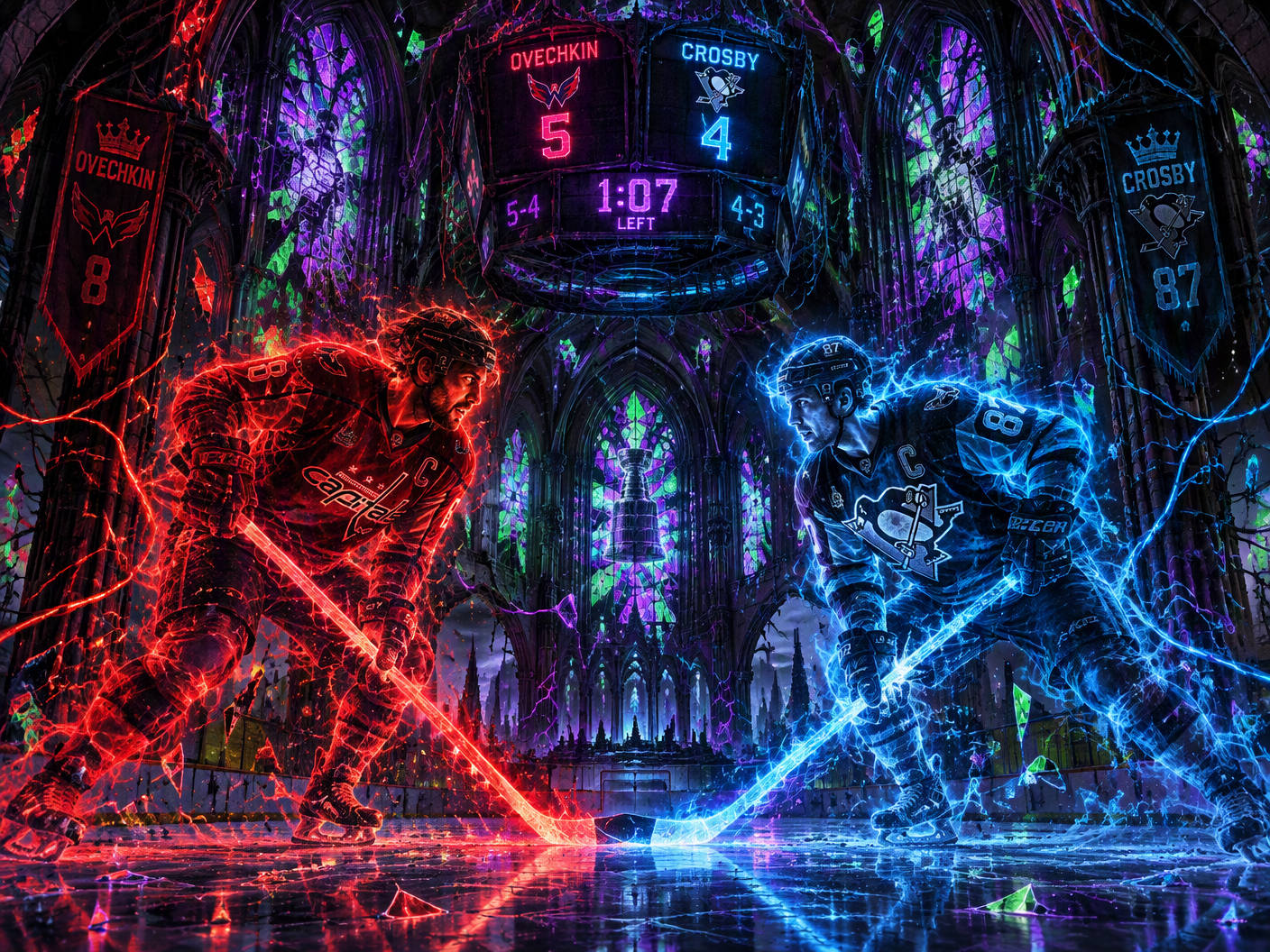
On November 22, 2005, in Pittsburgh, Alexander Ovechkin and Sidney Crosby met for the first time in an NHL game. The Penguins won 5-4. Crosby scored a goal and added an assist; Ovechkin recorded an assist for Washington. The game entered the league’s ordinary statistical record as one result among many, but the two players would keep meeting until the result no longer stood alone. Their names became attached to the same schedule, the same postseason brackets, and eventually the same division.
They arrived in the NHL as franchise centers of attention for different organizations, but the league did not need to manufacture their proximity. Washington and Pittsburgh supplied the fixed geography. Each club carried its own ambitions, and each meeting gave the players another measurable contest: goals, assists, wins, and losses. The rivalry grew by accumulation. A later retelling could compress it into the opposition of two stars; the sequence itself was less simple. It was built from games that required both men to return to the same conflict.
The playoff version became unmistakable in 2009. Washington and Pittsburgh met in a seven-game Eastern Conference semifinal series, moving the rivalry from the regular-season calendar into the elimination structure that governs the NHL’s spring tournament. In that setting, an individual performance did not end with its own statistics. Every goal altered the position of an entire club, and every victory carried the possibility of ending the season for the other.
On April 22, 2009, Game 2 in Washington produced the most concentrated display of the two players’ competition. Crosby scored three times for Pittsburgh. Ovechkin also scored three times for Washington. Both players recorded hat tricks, and the Capitals won 4-3. The score preserved the narrow margin between them: neither star disappeared inside the game, and neither performance settled the larger contest. The result belonged to Washington, while the individual record gave both players an equal statistical claim to the night.
The 2009 postseason continued to give the matchup a structure beyond personal comparison. Washington and Pittsburgh were not meeting for exhibition, ceremony, or symbolic recognition; they were contesting a playoff series in which the next game determined the next obligation. The Capitals’ victory in Game 2 became one part of a seven-game Eastern Conference semifinal, while the repeated appearances of Crosby and Ovechkin supplied the human scale. Their rivalry could be counted in series results, but it could also be seen in the way each game placed one star’s production directly against the other’s.
On May 2, 2009, the clubs opened another Eastern Conference semifinal with a Washington victory in Game 1. By then, the matchup had acquired a second layer. The players were no longer simply two prominent young forwards appearing in the same season. Their teams were meeting in rounds where the consequences were immediate, and the league’s postseason calendar kept returning the comparison to the same question: which club could convert its star’s performance into the series result?
The league later altered the conditions under which the answer would be pursued. Before the 2013-14 season, the NHL announced a realignment that placed Washington and Pittsburgh in the same Metropolitan Division. The decision was administrative, but its effect was practical. The clubs now occupied the same divisional field, where regular-season meetings were built into the schedule rather than left to the chance of conference standings or occasional playoff qualification.
Realignment did not create the rivalry, because the players and clubs had already met in regular-season and playoff competition. It did give that rivalry an institutional home. Washington and Pittsburgh would see one another with greater regularity, and the comparison between their captains could persist outside the compressed weeks of the postseason. The rivalry became part of the league’s operating arrangement: a recurring divisional obligation, renewed by scheduling rather than dependent entirely on a particular playoff draw.
Five years later, the teams met again in the 2018 Eastern Conference Second Round. The setting had changed, as had the players’ place within their organizations. The contest still reduced the larger history to the immediate demands of a playoff game: possession, position, and the remaining minutes. On May 2, at PPG Paints Arena in Pittsburgh, Game 3 moved toward its closing minute with Washington and Pittsburgh still separated by the next decisive play.
With 1:07 remaining in the third period, Ovechkin scored the go-ahead goal. Washington won Game 3 and led the series 2-1 afterward. The goal did not erase the earlier games, and it did not reduce Crosby’s role to a foil in a prewritten story. It was another documented reversal in a matchup defined by repeated opportunities to answer: Pittsburgh’s first victory in 2005, the dual hat tricks and Washington win in 2009, the divisional realignment, and now a late Washington goal on Pittsburgh ice.
The public shape of the Capitals-Penguins rivalry therefore rests on sequence rather than origin myth. It begins with a 5-4 Pittsburgh win in November 2005, passes through the seven-game playoff structure and the 4-3 Washington victory in April 2009, and continues after the NHL places both clubs in the Metropolitan Division. By May 2018, the rivalry had become durable enough that one goal with 1:07 left could alter a series while still belonging to a much longer history of scheduled contests.
Investigative Dossier & Evidence
Read the companion investigation notes, verified source claims, and primary documents.
Read the Companion Notes & Evidence Record →