
Scandals & Feuds · 2010s
Rick Crawford’s Lake Mary Sting and the Federal Conviction That Followed
Rick Crawford arrived at a Florida parking-lot meeting on February 28, 2018, and was arrested after communicating with an undercover officer posing as the father of a fictitious 12-year-old girl. A jury convicted the former NASCAR Truck Series driver, and federal court later sentenced him to 10 years and 10 months in prison.
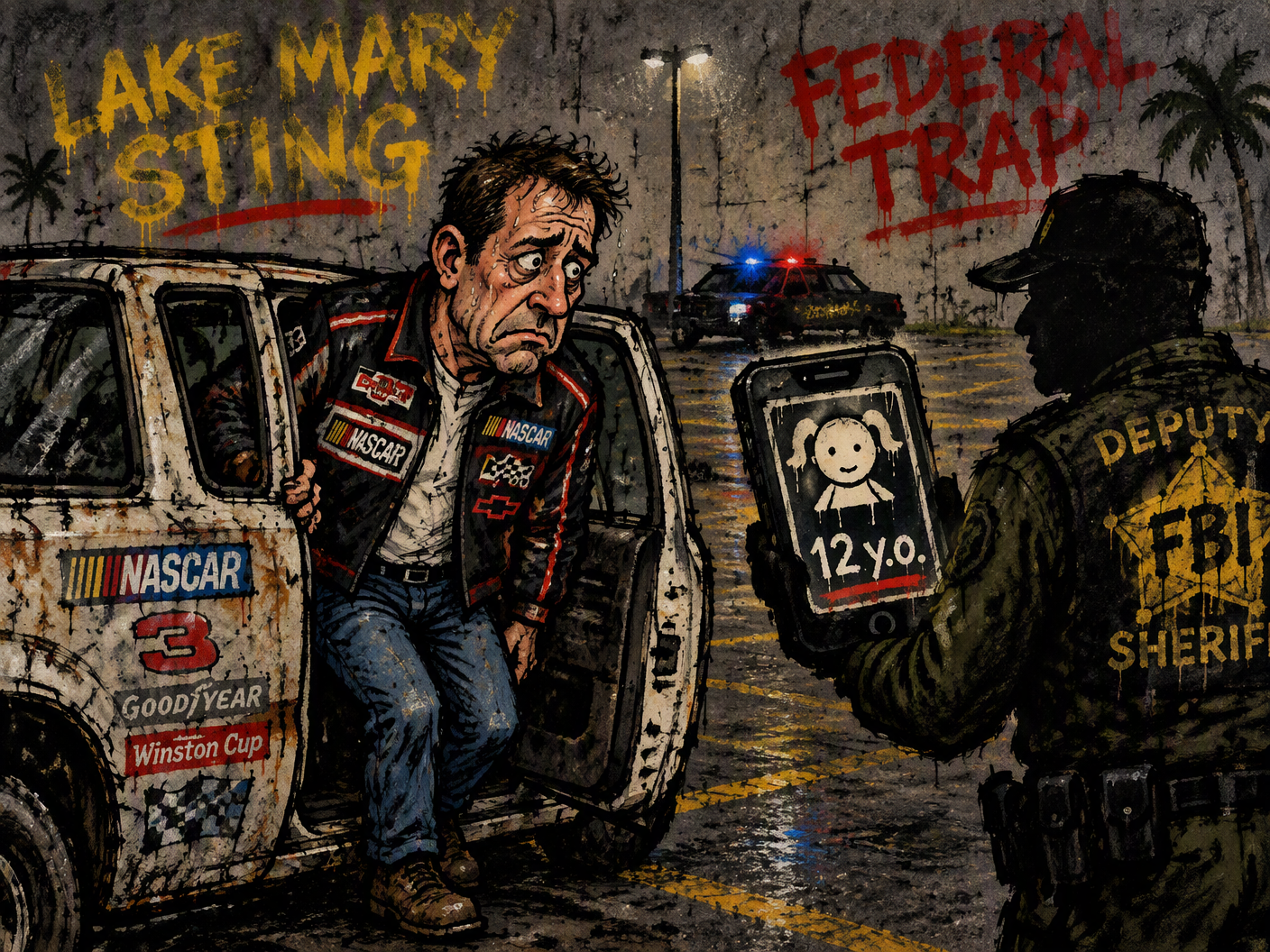
Rick Crawford was getting out of his vehicle in a Lake Mary parking lot when the meeting ended. The man waiting for him was a Seminole County sheriff’s deputy working with an FBI child sex crimes task force. The deputy had presented himself as the father of a 12-year-old girl. Crawford arrived anyway. On February 28, 2018, officers arrested him in Florida and took the meeting out of the realm of messages, arrangements, and intention. The charge waiting for him was attempted enticement of a minor.
The operation had begun online. Between February 10 and the arrest, Crawford exchanged numerous emails and text messages with the undercover officer. The communications moved toward a meeting and toward a transaction. The girl was fictitious, but the arrangement presented to Crawford was not casual. It was built around the supposed father, the supposed child, and a planned encounter in Lake Mary. The messages became the bridge between a former racing driver’s public identity and a federal criminal case.
The final price was reported as between $50 and $75 for sex with the supposed 12-year-old. That sum appeared in the case’s account of the arrangement, a small figure attached to a charge that would eventually remove Crawford from ordinary life for years. The exchange was not discovered after an accident or exposed by a rival. Investigators created the identity, maintained the contact, and set the meeting. Crawford supplied the replies and came to the parking lot.
The arrest was the hard turn in the case. Until then, the contact lived on screens and in the language of planning. At the meeting, the deputy’s false identity stood opposite Crawford in a Florida parking lot, and the FBI task force moved in. Crawford was taken into custody on February 28. The former NASCAR Truck Series driver was no longer being measured by laps, starts, or finishes. He was facing a federal attempted-enticement charge.
By March 1, Crawford remained in the Seminole County Jail in Sanford. The jail was the immediate address of the case, but the prosecution belonged to federal court. The charge concerned attempted enticement of a minor, and the government’s case rested on the undercover communications and the meeting arranged in Lake Mary. There had been no real child at the parking lot. The child had been a fictitious 12-year-old persona used by the deputy. The arrest, however, was real, and so was the prosecution.
Crawford had once occupied a narrow, recognizable place in American racing as a NASCAR Truck Series driver. That history did not soften the federal process. The case did not remain a matter for a team statement or a suspension announced between races. A charge was filed. The jail held him while the case advanced. The communications, the proposed price, and the scheduled meeting supplied the sequence prosecutors brought into court.
The prosecution reached a jury on August 30, 2018. The jurors convicted Crawford of enticing a minor. The verdict turned the undercover meeting into a judgment entered against him, not merely an arrest preserved in a racing biography. Eight months earlier, the case had been a chain of electronic exchanges and an appointment in a parking lot. Now the federal court had a conviction to sentence.
The conviction carried the weight of the original arrangement: the supposed child, the messages, the price, and Crawford’s arrival. The operation had used a fictitious girl, but the jury’s verdict concerned Crawford’s conduct in the attempted encounter created by the investigation. The legal question was no longer whether he had shown up. He had. The question was what that conduct meant under federal criminal law. The jury answered with a guilty verdict.
On November 26, 2018, federal court sentenced Crawford to 10 years and 10 months in prison. The sentence followed the arrest, the jail stay, the charge, and the jury conviction in a sequence that took less than a year to reach its final courtroom stage. The former driver’s name had moved from racing results into federal sentencing records. The prison term was not an administrative penalty from the sport. It was the consequence imposed by the court after conviction.
The case later carried into the appellate record, where the conviction was affirmed. That outcome left the central sequence intact: Crawford communicated with an undercover officer, agreed to a meeting involving a fictitious 12-year-old persona, arrived in Lake Mary, and was arrested. A jury convicted him on August 30. Federal court imposed 10 years and 10 months on November 26. The later legal history did not return him to the track or erase the sentence.
There was no real minor at the meeting. The child existed as an undercover identity carried by a Seminole County deputy working alongside the FBI task force. That fact fixes the shape of the case without changing its ending. Crawford was arrested, charged, convicted, and sentenced. The public criminal record stops short of turning the fictitious girl into a real victim, and it does not resolve every defense question that might have been raised in court. It does leave a former driver with a federal conviction and a prison term measured in years.
Investigative Dossier & Evidence
Read the companion investigation notes, verified source claims, and primary documents.
Read the Companion Notes & Evidence Record →