
Violence & Brawls · 1960s
The Battle of Santiago: When Chile and Italy Needed Police to Finish a World Cup Match
On June 2, 1962, a World Cup match between Chile and Italy deteriorated into repeated violence at Santiago’s Estadio Nacional. Referee Ken Aston required four police interventions as players fought, one refused to leave after being sent off, and Chile’s 2–0 victory eliminated Italy from the tournament.
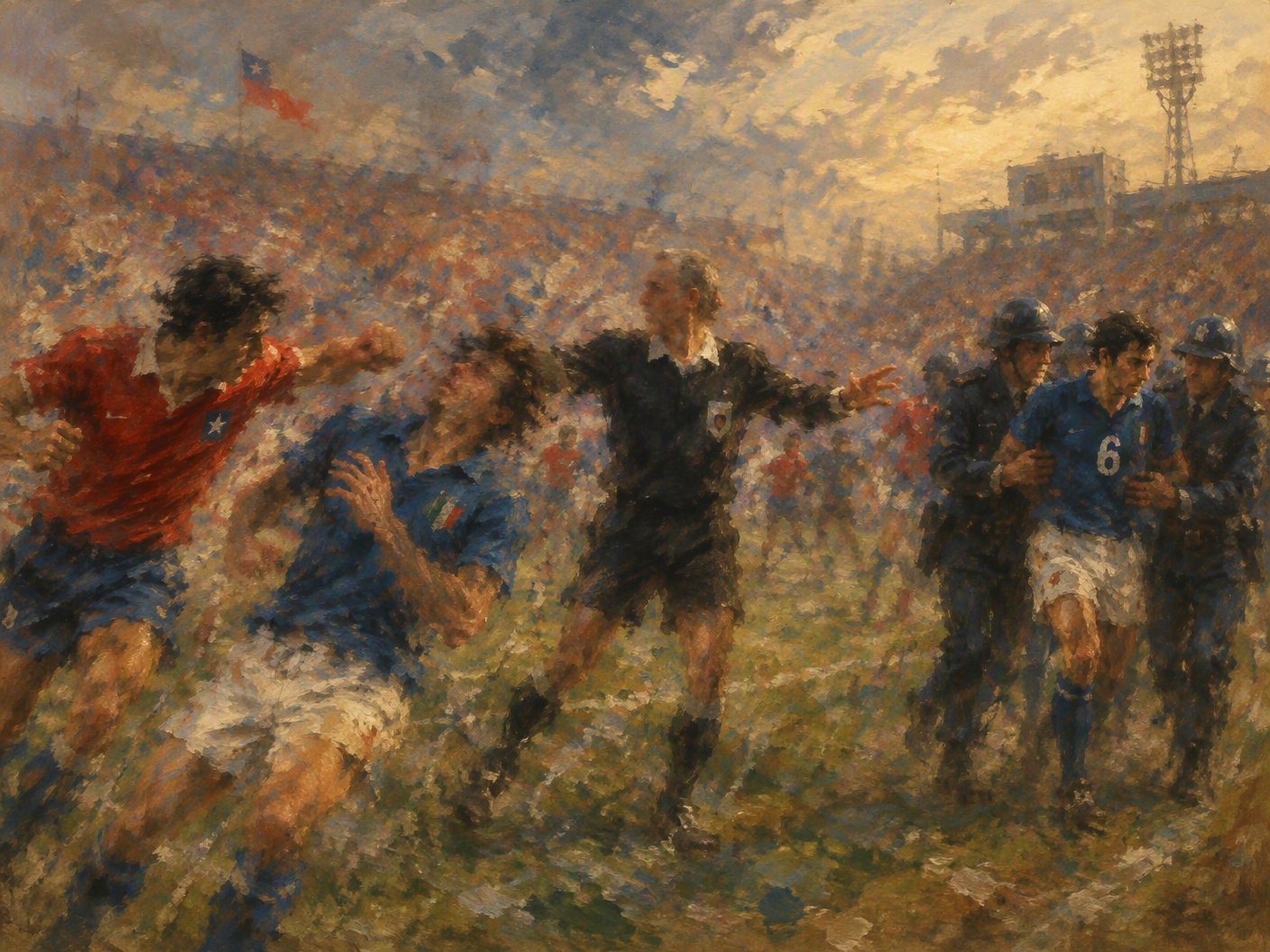
On June 2, 1962, at Santiago’s Estadio Nacional, the match officials had barely established control before the football ceased to resemble an ordinary contest. Chile and Italy met beneath the hard pressure of a World Cup match, with the host nation carrying the heat of national expectation and Italy carrying the hostility of words already printed about Chile and its citizens. Within minutes, the referee, Ken Aston, was managing not only tackles and fouls but the movement of police across the playing surface. The afternoon would become known as the Battle of Santiago.
The antagonism had been prepared before the players reached the field. Italian journalists had published derogatory comments about Chile and its people, intensifying the atmosphere around a match that already carried the ordinary pressure of elimination football. The language traveled into Santiago with the teams. By kickoff, the contest contained a second, less visible struggle: the host country against the insult, the visitors against the reception that followed, and officials attempting to contain feelings that had been given public shape in print.
Aston was the central authority on the grass, but authority in those opening minutes proved fragile. In the eighth minute, Italy’s Giorgio Ferrini committed a foul and Aston sent him off. Ferrini did not immediately leave. The red card, in an era when disciplinary procedures were less formalized and the referee’s command depended heavily on physical enforcement, became another confrontation. Ferrini remained on the pitch while the match waited around him. Police entered to remove him, converting a football sanction into a public act of custody.
The removal established the pattern that would define the afternoon. A dismissal no longer ended an incident; it extended it. Players watched the police intervention, the crowd watched the players, and Aston watched for the next breach. The match continued, but its boundaries had begun to fray. Four separate police interventions would be required before the final whistle. Each entrance carried the same quiet procedural message: the officials could still restart the game, but they could not guarantee that the game would govern the men inside it.
Chile’s Leonel Sánchez became one of the match’s principal figures in an episode that further narrowed the distance between football and assault. Sánchez punched Italy’s Humberto Maschio. The act joined the earlier foul and dismissal in a sequence of blows, stoppages, and confrontations that made ordinary competition difficult to recognize. The names belonged to international players, men placed inside the ceremony of the World Cup, but the conduct required a response more familiar to a police cordon than to a referee’s whistle.
Aston remained at the center of the disorder, moving through a match in which every decision threatened to become another dispute. He later described the experience as akin to acting as an umpire in military manoeuvres. The comparison was exact in its bleakness. An umpire observes, judges, and signals; military manoeuvres demand vigilance over movement, position, and sudden collision. Aston had been appointed to enforce football’s laws. Instead, he confronted a contest whose violence repeatedly summoned the law enforcement outside the sport.
The police interventions did not erase the match or restore its original shape. They became part of its structure. The players returned to their positions, the ball moved again, and then the pressure gathered until another intervention was necessary. Four times, police were required during the match. The number matters because it measures the distance between a difficult game and a breakdown of control. This was not one isolated confrontation that ended with a whistle. It was a recurring condition, renewed across the afternoon.
For Italy, the violence carried a competitive cost that could not be separated from the tournament table. Chile scored twice. Italy did not score. When the match ended, Chile had won 2–0, a result that effectively eliminated Italy from the 1962 World Cup. The scoreline was clean; the route to it had not been. Two goals remained in the official arithmetic, while the rest of the afternoon survived in the memory of police entering the field, a player resisting removal, and fists interrupting the sport.
The match acquired its name because the violence was not incidental to its identity. The Battle of Santiago became the phrase attached to Chile–Italy, binding the city to an international spectacle that had exceeded its own rules. Santiago supplied the setting, but the conditions had arrived from several directions: hostile journalism, national pride, tournament pressure, and the players’ willingness to answer provocation with force. Aston’s whistle remained audible, yet it shared the field with the heavier authority of police uniforms.
In the aftermath, the result and the violence could not be filed separately. Chile’s 2–0 victory advanced the host nation’s position while Italy left the tournament effectively finished. Ferrini’s eighth-minute dismissal remained tied to the sight of police escorting him away. Sánchez’s punch remained tied to Maschio and to the accumulating disorder. Aston’s phrase supplied the final image: an official trying to referee a game that had begun to resemble a military operation. The match ended with football’s score intact and its authority repeatedly breached.
Investigative Dossier & Evidence
Read the companion investigation notes, verified source claims, and primary documents.
Read the Companion Notes & Evidence Record →