
Tragedy ·
Belcher Killed Perkins. A Later Brain Report Left Questions.
The December 2012 killing and suicide left an infant without either parent. Later CTE-associated findings did not establish a cause for the violence, and an independent specialist said they needed corroboration.
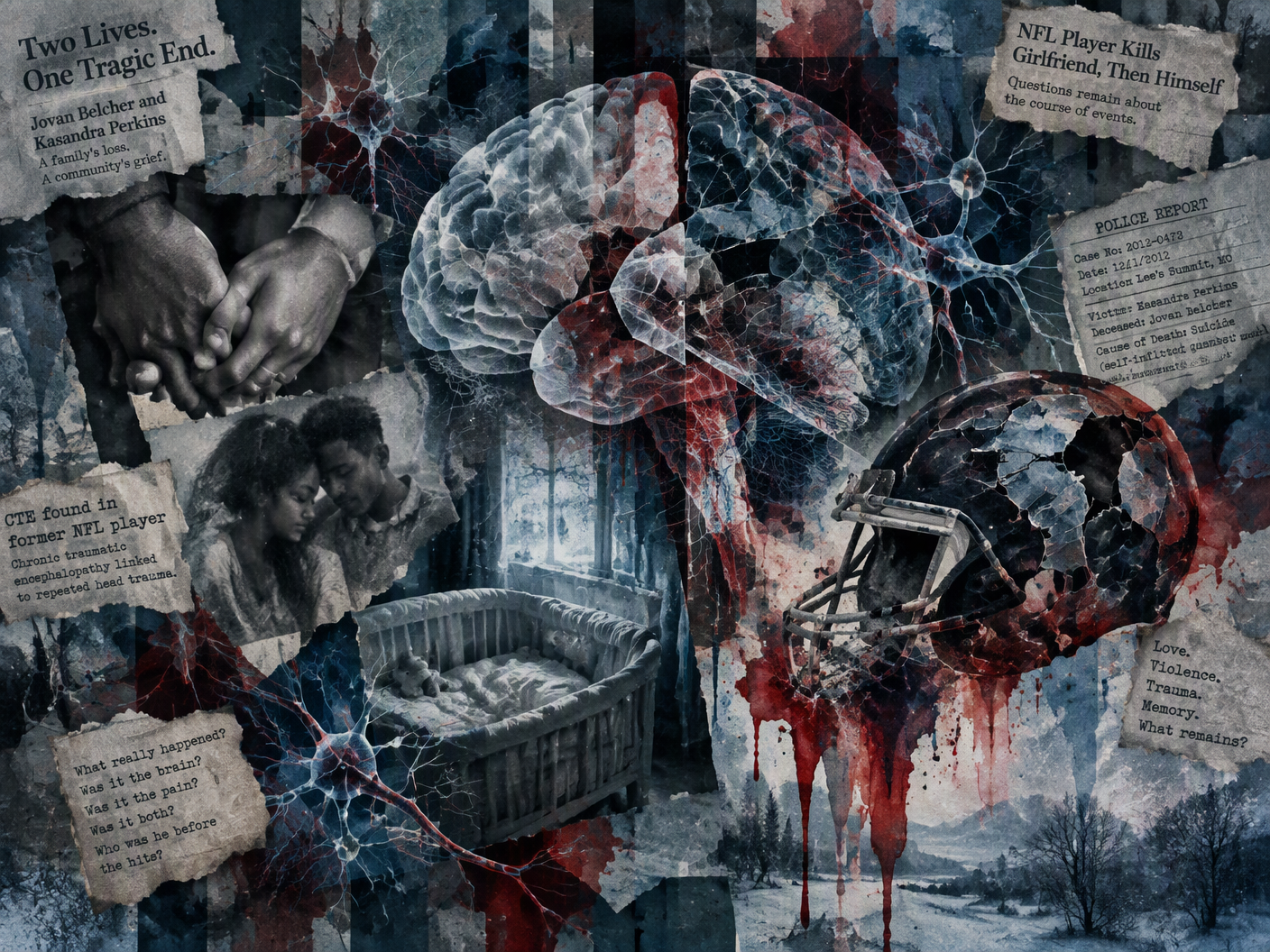
On Dec. 1, 2012, Kansas City Chiefs linebacker Jovan Belcher fatally shot Kasandra Perkins at the home they shared, then drove to the team’s practice facility and killed himself. Perkins was 22; Belcher was 25. Their infant daughter lost both parents. Later findings associated with a brain disease would raise questions about Belcher’s health, without establishing why he killed Perkins or himself.
Police reports released two days after the deaths said Belcher shot Perkins nine times in the home’s master bathroom. The emergency call came from Belcher’s mother, who had recently moved in with the couple. She described Perkins as her daughter, initially confusing authorities about who had called. “She treated Kasandra like a daughter,” police spokesman Darin Snapp explained.
At the Chiefs’ practice facility, Belcher encountered head coach Romeo Crennel, general manager Scott Pioli and defensive coordinator Gary Gibbs. Snapp said Belcher thanked the coaches for what they had done for him. They later told police they had not felt in danger. According to the subsequently released police reports, Belcher ducked behind a car and shot himself after seeing police arrive in the parking lot.
Authorities did not release a possible motive in their initial account. Police said the couple had been arguing recently, but that information did not explain the violence. The Chiefs and the NFL announced counseling support for those affected. Perkins’ family described her as a beloved daughter, granddaughter, sister, mother, cousin and friend.
Nearly two years later, in September 2014, reporting by ESPN’s “Outside the Lines” brought attention to an examination of Belcher’s brain. His body had been exhumed a year after his death, and his brain was examined two weeks afterward. Neuropathologist Piotr Kozlowski had been hired by court-appointed attorneys representing the interests of Belcher’s daughter. Attorney Dirk Vandever said Belcher’s mother initiated the effort to have his brain studied.
In a report obtained by “Outside the Lines,” Kozlowski described neurofibrillary tangles of tau protein, associated with chronic traumatic encephalopathy, or CTE. He found the tangles throughout Belcher’s hippocampus, a region involved in memory, learning and emotion. The report also noted some decomposition, with parts of the brain better preserved than others.
Those findings carried an important limitation. “Outside the Lines” requested brain images for another neuropathologist to examine independently, but the request was denied. Neurosurgeon Julian Bailes, who had not examined Belcher’s brain, said violence against others was “not typically part of the CTE picture.” He added: “It would be nice to have these findings corroborated.” The reported examination left unresolved whether brain injury played any role in either death.
The later medical questions did not change what Perkins’ family had said in the days after she was killed. “Our hearts are truly broken,” their statement began. In a separate statement, the family of Chiefs running back Jamaal Charles remembered Perkins as “a friend and a loving mother” and asked that people keep “most importantly, their child in prayer.”