
Violence & Brawls · 1890s
James Oxley and the 1892 East End Fight with Crib
In 1892, James Oxley was named as the human participant in a reported fight against Robert Green’s dog, Crib, at an East End club near Hoxton’s Britannia Theatre. The surviving account preserves the sequence and injury it described, while the later identity of a mathematician named James G. Oxley belongs to another life entirely.
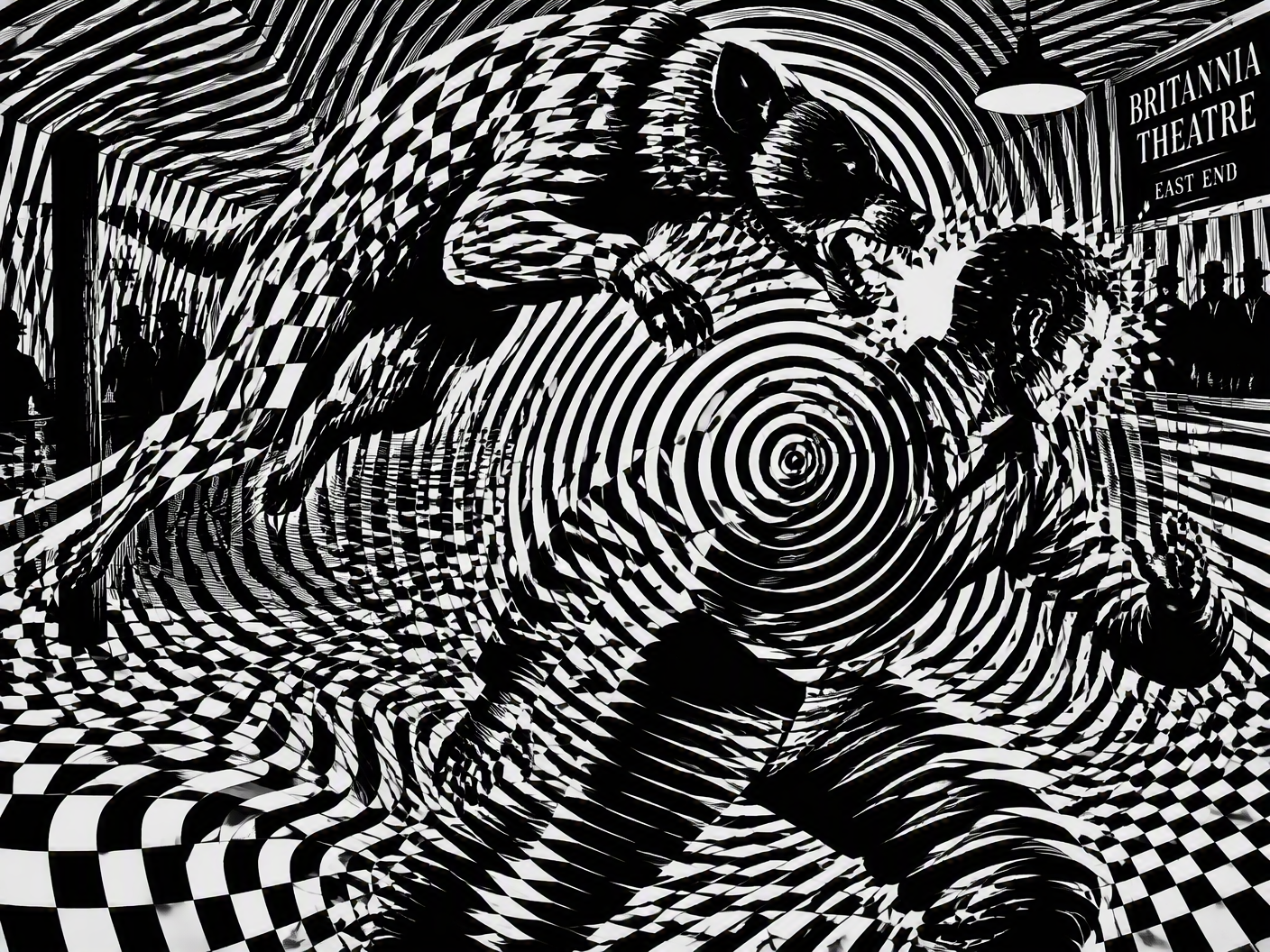
In 1892, at an East End club not many yards from the Britannia Theatre in Hoxton, James Oxley entered a contest arranged against a dog called Crib. The animal belonged to Robert Green. The encounter was presented as a human-versus-dog match, not as an accidental attack or an ordinary fight that had broken out among spectators. Its terms were simple and severe: Oxley would face the dog, and the contest would continue until one of them could no longer remain in it.
The setting placed the event within the working geography of late-Victorian entertainment, close to a known theatre and inside a club whose name has not carried forward with the story. The Britannia Theatre supplied the fixed point: a few yards away, the account located a separate room where a man and an animal were brought together for combat. Green stood in the story as Crib’s owner, while Oxley occupied the other side of the contest. Their roles were defined before the struggle began.
For twenty-one minutes, Oxley kept Crib off with his fists. That detail gives the episode its measured interval, turning what might otherwise survive as a single grotesque image into a sequence of exertion and resistance. The man did not simply meet the dog once and disappear from the account. He remained engaged through the opening period, using his hands to prevent Crib from reaching him as the contest continued inside the East End club.
Then the balance changed. Crib jumped over Oxley’s left shoulder and fastened onto his right ear. The movement crossed the line of Oxley’s body: from the left side, over the shoulder, to the opposite ear. In the brief description, the dog’s bite became the decisive act. The fists that had held Crib away could no longer keep the animal from closing the distance, and the contest narrowed to the grip at Oxley’s head.
The account ends the physical sequence with Crib being choked off. By then, the upper part of Oxley’s right ear had disappeared. The wording is blunt because the injury is not treated as a metaphor or as an emblem of courage. It is the reported result of the bite: a portion of the ear gone after the dog had fastened on and was forced away. No treatment, recovery, or later medical examination enters the surviving narrative.
That compressed sequence—twenty-one minutes, the leap over the left shoulder, the grip on the right ear, the removal of the upper part of it—became the entire architecture of Oxley’s place in the story. Green’s presence explains how Crib entered the contest, but the account gives him no extended role beyond ownership. Oxley is named as the combatant; Crib is named as the animal; the club near the Britannia Theatre is the fixed location where their brief and damaging encounter was said to have occurred.
The event belonged to a period when contests involving animals could be circulated as entertainment and when a strange incident could travel through print without acquiring the formal shape of a court case. The story required no league, governing body, or professional license to give it an audience. A named man, a named dog, an owner, a nearby theatre, and an injury were enough to preserve it. Its force came from the unusual pairing and from the precision of the physical detail.
Later readers also had to decide which James Oxley the story concerned. A modern database lists James G. Oxley, a mathematician who earned a D.Phil. From the University of Oxford in 1978. That James Oxley belonged to a twentieth-century academic record, separated from the Hoxton club by generations and by an entirely different occupation. His entry provides a name that resembles the one in the 1892 account, but it does not place the mathematician inside the East End contest.
The distinction matters because unusual stories invite unusual biographies. A missing piece of an ear can become a career, and a career can be attached to the nearest person who shares a name. In this case, the named combatant remains James Oxley, the man who faced Crib; the mathematician remains James G. Oxley, the Oxford-trained scholar. The two identities do not join merely because a later search can retrieve both. The story’s old names must remain with the roles assigned to them.
What endured from the East End episode was therefore not a complete biography of Oxley or a documented career for Crib, but a sharply outlined incident: an 1892 club near the Britannia Theatre, Robert Green’s dog, twenty-one minutes of resistance, a leap over the left shoulder, and an injury to the right ear. The account preserved those particulars while leaving the larger lives outside its frame. The legacy rests on that narrow arrangement of names, place, duration, and wound.
Investigative Dossier & Evidence
Read the companion investigation notes, verified source claims, and primary documents.
Read the Companion Notes & Evidence Record →