
Scandals & Feuds · 2039
Hockey Canada’s 2022 Settlement, Reserve Fund, and the London Case’s 2025 Acquittals
A 2022 civil claim brought Hockey Canada’s handling of sexual-misconduct allegations into a national dispute over settlements, reserve funds, public money, and institutional accountability. London police reopened the 2018 investigation that summer; charges were laid in January 2024, and an Ontario Superior Court judge acquitted all five defendants after the 2025 trial.
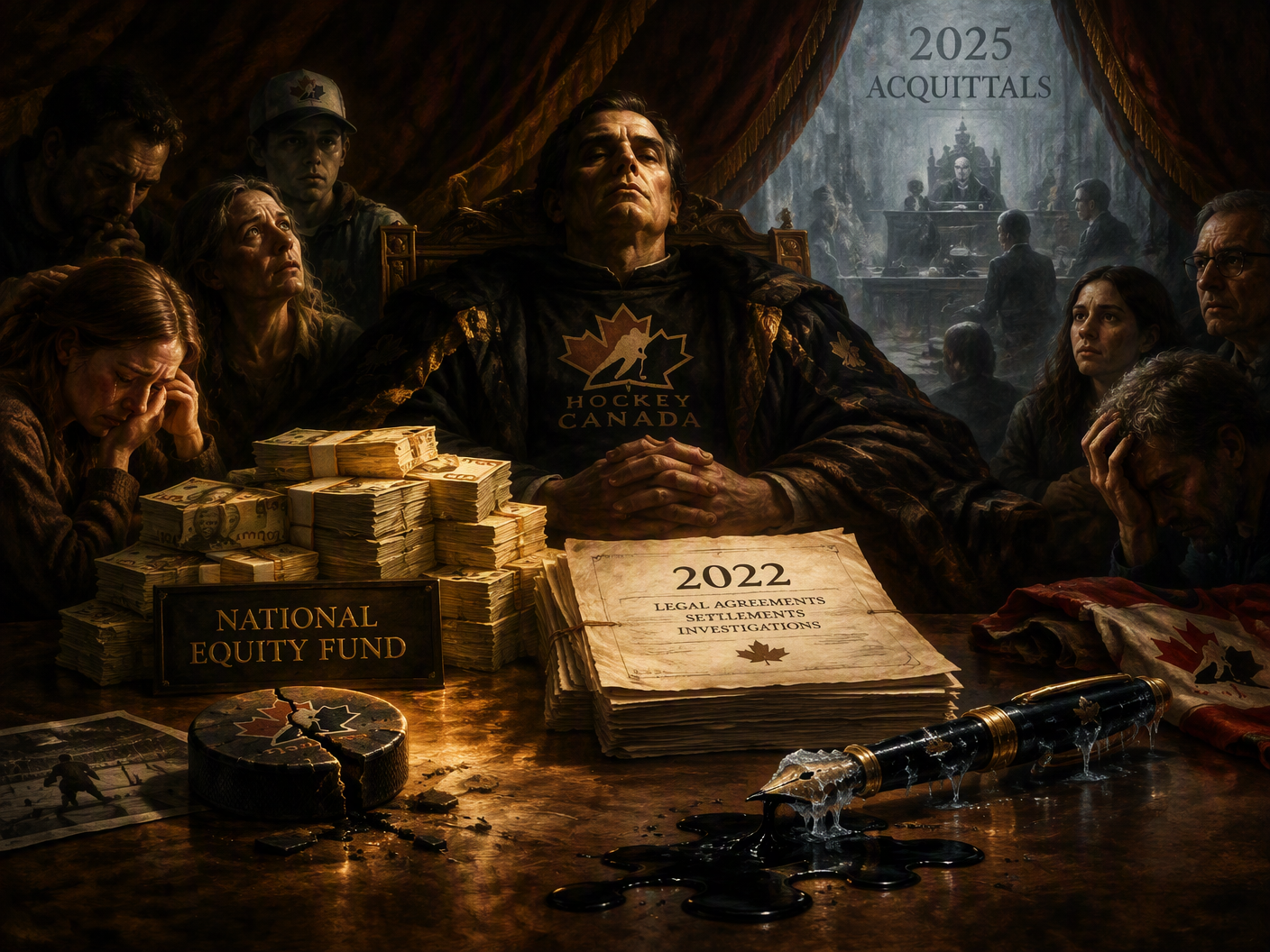
In April 2022, E.M. Carried a civil claim into Ontario Superior Court against Hockey Canada, the Canadian Hockey League, and eight unnamed junior players. The claim alleged that she had been sexually assaulted in a London, Ontario, hotel room after a Hockey Canada gala on June 19, 2018. A private event connected to the country’s most powerful junior-hockey institution had become a legal action with named defendants, an alleged assault, and a demand for accountability. The filing moved the matter from an enclosed hotel room into the public systems that govern money, policing, and sport.
The London incident entered a history already marked by unanswered questions. In January 2003, Halifax police began investigating allegations of a group sexual assault connected to the junior Team Canada program. The later London case involved a different group of players and a different police service, but the recurrence mattered to the institution that would eventually face Parliament: Hockey Canada was not dealing with a single isolated legal bill. It was carrying decades of exposure to allegations involving young players, national teams, staff networks, and an organization whose authority reached from elite competition into local rinks.
London police closed the initial investigation in February 2019 without laying charges. More than three years later, E.M.’s civil claim forced a separate question into view: what had Hockey Canada done with the allegations, and how had it paid to resolve earlier claims? Hockey Canada and the CHL settled the lawsuit in May 2022 for an undisclosed sum. The settlement ended the civil action without a public trial, while leaving the alleged events outside a judicial finding. For E.M., the legal route produced confidentiality and financial resolution; for the organizations, it created a new problem of institutional explanation.
The financial explanation arrived before the criminal case did. Hockey Canada testified that it had spent C$8.9 million settling 21 sexual-misconduct lawsuits between 1989 and the May 2022 settlement. Of that amount, the organization said C$7.6 million came from its National Equity Fund. The figures transformed a question about one settlement into a question about how a national sports body reserved money for legal consequences. In an economy built on registration fees, sponsorships, broadcasts, and public relationships, the payment of a claim was no longer only a private transaction between lawyers.
The fund had its own institutional history. In 1999, Hockey Canada created a Participants Legacy Trust Fund using money from the National Equity Fund. The arrangement became part of the public controversy because the same reserve structure was discussed alongside sexual-misconduct settlements. Hockey Canada disputed aspects of that account, but its testimony established the central figures: millions had been paid, and most of the acknowledged total had come from the equity fund. The dispute was therefore about architecture and control—who supplied the money, who authorized its use, and whose risks the fund was designed to absorb.
In June 2022, Pascale St-Onge, the federal minister for sport, froze government funding to Hockey Canada and called for an audit into possible use of public money. Parliament opened an inquiry through the Standing Committee on Canadian Heritage. The decision carried a practical consequence for the organization: money connected to federal programs was no longer treated as an automatic extension of Hockey Canada’s authority. Scott Smith, then the president and chief executive, testified about the organization’s handling of the allegations. The reserve fund had become a matter of public administration, not merely internal accounting.
The parliamentary hearings also exposed the distance between organizational language and the experience of a complainant seeking an answer. Andrea Skinner, serving as interim board chair, said the settlement was intended to resolve the matter respectfully without a trial. That explanation described the legal purpose of settlement, but it could not supply the factual determination a trial might have produced. E.M.’s claim had been resolved; the alleged assault had not been adjudicated. The institution could close its file financially while the public institutions around it continued asking what had happened and who had known.
In July 2022, Hockey Canada announced that it would no longer use the National Equity Fund to finance sexual-misconduct settlements. The policy change followed the funding freeze and parliamentary scrutiny. It did not declare the fund illegal, and it did not determine that public money had paid the London settlement. It did establish a new boundary for the organization’s own finances. A reserve once used in the settlement system would no longer serve that purpose, placing future legal costs somewhere else and acknowledging that the old arrangement had become impossible to defend as ordinary administration.
That same summer, London police reopened their investigation into the 2018 allegations. The criminal process now moved on a separate track from the civil settlement and the parliamentary inquiry. In January 2024, police charged Carter Hart, Dillon Dubé, Michael McLeod, and Cal Foote with sexual assault; Alex Formenton had surrendered two days earlier and was also charged. The names belonged to players from the 2018 Canada World Juniors team. Their careers, contracts, and public identities were pulled into a process that had begun with a hotel-room allegation and passed through a confidential settlement.
The trial ran from April 22 to July 24, 2025, in Ontario Superior Court in London. Justice Maria Carroccia entered acquittals for all five defendants. The result fixed the criminal legal outcome: the charges did not end in convictions. It also placed a limit on what the earlier stages could establish. A civil claim, a settlement, a police reopening, parliamentary testimony, and a funding controversy could all be documented without proving that the alleged assault occurred or that Hockey Canada had committed a criminal offense. The institutions had generated consequences, but not a single final account of every disputed fact.
Hockey Canada’s response continued beyond the courtroom. The organization reopened its own investigation, ended the use of the National Equity Fund for sexual-misconduct settlements, and announced governance and culture changes. Smith later resigned with the board, and Skinner resigned as interim chair. Those departures showed how institutional responsibility can travel upward even when criminal liability is not established. The consequences were administrative and political: funding was frozen, leaders left, and a national governing body was required to explain not only what its players were accused of doing, but how its own policies had managed the risk.
For E.M., the central event remained the alleged assault in a London hotel room on June 19, 2018, followed by years in which the matter moved through police closure, civil litigation, settlement, police reopening, and criminal trial. For Hockey Canada, the cost included C$8.9 million in acknowledged settlements, a reserve fund placed under scrutiny, lost federal support, parliamentary examination, and leadership change. The public outcome carried two realities at once: the organization’s financial and institutional choices were exposed, while the criminal case ended in acquittals. What remained with the people involved was not one uncomplicated verdict, but the unequal burden of a process that took seven years to reach its legal end.
Investigative Dossier & Evidence
Read the companion investigation notes, verified source claims, and primary documents.
Read the Companion Notes & Evidence Record →