
Violence & Brawls · 1920s
Fritz Pollard’s 1923 Hammond Pros Start and the NFL’s Black Firsts
Fritz Pollard started at quarterback for the Hammond Pros in 1923, becoming the first Black quarterback in the NFL record and the league’s first Black head coach. His career unfolded within a hostile racial order, then entered the institution’s permanent memory with his 2005 Hall of Fame induction.
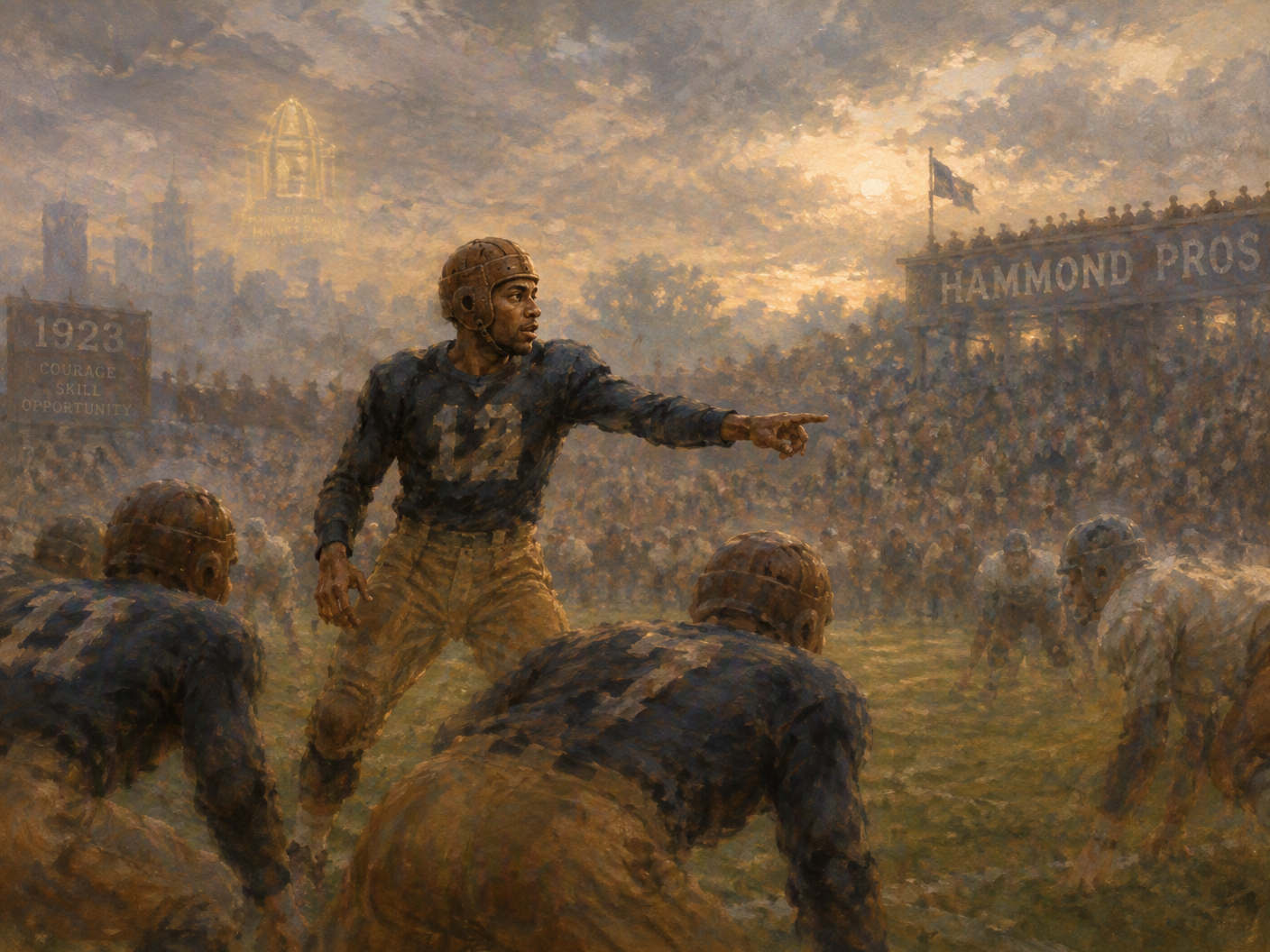
In 1923, Fritz Pollard started at quarterback for the Hammond Pros. The position placed him at the center of the offense and at the edge of what professional football was prepared to recognize. Pollard was not simply a Black player appearing on a professional roster. He was directing play from the quarterback position, and the league’s later historical record identified him as its first Black quarterback. The event was brief in calendar terms—a season’s place on a team—but durable in consequence. From that point forward, the history of Black quarterback play in the NFL had a named beginning.
Pollard had arrived at Hammond after establishing his authority at Brown University. In 1916, he led Brown to its only Rose Bowl appearance and to the university’s first victory over Harvard. Those accomplishments gave him a collegiate distinction before professional football placed him inside its more restricted racial order. Brown was not merely the institution from which he graduated; it was the setting in which Pollard’s ability had already been attached to victories, leadership, and public expectation. When he moved into the professional game, he carried that established football authority with him.
The interval between Brown and Hammond represented a change in scale, not a change in the demands placed on him. College success could be preserved as a campus achievement, held within the memory of an alumni institution. Professional football required the same player to claim authority in a league whose racial conditions were hostile to Black participation. Pollard entered that world with the experience of having led a major program, but without the protection that later recognition might provide. The role had to be performed before it could be commemorated.
The historical designation attached to Pollard rests on a precise fact: in 1923, he played quarterback for Hammond. He is also identified as the first African American to play in the National Football League. These two descriptions place him at separate points in the same boundary. He was the first Black player in the league’s institutional history, and he did not enter as an incidental participant. He entered at quarterback, the position associated with directing the offense. The first appearance and the first quarterback start therefore belong to the same career.
Quarterback play gave Pollard a particular form of visibility. A player in that position could not be reduced to speed or size alone; the offense moved through his decisions and execution. The Hammond Pros’ use of Pollard at quarterback placed a Black athlete in a role of command at a time when football’s racial order made such authority difficult to treat as ordinary. His achievement was athletic, but its meaning was institutional as well. The league had to record that a Black player had occupied the position, even if the surrounding culture had not made the path equal.
Pollard’s professional career thus unfolded amid racist hostility, not outside it. The surviving historical account supports that broad condition without requiring a catalogue of sensational incidents. The central fact is more direct: a Black pioneer was asked to establish legitimacy in a sport that had not made Black leadership routine. Every appearance carried the pressure of representation, while the football itself still demanded the ordinary work of preparation, decision-making, and performance. Pollard’s place in the story comes from holding those burdens together rather than from separating athletic accomplishment from the racial conditions around it.
His authority extended beyond the position on the field. Pollard also served as the NFL’s first Black head coach. The coaching distinction altered the nature of his responsibility: the quarterback directed play during competition, while the coach held authority over the preparation and organization of a team. Pollard therefore appears in the league’s history not only as the first Black player and quarterback, but as its first Black figure in the senior football role on the sideline. In the 1923 record, playing and leadership were joined in one career.
That combination separated Pollard from a narrow account of integration in which a player merely crossed a roster line. He entered the NFL as a participant, occupied its most consequential offensive position, and became a coach. The sequence shows a Black football professional exercising authority at multiple levels of the sport. It also reveals why later summaries of his career treated the firsts as connected. Pollard’s significance was not exhausted by the fact that Hammond used him at quarterback for one season; the same career challenged the assumption that Black football labor belonged only in subordinate roles.
The later history of Black quarterbacks makes the 1923 start legible as the beginning of a longer, difficult arc. Pollard’s designation came from the position he actually played, but its importance expanded as the league continued to measure who was permitted to lead. The first Black quarterback and the first Black head coach were not separate curiosities. Together they marked the range of football authority Pollard had already occupied before later generations could make those roles more familiar. His career remained an early point of reference because the institution moved slowly beyond it.
For years, Pollard’s accomplishments existed across different forms of memory: Brown’s victories, Hammond’s 1923 lineup, and the league’s account of its first Black quarterback and coach. On February 5, 2005, that career received another institutional acknowledgment when Pollard was voted into the NFL Hall of Fame. The induction came long after the games and after the professional roles that had defined his pioneering place. It did not create the achievement. It placed the achievement inside the sport’s most durable official honor.
Pollard’s afterlife in football rests on a sequence that later myth can easily flatten: Brown leadership in 1916, a Hammond Pros quarterback start in 1923, the first Black quarterback and head-coaching designations, and Hall of Fame recognition in 2005. The sequence preserves both the individual and the institution that eventually claimed him. Pollard did not wait for the league to make the position ordinary before occupying it. He played quarterback, coached, and left the record with a precedent that remained visible even when the sport was slow to follow.
Investigative Dossier & Evidence
Read the companion investigation notes, verified source claims, and primary documents.
Read the Companion Notes & Evidence Record →