
Tragedy · 1983
The Final Round of Francisco Bejines
On September 1, 1983, Francisco Bejines entered Los Angeles's Olympic Auditorium for a sanctioned fight against Alberto Davila for the vacant WBC interim bantamweight title. He led on two judges' scorecards before a final-round knockdown ended the bout; three days later, after emergency treatment and an air transfer between hospitals, Bejines died.
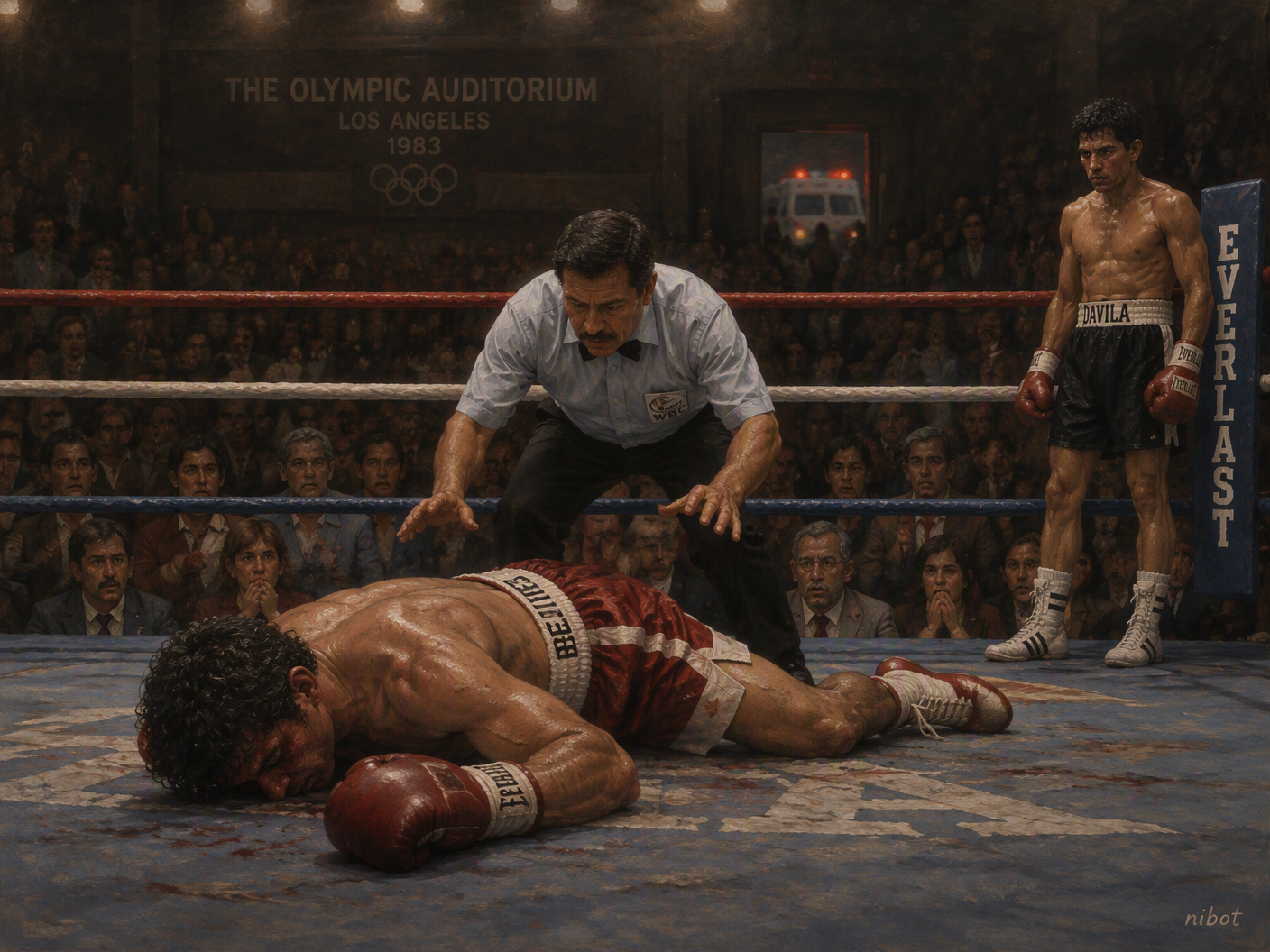
On September 1, 1983, at the Olympic Auditorium in Los Angeles, Francisco Bejines was dropped in the final round of a fight that had been moving toward a decision. He had entered the ring against Alberto Davila for the vacant WBC interim bantamweight title, a championship contest conducted under the authority of the sport's established officials. The bout changed in its closing minutes. Davila landed a left jab and then a hard right, Bejines went down, and referee Waldemar Schmidt stopped the fight after Bejines tried to rise.
The title was vacant, which gave the contest a particular administrative meaning before either man threw a punch. The winner would not be taking a championship from a reigning opponent; he would be filling an open place in the World Boxing Council's bantamweight structure. Bejines and Davila therefore met in a formal title bout, with judges, a referee, ringside physicians, and the procedures that accompanied a sanctioned professional fight. Those arrangements governed the contest until the final exchange placed Bejines in need of medical care.
Before the last round began, Bejines was ahead on two of the three judges' scorecards. The scoring placed him in front at the point when the fight's outcome still appeared to depend on the remaining minutes. That detail also fixes the contest's shape: this was not a bout recorded as one-sided from its opening, but a competitive championship fight whose decisive event came late. The scorecards carried the fight toward its ordinary conclusion—a decision—until Davila's punches replaced the judges' arithmetic with an immediate stoppage.
Early in the final round, Davila landed the left jab and followed it with the right hand that dropped Bejines. The sequence was brief and consequential. Bejines fell during the round in which he had begun with the advantage, and the contest ended at the moment when the referee determined that he could not safely continue. Waldemar Schmidt stopped the bout after Bejines attempted to get up. Davila received the result, while the vacant interim title fight ended without reaching the scorecards.
The ring's decision was not the last medical event of the night. After the stoppage, Bejines received emergency treatment from medical personnel. He was taken to California Hospital, where staff attempted to treat the injuries sustained in the fight. The sequence moved quickly from the regulated space of the auditorium to the hospital system: the boxer who had been competing for a title was now under clinical care, and the title result had become secondary to his condition.
California Hospital did not mark the end of the response. Bejines was transferred by air to Los Angeles County-University of Southern California Medical Center, an escalation that placed him in another institution while the consequences of the final-round collapse continued. The documented movement between the two hospitals is central to what followed. It records not simply that Bejines left the auditorium injured, but that medical staff continued active treatment after the fight and arranged a transfer for further care.
For the people inside the fight on September 1, the immediate facts were narrower than the later consequence. Davila had landed the punches. Schmidt had stopped the bout. Bejines had received treatment and been moved from California Hospital to Los Angeles County-USC Medical Center. The larger meaning of those events was not yet visible in the ring. A title contest that had turned on a final-round exchange had become a hospital case, but the timeline was still unfolding.
Bejines died on September 4, 1983, three days after the fight. His death fixed the final boundary of the episode: the championship bout in Los Angeles, the knockdown in its last round, the emergency treatment, the air transfer, and the death that followed. The sequence does not require embellishment. Its force rests in the compressed interval between a competitive scorecard and a medical emergency, between an attempted return to the ring and a life that ended before the week was over.
The surviving public account identifies the event as a sanctioned championship fight that ended after a knockdown and stoppage. It does not turn the contest into an intentional assault or a murder allegation. Davila's role in the documented sequence is that of Bejines's opponent, the fighter who landed the final-round punches and received the stoppage result. Schmidt's role is equally specific: he was the referee who ended the bout after Bejines tried to rise. The sequence assigns responsibility to the event's participants without inventing a crime beyond what is established.
Nor does the public account supply a more granular medical narrative than the one preserved in the chronology of treatment, transfer, and death. It establishes that Bejines was injured, treated, moved by air, and dead three days later. It does not furnish a terminal diagnosis that would support claims beyond that sequence. What endured in the record was therefore not a complete medical reconstruction, but a precise sporting and institutional outline: a vacant title, two leading scorecards, a final-round collapse at the Olympic Auditorium, and a death that followed on September 4.
Investigative Dossier & Evidence
Read the companion investigation notes, verified source claims, and primary documents.
Read the Companion Notes & Evidence Record →