
Scandals & Feuds · 1990s
The Cross at ECW High Incident
On October 26, 1996, ECW turned a championship defense at its Philadelphia arena into a barbed-wire crucifixion angle led by Raven's Nest. The same event marked Kurt Angle's first professional wrestling appearance, placing a future Olympic champion inside one of the promotion's most extreme productions.
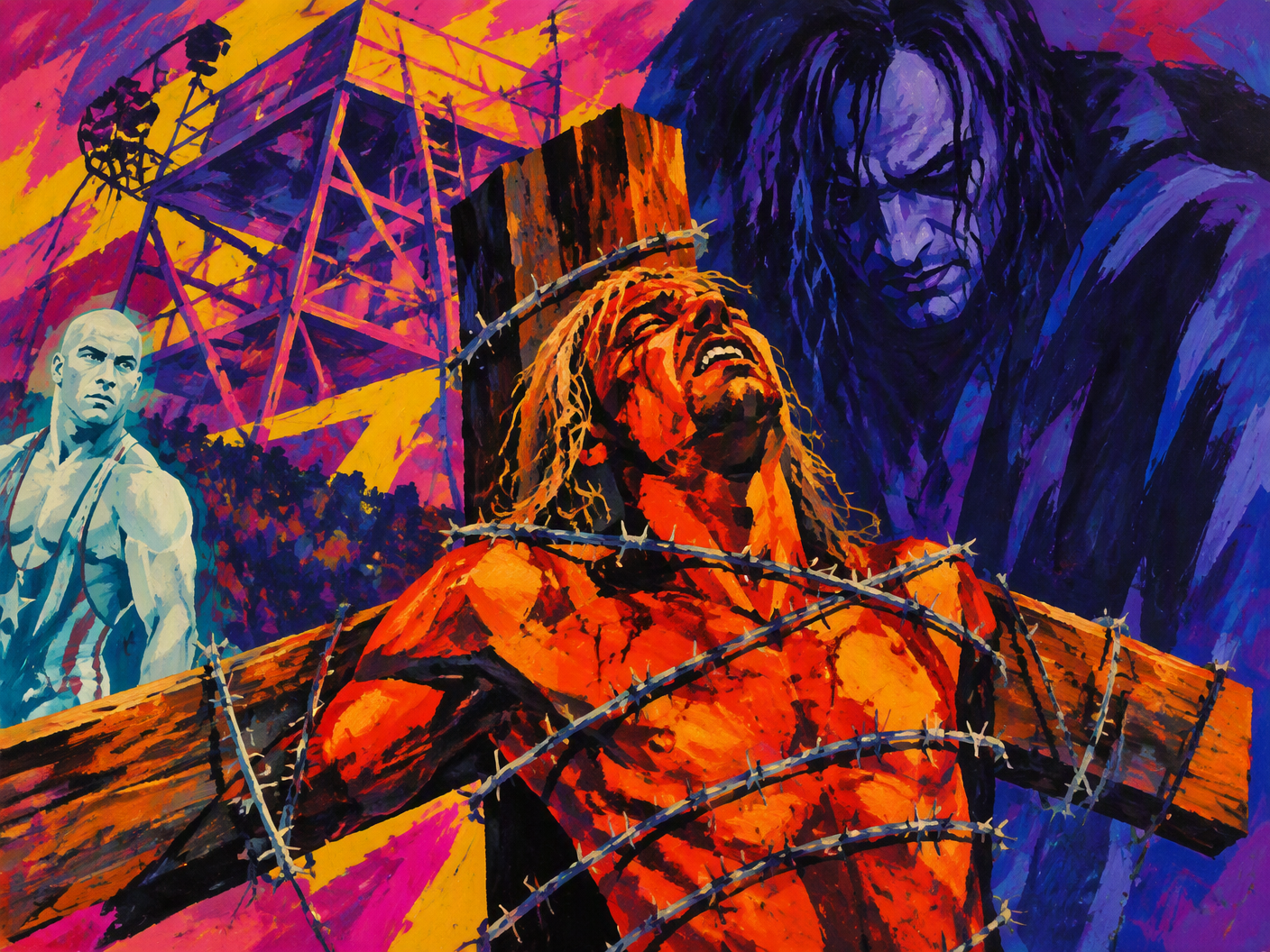
On October 26, 1996, at the ECW Arena in Philadelphia, The Sandman defended the ECW World Heavyweight Championship against 2 Cold Scorpio. He retained the title. Then the match stopped being a championship contest. Raven's Nest moved against him, brought out a wooden cross, and tied the champion to it with barbed wire. The image became the defining incident of ECW High Incident: a titleholder still inside the arena, bound beneath the authority of a rival faction, while the promotion converted a wrestling finish into an assault staged through religious symbolism and physical restraint.
The event had been built around a card in which danger was not confined to the ordinary boundaries of a wrestling ring. Its main event was a scaffold match between Tommy Dreamer and Brian Lee, a contest conducted above the floor rather than on it. The structure altered the basic terms of movement: the wrestlers fought with height beneath them and the arena surface waiting below. For ECW, the scaffold was not decoration. It was the central object of the match, and it made the possibility of a fall part of the contest's design.
Another scaffold match supplied the card's earlier descent. Perry Saturn, wrestling for The Eliminators with Kronus, faced Steve Williams and Terry Gordy in a tag team contest. Saturn won by dropping from the scaffold and connecting with Gordy. The result was not a conventional pinfall built from a sequence of holds; it was decided by a fall from the elevated structure, with the height itself serving as the decisive weapon. That sequence established the event's physical vocabulary before the championship match carried it into a different form.
Tommy Dreamer and Brian Lee then occupied the position reserved for the night's principal contest. Their scaffold match placed two wrestlers in the setting that had already defined the earlier tag bout, but the match also carried the accumulated logic of their feud and of ECW's presentation. The scaffold made every exchange legible from the arena floor: distance, balance, and the threat of a fall were visible parts of the performance. High Incident did not need a separate explanation for its severity. The card had already made elevation into an instrument of conflict.
The championship bout gave the evening its final formal result. The Sandman met 2 Cold Scorpio for the ECW World Heavyweight Championship and kept the belt. In the ordinary structure of a wrestling event, that should have closed the principal contest: champion survives challenger, title remains with its holder, and the card moves toward its conclusion. Instead, the title defense became the threshold for the night's lasting angle. The victory settled the sanctioned contest only long enough for Raven's faction to impose a second one.
Raven led the post-match attack. His faction, Raven's Nest, tied The Sandman to a wooden cross with barbed wire, binding the ECW champion after he had retained the title. Lori Fullington and Tyler Fullington were connected to the scene as members of the group surrounding Raven's conflict with Sandman. The angle relied on a direct reversal of wrestling's usual symbols: the champion's belt represented possession and status, while the cross represented helplessness. Sandman's victory remained official; his body became the message that followed it.
The cross also changed the scale of the confrontation. A wrestling match has rules that announce when violence begins and ends, even in a promotion built around their deliberate expansion. The post-match scene moved into a different register, using barbed wire to make the restraint visible and making Raven's leadership unmistakable. The act was performed within ECW's wrestling framework, but it was designed to look like a violation of that framework. That tension—staged action presented through the language of punishment—gave High Incident its durable place in accounts of the promotion.
Kurt Angle was present at the same event for his first professional wrestling appearance. The Olympic medallist did not wrestle a match that night. His role centered on commentary surrounding Taz's match with Little Guido, alongside Joey Styles and the wrestlers involved in the broadcast presentation. Angle therefore entered professional wrestling not through a debut bout, but as a recognizable athlete placed near the action while ECW explained itself through its own voices and confrontations.
That proximity later acquired a second meaning. Angle would become one of professional wrestling's most accomplished performers, and later retellings naturally placed the beginning of that career beside the barbed-wire cross. The date fixes the first appearance, but the event itself does not turn every later development into a consequence of that night. At High Incident, Angle was an Olympic medallist making an initial appearance around Taz and Little Guido; the future career belonged to a later sequence of decisions.
ECW's television record preserved portions of High Incident and helped carry the event beyond the Philadelphia arena. The scaffold matches and the championship aftermath belonged to the promotion's continuing cycle of rivalries, broadcasts, and remembered angles. The cross became the image most often attached to the show, even as television presentations did not include the crucifixion footage in the form later viewers sometimes assumed. The distinction belongs to the event's afterlife: what happened in the arena and what was later shown were related, but they were not identical.
No police action, criminal charge, or court proceeding formed the public consequence of the angle. Its force came from the decision to present a staged post-match assault with a champion, a faction leader, a wooden cross, and barbed wire, then leave the image inside ECW's continuing wrestling narrative. High Incident remained a performance event rather than a criminal episode, while the documented facts stayed narrower than the legends that gathered around it: a Philadelphia card, a scaffold-centered program, Sandman's title defense, Raven's attack, and Kurt Angle's first appearance.
Investigative Dossier & Evidence
Read the companion investigation notes, verified source claims, and primary documents.
Read the Companion Notes & Evidence Record →